
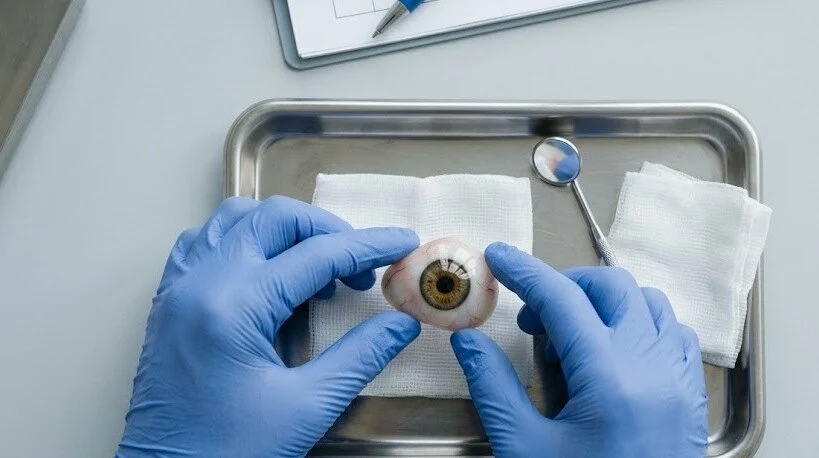
Losing an eye is hard enough without a pile of confusing medical terms on top of it. Artificial eye surgery sounds like a single operation, but it is really a short journey: the damaged eye is removed, a buried implant restores volume, and a custom-painted prosthesis is fitted weeks later.
This guide explains each stage in plain language, from the choice between enucleation and evisceration to recovery, daily care and the questions worth asking your surgeon. It is general information, so your own eye surgeon’s advice always comes first.
Key Takeaways
- The visible artificial eye is not placed during the removal operation. A buried orbital implant goes in first, and the prosthesis follows after healing.
- Evisceration keeps the white outer shell and the eye muscles, while enucleation removes the whole eyeball. Suspected tumors usually call for enucleation.
- Most people are fitted with an ocular prosthesis about four to eight weeks after surgery.
- A prosthetic eye cannot bring back sight, but it can look natural and move along with the socket.
- Plan on a yearly polish and a replacement every three to five years, sooner for growing children.
- Wear impact-resistant lenses to protect your remaining eye.
What Artificial Eye Surgery Actually Involves
People often picture a surgeon slipping a fake eye into the socket. In reality the work happens in two phases, and knowing both makes the timeline make sense.
Phase one is removal. The surgeon takes out the eye or its contents, then places a round orbital implant deep in the socket to replace the lost volume. A small clear plastic conformer sits on top to shape the tissue while it heals.
Phase two is the ocular prosthesis. Once swelling settles, a specialist called an ocularist makes a custom shell that fits over the implant and under the eyelids. Together, the implant and shell give the socket a natural look.
Keeping the two phases separate also explains why the process takes weeks rather than days.
A quick note on terms. This guide is about the cosmetic shell that replaces a lost eye. It is different from a bionic eye, which is a retinal implant that aims to restore some sight, and from an artificial iris, which is placed inside a damaged eye. Neither is covered here.
Who May Need an Artificial Eye
Surgeons recommend artificial eye surgery only when the eye cannot be saved or when leaving it in place would cause harm. Common reasons include:
- Severe injury that destroys the structure of the eye.
- A blind eye that stays painful, for example after glaucoma or long-standing disease.
- Serious infection inside the eye.
- Eye cancers such as retinoblastoma in children or melanoma inside the eye.
- An eye that did not develop normally before birth.
Removal is a major decision, and surgeons normally explore every other option first. A prosthesis replaces appearance, not vision.
Enucleation vs Evisceration: Which Procedure Fits?
| Feature | Evisceration | Enucleation |
| What is removed | The inner contents of the eye; the white outer shell stays | The entire eyeball |
| Eye muscles | Stay attached to the shell | Detached, then reattached to the implant |
| Typical reasons | Severe infection, painful blind eye, injury with no suspected tumor | Known or suspected tumors, or when the cause is unclear |
| The operation | Often slightly shorter and simpler | Slightly more involved |
| Final look | Looks the same from the outside | Looks the same from the outside |
One comparison of the two techniques reported better implant movement and fewer complications after evisceration, although the overall cosmetic result was similar. Your surgeon chooses based on your diagnosis, not on preference alone.
A third and much larger operation, called exenteration, removes the eye together with surrounding tissue. It is reserved for certain cancers and involves a different kind of reconstruction.
Orbital Implants: What Sits Behind the Prosthesis
The orbital implant is a sphere roughly the size of a marble, slightly smaller than the natural eye. Common materials include porous hydroxyapatite, porous polyethylene and silicone. Porous types let body tissue grow into them, which supports stability.
In enucleation, the surgeon usually attaches the eye muscles to the implant or its wrapping so the shell can move with the socket. Some designs add a small magnet to improve movement. Ask your surgeon which type they recommend and why.
Step by Step: What to Expect From Artificial Eye Surgery
- Consultation. Your surgeon confirms the diagnosis, explains the procedure and discusses implant options.
- Surgery day. The operation often takes less than an hour and is commonly done under local anesthesia with sedation, although general anesthesia is an option. Some patients go home the same day, others the next morning.
- Right afterward. A pressure bandage covers the eye. Some surgeons temporarily close the eyelids for a week or two to limit swelling.
- Early healing. Expect redness, swelling and soreness for a couple of weeks. Antibiotics and pain medicine are commonly prescribed.
- Conformer stage. The conformer stays in place while the socket heals, typically six to eight weeks.
- Ocularist fitting. The ocularist takes an impression, builds the shell and hand-paints the iris and fine blood vessels to match your other eye. This usually takes at least two visits.
- Follow-up. A check about a month later often allows small adjustments as the socket settles.
Recovery Timeline at a Glance
| When | What usually happens |
| First two weeks | Swelling, redness and soreness; avoid dust, dirt and heavy lifting as your surgeon advises |
| Weeks two to six | Swelling fades and the tissue forms a stable base |
| Weeks four to eight | Healing is checked and the ocularist fitting begins |
| After fitting | Adjustments for a few weeks or months as the socket settles |
Timelines vary with the surgeon, the technique and your own healing, so treat these ranges as a guide.
When the first shell goes in, it may feel snug or slightly strange for a while. Mild awareness of it usually fades over several weeks, but lasting pain, rubbing or discharge deserves a call to your ocularist.
What a Prosthetic Eye Can and Cannot Do
A modern prosthesis is custom-made, usually from hard acrylic rather than glass, despite the old nickname. Each one is painted by hand to match the other eye.
It can restore symmetry, support the eyelids and help you feel at ease in public. It also moves, though usually less fully than a natural eye. The pupil does not react to light, so the two pupils may look slightly different in changing light.
It cannot restore vision. Sight in that eye is gone after removal, which is why protecting the remaining eye matters so much. Ready-made stock shells exist and cost less, but a custom ocular prosthesis normally fits and looks better.
Living With One Eye
Daily life adjusts faster than most people expect. You keep producing tears, so crying works normally, and the shell usually sits comfortably once the socket has settled.
Seeing with one eye narrows your side vision and can make judging distance harder at first. The brain adapts over time, but take extra care with stairs, pouring drinks and busy roads.
Many places allow driving with one healthy eye, though rules differ, so check local licensing requirements and ask your doctor when it is safe to start. Sports are possible with proper protection, such as goggles with impact-resistant lenses.
Risks and Warning Signs
Artificial eye surgery is generally safe, yet complications can occur. The most discussed ones are:
- Implant exposure or extrusion, where the implant pushes toward the surface or through the tissue.
- Infection of the socket or surrounding tissues.
- The implant shifting out of position.
- A sunken-looking upper eyelid or a drooping lid. Volume loss is common, and a shell adjustment, a larger implant or a secondary implant can often improve it.
- A shell that fits poorly as the socket changes over time.
Call your surgeon promptly for worsening pain, fever, marked swelling, thick or foul-smelling discharge, or a shell that keeps falling out.
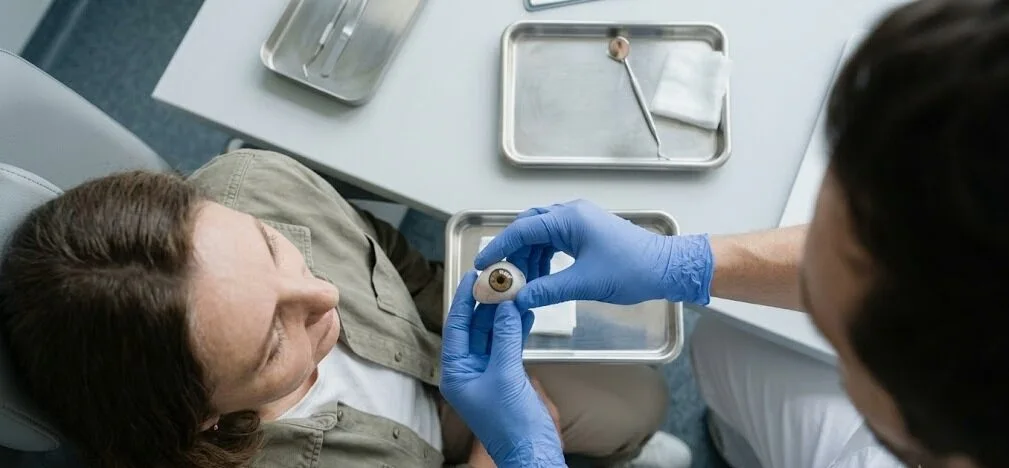
Daily Care for Your Prosthetic Eye
Good habits protect comfort and extend the life of the shell. Your ocularist’s instructions override general tips, because needs differ from person to person.
- Handle it as little as possible. Many people do not need to remove the shell daily, and over-handling can irritate the socket.
- Wash your hands first. Work over a towel in case it drops.
- Clean on your ocularist’s schedule. Some clinics suggest a short hydrogen peroxide soak followed by a sterile saline rinse.
- Use lubricating drops if recommended, to reduce dryness and surface deposits.
- Book a yearly polish. Tear proteins build up on the surface, and polishing restores smoothness while the ocularist checks the fit.
- Plan for replacement every three to five years, more often for children whose faces grow.
- Protect the other eye with impact-resistant glasses, and wear goggles for swimming, since water can wash a shell out.
For children: a growing face changes the shape of the socket quickly, so young patients need more frequent checks and shell changes. Ask the ocularist how often to expect them.
Cost, Insurance and Questions to Ask
The cost of artificial eye surgery varies widely by country, hospital and implant type, and by whether an ocularist is part of the same team. Ask for a written breakdown covering surgery, the implant, the first prosthesis, follow-up visits and future polishing or replacement.
Published figures vary. One US academic eye center put a custom prosthesis at around $3,200 in 2021, while an ocularist elsewhere describes US prices running from roughly $1,800 up to $8,500. Surgery, the implant and hospital fees come on top.
Insurers commonly cover medically necessary surgery, while coverage for the prosthesis differs by plan, so check early. Some public health systems cover the shell as part of the operation.
Questions worth asking your surgeon:
- Why is enucleation or evisceration better for my situation?
- Which implant do you use, and what are its risks?
- Who will make my prosthesis, and when will I meet them?
- Which warning signs should make me call right away?
- Can I speak with someone who has been through this?
The Emotional Side of Eye Loss
The operation may be minor in medical terms, but losing an eye can feel anything but minor. Mixed feelings are normal. Counseling and peer support groups can help, and asking your care team for a referral is a sensible step.
Faqs
How long does recovery from artificial eye surgery take?
Initial healing takes a few weeks, and the custom prosthesis is usually fitted around four to eight weeks after artificial eye surgery. Fine adjustments can continue for several months as the socket settles.
Is artificial eye surgery painful?
You are numbed or asleep during the operation, and pain medicine is prescribed afterward. Soreness and pressure in the first days are common, and your surgeon can adjust the plan if pain is hard to control.
Can artificial eye surgery restore vision?
No. The prosthesis replaces appearance and socket volume, not sight. Vision in the removed eye does not return.
How long does an artificial eye last?
A shell is usually replaced every three to five years, sooner for children, because the socket changes and the surface gets scratched. Yearly polishing helps in between.
Can you get an artificial eye without surgery?
Sometimes. If a blind eye is comfortable but looks different, a thin scleral shell can be worn over it. When the eye is painful or unsafe, artificial eye surgery is usually recommended instead.
Bottom Line
Artificial eye surgery is less about replacing an eye and more about restoring comfort, balance and confidence after a serious loss. Knowing the stages makes it far less intimidating: removal and implant first, a custom prosthesis after healing, and simple care for years afterward.
Talk openly with your surgeon and ocularist, ask for timelines in writing, and protect your remaining eye. With good fitting and regular checkups, many people find the result looks natural and becomes part of everyday life.