
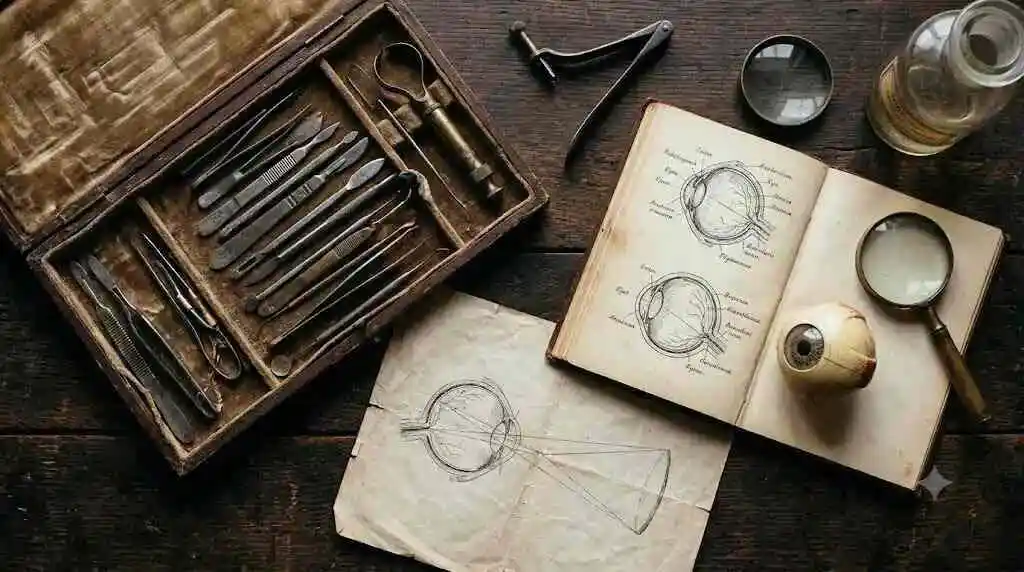
The first eye surgery did not happen in a sterile theatre under a calm surgeon’s lamp. It involved a sharp needle, a firm hand and a person who could hardly see. Even so, that daring attempt from thousands of years ago began a chain of progress that now restores clear sight to millions of people each year.
Here, we trace the path from ancient couching to the lens implants of today. You will learn what historians can actually prove, which questions remain open, and why the history of eye surgery matters if you are heading into an operation yourself.
Key Takeaways
- Cataract couching, a needle technique recorded in ancient India and referred to by Greek authors, is the earliest eye surgery that can be described in detail.
- Scholars still argue over who carried out the first eye surgery in the world, so treat any source that names a single inventor with total confidence cautiously.
- Jacques Daviel performed the first documented planned cataract extraction on 18 September 1750.
- Sir Harold Ridley implanted the first artificial lens in 1949, while Eduard Zirm completed the first successful corneal transplant in 1905.
- Charles Kelman introduced phacoemulsification in 1967, cutting the incision from roughly 10 mm to less than 3 mm.
- Today’s cataract operation lasts around 10 to 15 minutes, and about 95% of patients see better afterwards.
Why Nobody Can Name the First Eye Surgery for Certain
Ask who performed the first eye surgery in the world and the answers will come quickly and confidently. Few survive careful checking.
Ancient texts are brief, translations shift meaning, and later writers frequently repeated old claims without verifying them. A peer-reviewed article in Annals of Translational Medicine, freely accessible through the National Library of Medicine’s PMC archive, calls the beginnings of cataract surgery a long-standing mystery and examines the evidence behind each ancient method.
The truthful answer comes in layers. The oldest operation we can picture with reasonable clarity is cataract couching. Anything earlier depends on hints, not proof, and the first cataract surgery may never be tied to one person or one date.
Why Cataracts Led the Way in Eye Surgery
A cataract happens when the eye’s natural lens turns cloudy. Vision grows blurry, colours fade, lights develop halos, and in severe cases sight is lost. The name derives from the Latin “cataracta”, meaning waterfall, since people once imagined cloudy liquid pouring across the lens.
Ageing is the usual culprit. In the US, close to one in five people between 65 and 74 have cataracts that interfere with their sight, and over half of people above 80 either have them or have already had surgery to remove them.
A clouded lens can shut out light even when the rest of the eye works well, which made it one of the few causes of blindness surgeons could realistically hope to fix. Even now, an operation remains the only treatment once a cataract seriously affects sight.
Ancient Egypt and Babylon: Hints, Not Proof
Egyptian medical writing, including the Papyrus Ebers from about 1550 BC, probably refers to cataracts. Researchers doubt, however, that these healers recognised them correctly, since their treatments relied on salves and incantations, neither of which can clear a cloudy lens.
Babylon’s Code of Hammurabi went further, laying down severe punishments for surgeons who damaged a patient’s eye. This hints that eye operations were carried out, yet it does not reveal which procedures were involved.
Couching: The Earliest Eye Surgery We Can Describe
The word comes from the French “coucher”, which means “to put to bed”. Using a sharp needle, the surgeon pierced the eye near the cornea’s edge and pushed the cloudy lens downward, out of the line of vision.
A Sanskrit medical text linked to Sushruta describes this method. Scholars usually date Sushruta to somewhere between 800 and 600 BCE. The Greek philosopher Chrysippus of Soli, who lived roughly from 279 to 206 BC, also referred to couching.
Did it work? To a degree. Light could reach the retina again because the lens no longer sat behind the pupil. Without any lens, though, sight remained very blurred.
Sterile practice was also absent. Patients risked high eye pressure, internal bleeding, severe infection and permanent blindness.
Couching stayed the main treatment until the 1700s. Remarkably, it still exists in places, including Northern Nigeria and West Africa, where people fear surgery, are unfamiliar with modern techniques and trust traditional practice.
Medieval Surgeons Tried Suction and Hooks
Texts from Baghdad, Cairo, Persia and the Ottoman world reveal that soft cataracts were drawn out through a tube between the 10th and 17th centuries. The traveller Evliya Çelebi described the technique in Bitlis in 1655, and soon after, the surgeon Roccho Mattioli used it in Europe at the Austrian court.
Surgeons in Europe also tried hooks and needles during the 1590s and 1690s. These were scattered efforts, mostly on soft or secondary cataracts, so couching kept its position.
1750: The Day Cataract Surgery Changed Direction
In Cologne on 18 September 1750, the French surgeon Jacques Daviel carried out the first documented planned cataract extraction, and many historians now regard him as the father of modern cataract extraction. Some popular accounts give 1747 or 1748 in Paris, but more recent research supports the Cologne date.
His approach was daring for its time. He opened the cornea with a knife, creating a cut longer than 10 mm, pierced the lens capsule with a blunt needle, and lifted the lens out using a spatula and curette. Afterwards, the patient rested for days in a dark room with a dressing soaked in wine.
At last the cataract was physically taken out of the eye. This marked a major advance over the first cataract surgery methods of the ancient world. Even so, a cloudy leftover capsule, retained lens fragments and infection occurred often.
London surgeon Samuel Sharp became the earliest documented surgeon to remove the lens together with its capsule, in 1753. This intracapsular technique required an even bigger cut, and carried risks of vitreous loss and retinal detachment, with slower healing.
The early versions were rough. One account says Sharp pressed the lens out with his thumb. The approach only became widespread in 1957, when Joaquin Barraquer used an enzyme to dissolve the fibres anchoring the lens.
Myths and Mix-Ups You Will See Online
Browse this topic online and you will find sites that contradict each other. These are the claims worth checking twice:
- Starting dates differ. Certain pages say the fifth century BC, whereas scholars place Sushruta somewhere between 800 and 600 BCE, and none of these dates is firm.
- A few pages state that Sushruta performed extracapsular extraction, yet the evidence points to couching rather than removal of the lens.
- Daviel’s date shows up as 1747, 1748 or 1750, depending on where you look.
- Some websites name the Book of Tobit as the first written record of cataract surgery, but its tale of blindness and recovery does not clearly describe an operation.
The Missing Lens Problem and Ridley’s Big Idea
Taking out a cataract left people without their natural lens, a condition doctors call aphakia. Thick, heavy glasses were the only aid, and the images they produced were far from crisp.
Efforts to solve this started early. By 1797, Johan Casaamata of Dresden had tried placing a glass lens in the eye, but it simply fell backward.
War produced the real breakthrough. Sir Harold Ridley saw that Royal Air Force pilots with plastic splinters in their eyes often showed little reaction. Partnering with a plastics firm, he created a lens from PMMA, the material used in aircraft canopies, and in 1949 he implanted the first one at St Thomas’ Hospital in London. A few sources say 1950, though most histories use 1949.
Plenty of surgeons rejected the idea at first. Early difficulties included glaucoma, inflammation, lenses that moved out of place, and no means of adjusting lens power. Ridley agreed that more work was needed, but he had opened the door.
Kai-yi Zhou implanted the first foldable silicone lens in 1978. Since it folds, it passes through a smaller incision, so healing is quicker and infections are less common.

Phacoemulsification and the Modern Era
Charles Kelman brought in phacoemulsification in 1967. Ultrasound shatters the cataract into tiny fragments, which are then suctioned away. The incision shrank from about 10 mm to below 3 mm, making recovery faster and the operation steadier.
In the 1990s, numbing eye drops became popular and foldable lenses became routine. Combined, these changes made surgery gentler and safer than the first eye surgery in the world, which relied on a single needle.
US regulators approved the femtosecond laser for cataract surgery in 2010. It can make incisions, open the capsule and soften the lens. In many lower-income regions, surgeons also rely on manual small incision cataract surgery, an inexpensive, stitch-free relative of Daviel’s method.
Here is the history of eye surgery at a glance:
| Date | Milestone |
| c. 800–600 BCE | An ancient Indian text describes couching (dates are disputed) |
| c. 279–206 BC | Chrysippus of Soli refers to couching |
| 10th–17th centuries | Suction removal of soft cataracts is recorded in the Middle East |
| 18 September 1750 | Jacques Daviel carries out a documented planned extraction |
| 1753 | Samuel Sharp performs the earliest documented intracapsular extraction |
| 1905 | Eduard Zirm completes the first successful human corneal transplant |
| 1949 | Harold Ridley implants the first artificial lens |
| 1967 | Charles Kelman introduces phacoemulsification |
| 1978 | Kai-yi Zhou implants the first foldable silicone lens |
| 1991 | The first LASIK procedure in the United States |
| 2010 | FDA approves femtosecond laser-assisted cataract surgery |
Other Firsts in Eye Surgery Beyond Cataracts
Cataracts take up most of this story, but they are not all of it. Two other milestones matter just as much to many readers.
On 7 December 1905, in Olomouc, now part of the Czech Republic, Eduard Zirm completed the first successful human corneal transplant. His donor was an 11-year-old boy whose injured eye could not be saved, and the boy’s father consented. The recipient was a labourer blinded by lime burns. One graft failed, while the other eye improved.
Zirm’s success came after more than a century of failed tries. Historians point to advances in anaesthesia and antisepsis as what finally made it possible.
Laser vision correction arrived much later. IBM developed the excimer laser, and it was first used on human eyes in the mid-1980s. Photorefractive keratectomy (PRK) appeared in 1987, although sources name different surgeons as performing the first one. In 1991, Stephen Slade and Stephen Brint carried out the first LASIK procedure in the United States.
What a First Eye Surgery Looks Like Today
If you are preparing for your own first eye surgery, expect something far removed from Daviel’s darkened room. A modern cataract operation lasts about 10 to 15 minutes. Many patients see better soon afterwards and resume normal activity within a day.
The surgeon creates a tiny incision of 1 to 3 mm, opens the front of the lens capsule, breaks the cataract apart with ultrasound and removes it, then places a foldable lens inside.
Selecting that lens is now a genuine choice. Monofocal lenses are still the most common and give clear vision at a single distance, usually far. Extended depth of focus, multifocal and toric lenses can widen the range of clear vision or correct astigmatism, though they may bring more glare or halos. Discuss your daily habits with your surgeon.
Digital planning tools and artificial intelligence now help surgeons make sense of measurements and pick lenses. They back up clinical judgment instead of replacing it.
The outcomes are encouraging. About 95% of patients see better afterwards, and in many centres roughly nine in ten reach somewhere between 20/20 and 20/40. This article offers general information, not medical advice, so let your own eye doctor guide your decisions.
Questions to Ask Before Your Own Operation
Knowing the history helps, but every eye is different. You might ask your surgeon:
- Which lens suits my everyday activities, and what are the trade-offs?
- Do any other eye conditions affect the plan?
- Which type of anaesthesia will you use?
- What complications could occur, and which symptoms mean I should call you immediately?
- How will recovery go, and when can I drive or go back to work?
Where the History of Eye Surgery Is Heading
Cataracts remain a major cause of blindness around the world. In 2010, more than 20 million people were affected, and the figure is expected to rise as populations age. Access is uneven, and many people still cannot reach modern care.
Researchers expect robotics and artificial intelligence to take on a larger role. Ideas such as a fluid lens, and even eye drops that might someday replace surgery, are under discussion, though none is proven.
Frequently Asked Questions
What was the first eye surgery ever performed?
The first eye surgery we can describe with confidence is cataract couching, a needle method recorded in ancient India and referred to by Greek writers. Egypt and Babylon may have treated eyes earlier, but their records do not clearly show an operation on the lens.
Who performed the first cataract surgery?
No one can be named with certainty. Tradition links Sushruta with describing couching, though his dates are debated. For modern extraction, Jacques Daviel carried out the first documented planned operation in 1750.
What other major firsts are there in eye surgery?
Eduard Zirm completed the first successful corneal transplant in 1905. Sir Harold Ridley implanted the first artificial lens at St Thomas’ Hospital in London in 1949, though a few sources say 1950. The first LASIK in the United States followed in 1991.
Did people feel pain during early eye surgery?
Very probably. Doctors tried these operations long before modern anaesthesia, so patients were awake and likely felt considerable discomfort. Numbing eye drops only became popular for cataract surgery in the 1990s.
How long does a first eye surgery take today?
A modern cataract operation generally takes 10 to 15 minutes. Preparation and a brief rest afterwards add time, but most people go home the same day.
Bottom Line
The first eye surgery was crude, dangerous and often unsuccessful, yet it set medicine on a path of steady progress. Couching gave way to extraction in 1750, Ridley’s lens followed in 1949 and Kelman’s ultrasound came in 1967.
The earliest eye surgery may never be linked to a single name. What counts is how far the history of eye surgery has come. If you are getting ready for your own first eye surgery, talk with a qualified ophthalmologist about your options.