
PRK eye surgery is a laser procedure that reshapes the clear front surface of your cornea so light can focus sharply on the retina. It is one of the oldest forms of laser vision correction, and it still has an important place in eye care today.
The big difference from LASIK is how it starts. Instead of cutting a flap, the surgeon gently removes the thin outer layer of the cornea, reshapes the tissue underneath, and lets the surface heal back over it.
That flapless approach makes PRK a smart option for some people who are not good LASIK candidates. It also means a slower, scratchier recovery, so it pays to know what you are signing up for.
Key Takeaways
- PRK reshapes the cornea with a laser and does not create a flap.
- It corrects nearsightedness, farsightedness and astigmatism.
- Thin corneas, dry eyes and high-risk jobs often point toward PRK over LASIK.
- Expect a few sore days and blurry vision while the surface heals.
- Most people see well within weeks, but your best vision can take a month or longer.
- PRK cannot prevent age-related reading problems.
What Is PRK Eye Surgery and How Does It Work?
Photorefractive keratectomy, usually shortened to PRK, is a type of refractive surgery. Refractive surgery changes how your eye bends light, which can reduce or even remove your need for glasses and contact lenses.
An excimer laser does the reshaping by removing microscopic amounts of tissue from the cornea. Treating the center flattens the cornea for nearsightedness. Treating the edges steepens it for farsightedness.
The idea dates back to the 1980s, and surgeons were treating patients by 1987. After US approval in the mid-1990s, it became the leading laser option until LASIK overtook it because of its faster recovery.
Even so, PRK surgery never went away, because it solves problems that LASIK cannot.
What Can PRK Correct?
PRK treats three common refractive errors: nearsightedness (myopia), farsightedness (hyperopia) and astigmatism.
It does not stop presbyopia, the normal loss of close-up focus that shows up around age 40. Some people choose monovision, where one eye is set for distance and the other for near. It is not for everyone, so many surgeons suggest a trial run with contact lenses first.
Results are most predictable with mild to moderate prescriptions. Very high prescriptions carry a greater chance of haze and regression, and your surgeon can tell you where your numbers fall.
Who Is a Good Candidate for PRK Eye Surgery?
You are more likely to qualify if you meet these basics:
- You are at least 18, and ideally over 21, when vision tends to settle.
- Your prescription has stayed the same for the past year.
- Your corneas and overall eye health are good.
- Your expectations are realistic.
PRK often beats LASIK in a few specific situations:
- Thin corneas. Without a flap, PRK preserves more of the cornea’s structure, so it can work when LASIK is not safe.
- Active lifestyles or risky jobs. With no flap to dislodge, an eye injury is less likely to cause complications. Military personnel, martial artists and firefighters are common examples.
- Dry eye tendency. Skipping the flap spares more corneal nerves, and dry eye symptoms tend to be less frequent after PRK than after LASIK.
- Earlier eye surgery. PRK can fine-tune vision after cataract surgery, LASIK or radial keratotomy, because it avoids cutting a new flap.
Keep one caution in mind. The healing surface can feel dry for a while, so your surgeon will want any existing dry eye under control first.
Who Should Avoid PRK?
Some conditions make PRK eye surgery riskier or less effective. Your surgeon may advise against it, or ask you to wait, if you have:
- A prescription that is still changing
- Keratoconus or other corneal thinning disorders
- Lupus, rheumatoid arthritis or another condition that affects healing
- Uncontrolled diabetes
- Advanced glaucoma, or a cataract that affects your vision
- Corneal scars, or a history of certain eye infections such as herpes
- Pregnancy or breastfeeding, because hormones can shift your prescription
Some medicines, including isotretinoin and amiodarone, can also interfere with healing, so share your full medication list. In select borderline cases, a few surgeons pair PRK with corneal cross-linking, a treatment that strengthens the cornea, but that is a specialist decision.
Finally, a cornea that is too thin for the planned correction can rule out any laser vision correction, PRK included.
What Happens Before Surgery?
Your first visit is a detailed eye exam, not the operation itself. Expect these checks:
- A vision test to confirm your prescription has been stable.
- A screen for dry eye, glaucoma, cataract and other eye problems.
- Corneal mapping to measure thickness and surface shape.
- A pupil size check, since large pupils can mean more night glare.
You will likely be told to stop wearing contact lenses beforehand, because lenses can temporarily change the shape of your cornea. A common guideline is about two weeks for soft lenses and three to four weeks for rigid ones. Follow your own surgeon’s schedule.
On surgery day, skip lotions, perfume and makeup, eat something light and bring someone to drive you home. Plan a few quiet days after the PRK procedure.
The PRK Procedure Step by Step
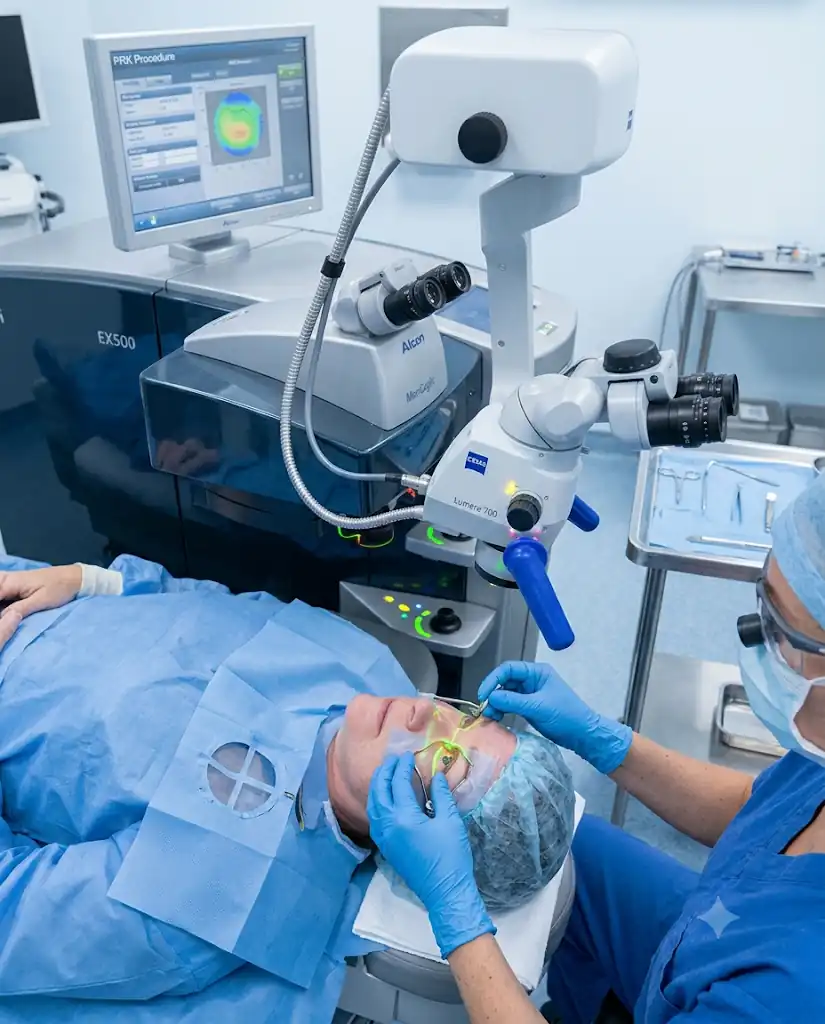
The PRK procedure is an outpatient visit. You stay awake, and the whole thing usually takes between five and 15 minutes. Your surgeon decides whether to treat one eye or both in the same visit.
- Numbing drops go into your eye, so you feel pressure but not pain.
- An eyelid holder keeps you from blinking.
- The surgeon removes the epithelium, the cornea’s thin outer layer, with a brush, blade, laser or alcohol solution.
- You stare at a target light while the excimer laser reshapes the cornea. A clicking sound is normal, and most modern lasers track small eye movements.
- A bandage contact lens goes on to protect the eye while the surface regrows.
Surgeons use different ways to remove that outer layer. Studies comparing hand scraping with laser-based removal found no major difference in final vision, although alcohol-assisted removal has been linked with more dry eye.
In some higher corrections, surgeons also apply a medicine called mitomycin C for a short time. It lowers the chance of a cloudiness called haze.
Types of PRK and Related Surface Procedures
Not every PRK treatment looks the same. Your surgeon may offer one of these approaches:
- Standard PRK. The laser follows a plan built from your prescription.
- Wavefront-guided PRK. A detailed map of the tiny imperfections in your eye steers the laser, which can improve visual quality.
- Transepithelial PRK. The laser removes the outer layer and reshapes the cornea in one continuous step, so no brush, blade or alcohol is needed.
You may also come across LASEK and epi-LASIK. Both are close relatives of PRK. Instead of discarding the outer layer, the surgeon separates it as a thin sheet, using alcohol in LASEK or a blunt blade in epi-LASIK, and places it back after the laser treatment. Studies have not shown one surface procedure to be clearly better than another, so the choice often comes down to your surgeon’s preference.
PRK Recovery: What to Expect Day by Day
Recovery after PRK eye surgery is where it differs most from LASIK. Healing happens on the surface, so it takes longer and feels rougher. Here is a typical timeline:
| When | What usually happens |
| Surgery day | Numbing drops wear off within about an hour, then soreness begins. Rest with your bandage lens in. |
| Days 2 to 3 | Discomfort often peaks. Expect grittiness, light sensitivity, tearing and blur. |
| Days 3 to 5 | The surface closes over, your surgeon removes the bandage lens, and vision starts to improve. |
| First week | Many people return to work. Avoid strenuous activity for up to a week. |
| Weeks 1 to 6 | Vision keeps sharpening and usually steadies within three to four weeks, while a small ridge at the center of the cornea smooths out. Your best vision can take a month or longer. |
| Up to 3 months | Some people need this long for the surface to heal completely. |
| Around 6 months | Vision is typically stable. |
Your eye drops do much of the heavy lifting. Antibiotic drops guard against infection, and steroid drops calm inflammation and haze. The steroid schedule can run from several weeks to a few months, so use them exactly as prescribed, not just until you feel better.
A few habits protect your results:
- Wear sunglasses outdoors for as long as your surgeon says, since sunlight can scar the healing cornea.
- Do not drive until your surgeon clears you.
- Resist rubbing your eyes.
- Stay out of pools and hot tubs for the first week or two, and wait for your surgeon’s okay before using makeup or skin products around your eyes.
- Ask which over-the-counter pain relievers are safe for you.
Call your surgeon right away for sudden vision loss, pain that keeps getting worse, discharge, swelling or heavy watering.
Risks and Side Effects of PRK Eye Surgery
Photorefractive keratectomy has a long safety record, and serious problems are rare. Still, you should know what can happen:
- Glare and halos. Lights may look haloed, especially at night, and this usually fades over several weeks.
- Corneal haze. Cloudiness tends to peak around one to two months and usually clears within six to twelve months.
- Dry eye. It is common after any laser eye surgery and is usually temporary.
- Under- or overcorrection. Glasses, contacts or a follow-up laser treatment can often fix it.
- Infection or scarring. Both are uncommon, which is why aftercare matters.
In very rare cases, vision can end up worse than before surgery, even with glasses or contacts. Your surgeon should walk you through these risks before you sign a consent form.
How Well Does PRK Work? Results to Expect
About nine in ten people end up with 20/40 vision or better without glasses or contacts, according to the American Academy of Ophthalmology. Roughly 70% reach 20/20 across all prescriptions, and the share is higher with mild to moderate nearsightedness.
The reshaping itself is permanent, but your eyes can still change with age. Almost everyone needs reading glasses after about 40, whether or not they have had surgery.
If your vision drifts later, a touch-up is possible once your prescription has been stable for a few months.
Keep your goals realistic. PRK surgery aims to reduce your dependence on glasses, not to guarantee perfect vision in every situation.
PRK vs LASIK: Which One Fits You?
Long-term results are similar for mild to moderate nearsightedness, according to systematic reviews. So the choice usually comes down to your corneal thickness, your lifestyle and how much downtime you can handle.
| Feature | PRK | LASIK |
| Corneal flap | No flap | Flap created |
| Early recovery | Slower, more discomfort | Faster, less pain |
| Flap-related risks | None | Possible |
| Thin corneas | Often suitable | May not be suitable |
| Long-term vision (mild to moderate nearsightedness) | Similar | Similar |
LASIK is more popular mainly because of that quicker, more comfortable recovery. PRK surgery wins when your cornea, your job or dry eyes make a flap a poor idea.
How Much Does PRK Eye Surgery Cost?
Prices vary by clinic, surgeon, laser technology and country. In the US, many clinics quote roughly $2,000 to $2,500 per eye, and some include a year of follow-up care in that figure. PRK is generally priced below LASIK because there is no flap to create.
Insurance usually treats laser vision correction as elective, so you will likely pay out of pocket. Some vision plans offer discounts through participating surgeons. Flexible spending and health savings accounts may cover the cost, and some providers offer financing.
Ask for a written quote that covers the exam, the surgery, follow-up visits, medications and any touch-up treatment.
Frequently Asked Questions
Is PRK eye surgery painful?
The procedure itself should not hurt, because your eyes are numbed first. Soreness shows up once the drops wear off and usually peaks around days two and three. Most people manage it with over-the-counter pain relievers, though some need prescription drops. Call your surgeon if the pain keeps getting worse.
How long is recovery after PRK eye surgery?
The surface usually closes over within three to five days, and vision improves gradually after that. Many people return to work in about a week. Your sharpest vision can take a month or longer, and your eyes typically settle by around six months.
Is PRK better than LASIK?
Neither is better for everyone. Long-term results are similar for mild to moderate nearsightedness. LASIK heals faster with less pain, while PRK avoids a corneal flap and suits thin corneas and active lifestyles. Your surgeon will recommend one based on your eye measurements.
Is PRK eye surgery permanent?
The reshaping of your cornea is permanent, but your eyes can still change with age. Reading glasses are usually needed after about 40, and some people need a small touch-up later.
Does insurance cover PRK?
Usually not. Insurance generally treats laser vision correction as elective, so most people pay out of pocket. Some vision plans offer discounts through participating surgeons.
Bottom Line
PRK eye surgery trades a rougher first week for a flapless, tissue-friendly way to correct your vision. It is a strong option if you have thin corneas, dry eyes or a job that puts your eyes at risk, and a reasonable one for anyone who can handle some downtime.
Whether PRK eye surgery is right for you depends on your corneas, your lifestyle and your patience for healing. The best next step is a full eye exam with an ophthalmologist, who can measure your eyes and talk you through photorefractive keratectomy and its alternatives.