
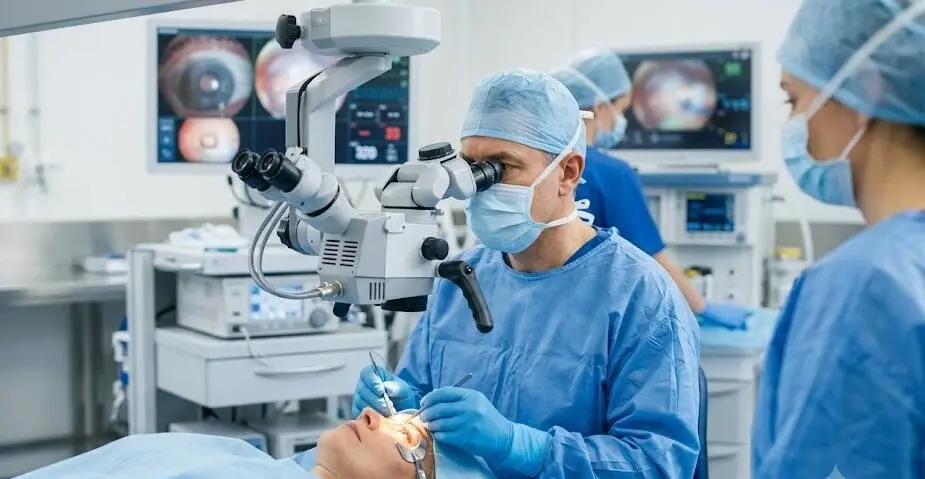
RLE eye surgery swaps your natural lens for a clear artificial one. In a single procedure it can correct nearsightedness, farsightedness, astigmatism and the reading trouble that creeps in after 40. It’s the same basic operation surgeons perform for cataracts, only done earlier and for a different reason.
If you’re tired of juggling reading glasses, or your prescription is too strong for laser, this is probably a name you’ve already come across. Here’s what it actually involves, who it suits, and where the real risks sit.
Key Takeaways
- RLE eye surgery replaces the eye’s natural lens with an intraocular lens (IOL), so it can treat presbyopia as well as your prescription.
- It usually suits people from their mid-40s upward, especially those who are strongly farsighted or whose eyes aren’t right for LASIK.
- Once the natural lens is gone, a cataract can’t form in that eye, although the thin lens capsule can cloud over later and is easy to treat.
- Retinal detachment is the most serious risk, and it is higher in very nearsighted and younger eyes.
- Your lens choice (monofocal, trifocal, EDOF or toric) decides the trade-off between freedom from glasses and night-time comfort.
- Insurance rarely pays for it because it’s elective, so ask for a full quote that covers the lens, tests and follow-up.
What Is RLE Eye Surgery and How Does It Work?
RLE stands for refractive lens exchange. You may also hear it called clear lens extraction, or simply lens replacement surgery. All three describe the same idea: take out the eye’s natural lens while it’s still clear and put in an artificial one.
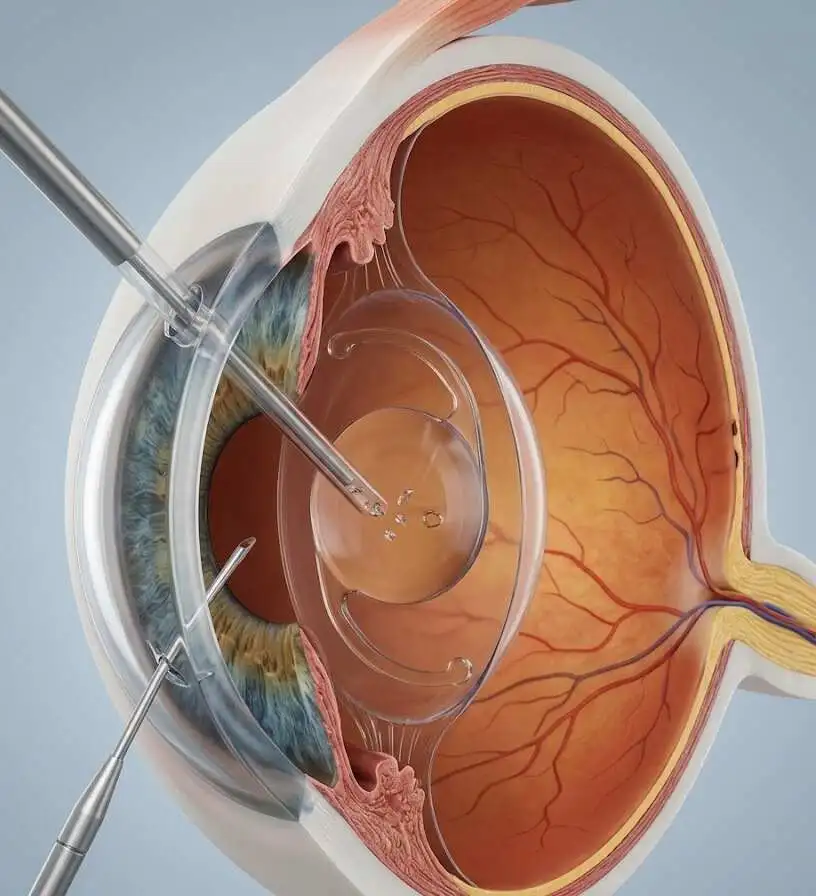
Your eye focuses light using two main parts, the cornea at the front and the lens just behind the pupil. LASIK reshapes the cornea. RLE eye surgery leaves the cornea alone and changes the lens instead, using an IOL with the exact power your eye needs.
The surgeon makes a tiny opening, breaks the natural lens into fragments with ultrasound and gently suctions them out. The folded IOL is then slipped into the same thin capsule, where it unfolds into position. Numbing drops are used, often with a little sedation to keep you relaxed.
Because the lens is replaced rather than reshaped, the correction is built to last. The implant doesn’t stiffen or cloud with age the way a natural lens does.
How RLE Eye Surgery Differs From Cataract Surgery
The operation itself is almost identical. The reason for doing it is not. In cataract surgery the lens has turned cloudy and is blocking your sight. With RLE the lens is still clear, and the goal is to sharpen your vision and cut your dependence on glasses.
That changes the standard everyone works to. You’re operating on an eye that already sees reasonably well, so the bar for safety, planning and honest counselling sits higher. Expectations are higher too. Someone with a dense cataract is thrilled to see again. Someone paying for elective surgery wants crisp vision at every distance.
Coverage is different as well. Cataract surgery with a standard lens is usually covered when it’s medically needed. Refractive lens exchange usually isn’t.
Who Is a Good Candidate for RLE Eye Surgery?
There’s no single age cutoff, but most surgeons start to consider lens replacement surgery seriously from the mid-40s or 50s, when the natural lens has lost much of its focusing ability. Good candidates tend to share a few things:
- Near vision problems (presbyopia) that are getting in the way of daily life
- A strong farsighted prescription, or a strong nearsighted one when other options don’t fit
- Corneas that are too thin, steep or irregular for LASIK
- Healthy retinas, optic nerves and a stable eye surface
- Realistic expectations about glasses and night vision
Presbyopia and the Over-40 Crowd
Somewhere in your forties the lens stiffens and close-up focus fades. Reading glasses turn into bifocals. Swapping the stiff lens for a presbyopia-correcting IOL deals with the cause instead of patching the symptom.
One honest caution: people whose distance vision is already close to perfect tend to be less satisfied with this surgery than those who start with a strong prescription. If that’s you, expect a longer and more careful conversation before anyone books a date.
High Farsightedness (Hyperopia)
This is where RLE eye surgery often does its best work. Strongly farsighted eyes are short, and laser struggles to correct them well. A lens exchange can fix the distance error and the reading problem together, and satisfaction is generally high when the case is chosen well. Surgeons also check these eyes for glaucoma risk, since crowded, shallow eyes are more prone to it.
High Nearsightedness (Myopia)
Here things get more delicate. Very nearsighted eyes are long, and their retinas are thinner and more fragile. Removing the lens changes the inside of the eye, which can raise the chance of a retinal detachment. We’ll look at the numbers in the risks section.
For younger people with high myopia, many surgeons lean toward phakic lenses instead. These sit in front of the natural lens, so the eye keeps its own lens and its focusing power.
Thin Corneas and Other LASIK Roadblocks
LASIK removes corneal tissue, so thin corneas, irregular shapes and some cases of dry eye can rule it out. RLE eye surgery doesn’t touch the cornea, which makes it a practical route for many people LASIK turns away.
Who Should Think Twice About RLE Eye Surgery?
It isn’t for everyone, and a good surgeon will say so. Be cautious if any of these apply to you:
- You’re young and still focus well up close, because you would lose that natural focusing
- You have macular disease, poorly controlled glaucoma or significant weak spots in the retina
- Your eye surface is unstable or you have severe dry eye
- You have a very long, highly myopic eye and haven’t had a thorough retinal exam
- You expect to never need glasses for anything, ever
If a surgeon talks you out of RLE surgery, treat that as a good sign. It usually means they’re weighing your risks honestly.
Lens Options for RLE Eye Surgery
The lens you pick shapes your everyday vision more than any other decision. These are the main choices.
Monofocal Lenses
A monofocal lens focuses at one distance, usually far away. Vision is crisp and night-time glare is lowest, but most people still need reading glasses. Some choose monovision, where one eye is set for distance and the other for near.
Multifocal and Trifocal Lenses
These split incoming light so you can see far, middle and near. They offer the best chance of going without glasses. The price is more halos and glare around lights at night, and sometimes a small dip in contrast.
EDOF Lenses
Extended depth of focus lenses stretch the range of clear vision into one smooth band, typically from distance to arm’s length. Night-time side effects are usually milder than with multifocals, though very small print may still call for readers.
Toric Lenses
If you have noticeable astigmatism, a toric lens corrects it during the same operation. It has to be lined up on the right axis, and it can be paired with a monofocal, EDOF or multifocal design. A few newer options, such as light-adjustable lenses, allow fine-tuning after surgery, but availability depends on where you live.
What to Expect Before RLE Eye Surgery
Expect a long first appointment. Your surgeon will measure the length of your eye and the curve of your cornea, map the corneal surface, check your tear film and pupil size, and examine the retina with your pupils dilated. Some clinics also scan the macula.
Accuracy matters more here than in most cataract cases. There’s no cloudy lens to excuse a small miss, so the lens power has to be spot-on. If you wear contact lenses, your clinic will tell you how long to leave them out before the measurements.
The RLE Eye Surgery Procedure Step by Step
Most people are surprised by how quick and calm the day of RLE surgery feels. Surgery takes roughly 15 to 30 minutes per eye, and you go home the same day.
- Numbing drops go in, and you may be given mild sedation.
- A tiny incision is made at the edge of the cornea.
- The front of the lens capsule is opened.
- The natural lens is broken up with ultrasound and removed.
- The folded IOL is inserted into the capsule and unfolds.
- The incision seals itself, and a protective shield may be placed over the eye.
Most patients feel pressure or light touch rather than pain. The second eye is normally done a few days to a few weeks later.
Recovery After RLE Eye Surgery
Recovery after refractive lens exchange is usually smooth, much like cataract surgery. Here’s a rough timeline, though your surgeon’s instructions always come first.
- First day: vision is hazy, and the eye can feel gritty or watery. Many people wear a shield while sleeping.
- First week: sight improves noticeably, and most people return to light everyday activities within a day or two.
- Several weeks: eye drops continue, and your prescription settles. Multifocal and EDOF users may need time to get used to halos and glare.
Avoid rubbing your eyes, and follow your surgeon’s advice on swimming, dusty places and heavy exercise.
Call your clinic straight away if you notice sudden flashes of light, a shower of new floaters, a dark curtain across your vision, worsening pain or a drop in sight. These can signal a retinal detachment or an infection, and both need quick attention.
Benefits of RLE Eye Surgery
- Less reliance on glasses and contact lenses, and in many cases freedom from reading glasses
- Treats presbyopia, which laser cannot do directly
- Works for high prescriptions that fall outside the range of LASIK
- Prevents cataracts from forming in the treated eye
- Quick procedure with an outpatient recovery
Risks and Side Effects
Clear lens extraction is an operation inside the eye, so it carries real if uncommon risks. Knowing them upfront is part of making a sound choice.
Retinal Detachment
This is the one to take most seriously. Highly nearsighted eyes already face a higher detachment risk without any surgery, with published estimates for unoperated myopic eyes ranging from about 0.7% to 3.2%.
After lens removal in myopic eyes, older reviews report detachment rates anywhere from 0% to around 8%, with higher figures in patients under 50. Those studies vary a lot and many are dated, and modern techniques plus careful retinal screening may improve the picture. The takeaway is simple: the longer the eye and the younger the patient, the more caution is needed. Ask your surgeon about their own results.
Posterior Capsule Opacification
Months or years later, the capsule holding your lens can turn hazy and blur your sight. It’s not a failure of the implant. A quick, painless laser procedure (YAG capsulotomy) clears it in minutes.
Infection and Inflammation
Serious infection inside the eye (endophthalmitis) is rare but can threaten vision, which is why sterile technique and prompt follow-up matter. Swelling at the macula, known as cystoid macular edema, can also occur and usually responds to drops.
Glare, Halos and a Residual Prescription
Night-time glare and halos are the most common complaints with multifocal designs, and they often ease as your brain adapts. A small leftover prescription is also possible. Some people end up wearing light glasses, and others have a laser touch-up to fine-tune the result.
RLE Eye Surgery vs LASIK vs Phakic Lenses
The right choice depends on your age, your prescription and your eye’s anatomy. This quick comparison shows how clear lens extraction, LASIK and phakic lenses differ.
| RLE | LASIK | Phakic IOL | |
| What it changes | Replaces the natural lens | Reshapes the cornea | Adds a lens, keeps the natural one |
| Treats presbyopia | Yes, with the right lens | Not directly | No |
| Future cataract | Cannot form | Still possible | Still possible |
| Reversible | No, the natural lens is gone | No | Lens can be removed |
| Often best for | Over 45, farsighted, or presbyopic | Younger adults with healthy corneas | Younger adults with high myopia |
How Much Does RLE Eye Surgery Cost?
Prices for refractive lens exchange vary by country, clinic and lens type. In the United States, clinics commonly quote somewhere between $2,500 and $8,000 per eye, with premium multifocal and toric lenses at the upper end. Treat that as a ballpark, not a quote.
Because RLE surgery is elective, health insurance and Medicare generally don’t cover it. Some people use an HSA or FSA, and many clinics offer financing. When you compare quotes, check what’s included: the lens, pre-surgery tests, follow-up visits, any laser touch-up and a possible YAG treatment later.
How to Choose a Surgeon for RLE Eye Surgery
Experience with lens replacement surgery matters more than a glossy brochure. These questions help you judge a clinic:
- How many lens exchanges do you perform each year?
- Will you examine my peripheral retina, and what happens if you find weak spots?
- Which lens would you choose for me, and why?
- What if I’m unhappy with my night vision afterwards?
- Is a touch-up included in the price?
Frequently Asked Questions
Is RLE eye surgery worth it?
For the right person, yes. People who are strongly farsighted, presbyopic or unsuitable for LASIK often report high satisfaction because one procedure handles both distance and near vision. It is less clear-cut if your distance vision is already good, since you could trade a small inconvenience for a permanent change.
What are the downsides of RLE eye surgery?
The main drawbacks are cost, the permanence of losing your natural lens, possible night-time glare with multifocal lenses, and a small chance of serious complications such as retinal detachment or infection. Some patients also need glasses or a touch-up afterwards.
How long does RLE eye surgery last?
The implanted lens is designed to last a lifetime, and your result should stay stable. The only common change is hazing of the capsule behind the lens, which a short laser treatment can clear.
Is RLE eye surgery covered by insurance?
Usually not. It is treated as elective vision correction, so most plans and Medicare won’t pay. Check whether your HSA or FSA can be used, and ask the clinic about payment plans.
What is the best age for RLE eye surgery?
It’s most often recommended from the mid-40s to 50s onward, once natural focusing has faded. Younger patients lose their focusing ability when the lens is removed, so lens-preserving options are often considered first.
Bottom Line
RLE eye surgery can be a strong, lasting fix for people with presbyopia, high farsightedness or a prescription that rules out LASIK. It removes the need for most glasses, and it takes cataracts off your future worry list.
It’s also a real operation with trade-offs, from night-time glare to the retinal risks that come with very long eyes. The best results come from honest screening, the right lens for your lifestyle and a surgeon who isn’t afraid to say no. Book a full consultation, ask the hard questions, and decide with your own eyes in mind.