
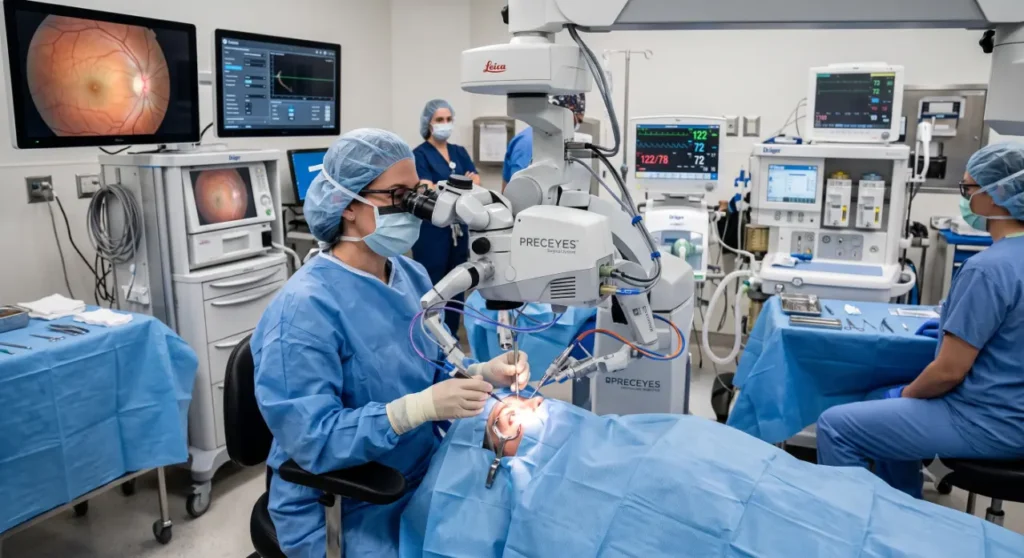
Eye surgery often involves working with structures that are extremely small and delicate. Even a tiny movement can matter when a surgeon is operating on the retina or other sensitive parts of the eye. This is one reason why researchers and eye specialists are exploring robotic eye surgery.
Key Takeaways
- Robotic eye surgery assists surgeons with highly precise eye procedures.
- The surgeon remains in control throughout the operation.
- Robotic systems may help reduce hand tremor and improve instrument stability.
- The technology is still developing and is not suitable for every eye condition.
Robotic eye surgery uses specialized robotic or computer-assisted equipment to help a surgeon make controlled, precise movements. The robot does not independently perform the operation. Instead, the surgeon remains in control and uses the technology as an additional tool during selected procedures.
Although robotic technology is promising, it is still an emerging area of ophthalmology. It is not a standard option for every type of eye surgery.
What Is Robotic Eye Surgery?
Robotic eye surgery involves using robotic systems to assist with delicate surgical tasks. These systems are designed to provide greater control when working with tiny tissues and instruments.
The technology is particularly interesting for procedures involving the retina because retinal surgery can require extremely fine movements.
Depending on the system and clinical setting, robotic assistance may be explored for:
- Retinal and vitreoretinal surgery
- Microsurgical procedures
- Precise drug delivery inside the eye
- Manipulation of delicate retinal tissues
- Research involving very small surgical instruments
The availability of these procedures varies from one medical center to another.
How Does Robotic Eye Surgery Work?
The process depends on the type of surgery, but the basic idea is fairly simple. The surgeon examines the patient’s eye, plans the procedure, and then uses a robotic system to assist with specific movements.
A typical procedure may involve:
- Detailed eye examination: Imaging and other diagnostic tests help the surgeon understand the condition of the eye.
- Surgical planning: The surgeon decides what needs to be treated and how the procedure should be performed.
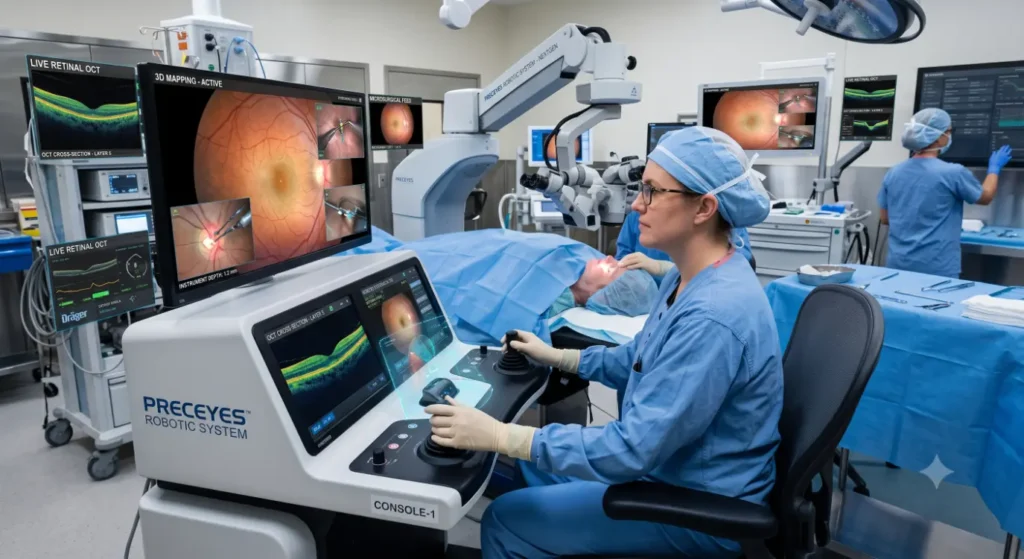
- Robotic assistance: Special instruments are controlled through the robotic system.
- Continuous supervision: The surgeon watches the surgical field and remains responsible for every important decision.
- Follow-up care: After surgery, regular examinations are needed to check healing and vision.
The technology is meant to support the surgeon, not replace their experience or judgment.
Also Read:Pterygium Eye Surgery: Before and After
Why Use Robotics in Eye Surgery?
The main reason for developing robotic systems is the level of precision that some eye procedures require.
Potential advantages include:
- Better movement control: Robotic instruments can help with very small, controlled movements.
- Reduced hand tremor: Some systems can filter out minor involuntary movements.
- Greater stability: Instruments may be held and positioned with consistent control.
- Fine tissue manipulation: Robotic assistance may be useful when working with fragile retinal structures.
- Improved surgical research: The technology allows researchers to explore procedures that require movements beyond the practical limits of conventional instruments.
However, these potential benefits do not mean robotic surgery is automatically safer or more effective in every situation. Clinical evidence and the surgeon’s experience remain important.
Robotic Eye Surgery vs Traditional Eye Surgery
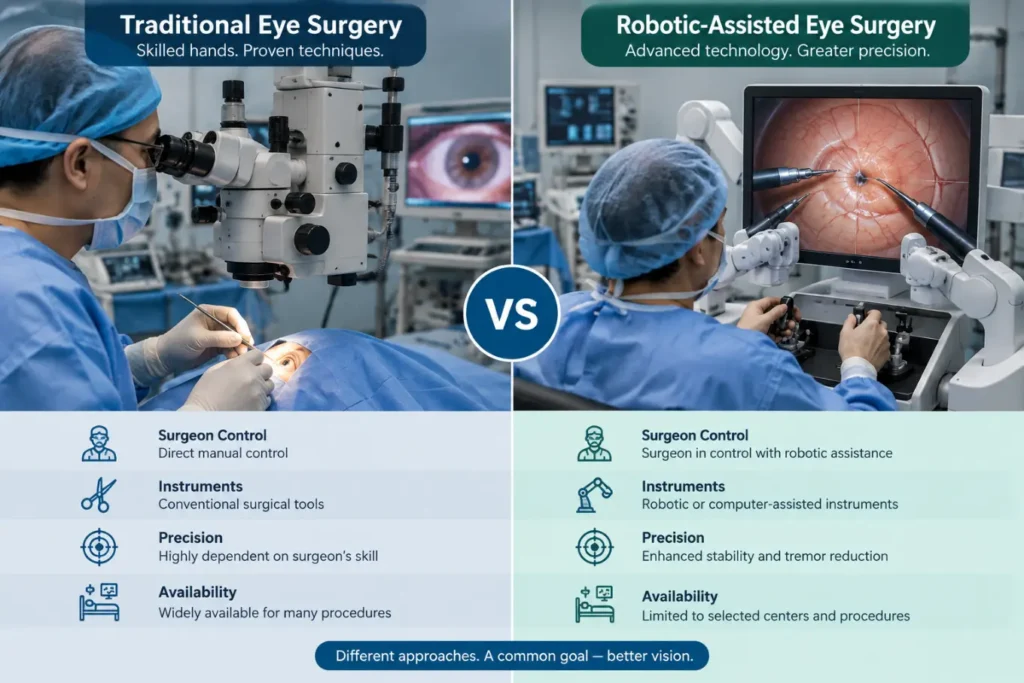
| Feature | Traditional Eye Surgery | Robotic-Assisted Surgery |
| Main operator | Surgeon | Surgeon |
| Instrument control | Direct manual control | Robotic or computer-assisted control |
| Tremor control | Depends on surgical technique | Some systems can reduce small movements |
| Precision | Depends heavily on surgeon skill | Technology may provide additional movement control |
| Availability | Widely available for many procedures | Limited to selected centers and procedures |
| Current use | Established | Developing and procedure-specific |
Is Robotic Eye Surgery Safe?
Like any surgical procedure, robotic-assisted eye surgery can involve risks. Safety depends on the type of operation, the patient’s eye condition, the equipment being used, and the surgeon’s training.
Patients should not choose a procedure simply because it uses robotic technology. Instead, they should ask their ophthalmologist about the expected results, possible complications, alternatives, recovery period, and the surgeon’s experience with the procedure.
For many common eye conditions, conventional surgical techniques remain well established and may be the most appropriate choice.
What Does the Future Look Like?
Robotic technology could become more useful as surgical instruments, imaging systems, and computer-assisted technologies continue to improve. Combining detailed eye imaging with robotic systems may eventually allow surgeons to perform certain highly precise procedures more consistently.
Still, the surgeon’s role will remain central. Eye surgery requires clinical judgment, experience, and the ability to respond when something unexpected happens during an operation.
For now, robotic eye surgery is best understood as a developing technology that may offer useful assistance in selected areas of ophthalmology.
Also Read:IOL Eye Surgery: Types, Procedure and Recovery
Frequently Asked Questions
Is robotic eye surgery performed entirely by a robot?
No. The surgeon remains in control. Robotic equipment assists with specific movements or tasks during the operation.
Can robotic surgery treat all eye diseases?
No. Robotic assistance is currently limited to certain procedures and is not a universal treatment for eye diseases.
Is robotic eye surgery better than conventional surgery?
Not necessarily. Its usefulness depends on the procedure and individual patient. Traditional surgery remains highly effective for many eye conditions.
Is robotic eye surgery available in India?
Availability depends on the hospital, surgeon, technology, and specific procedure. Patients should check with an ophthalmology center that offers advanced microsurgical services.
How can I find out if I am suitable for robotic eye surgery?
An ophthalmologist can examine your eyes, review your diagnosis, and explain whether robotic-assisted surgery is available and appropriate for your condition.