
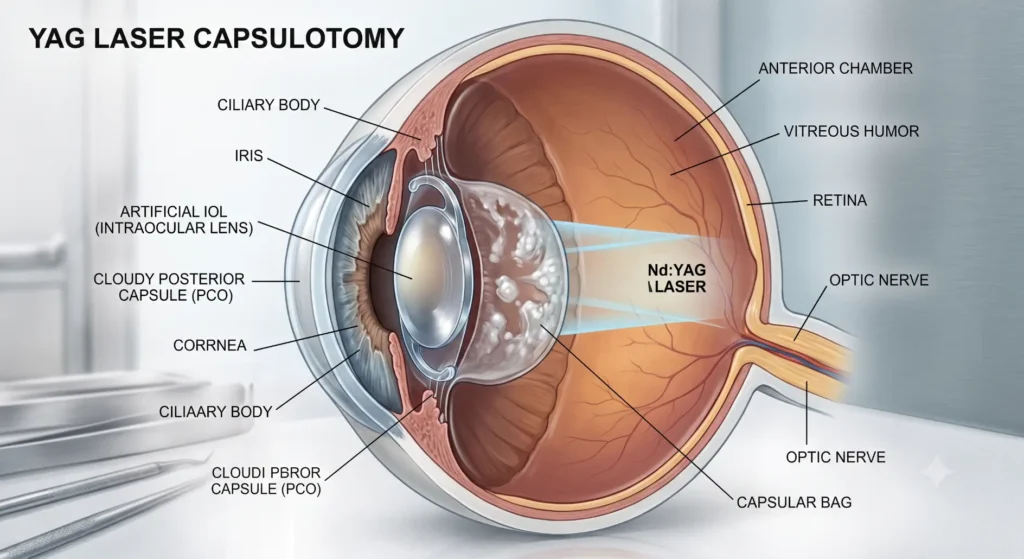
Have you started noticing cloudy or less sharp vision months or even years after cataract surgery? It may seem strange because the cataract was already removed. However, a different problem can sometimes develop behind the artificial lens.
Key Takeaways
- YAG eye surgery treats cloudy vision caused by PCO after cataract surgery.
- The laser creates a small opening in the cloudy capsule behind the lens.
- The procedure is quick and usually requires little recovery time.
- Sudden vision loss, flashes, or severe symptoms require prompt medical attention.
YAG laser capsulotomy, commonly called YAG eye surgery, is a laser treatment used to clear this cloudiness. Instead, the ophthalmologist uses a laser to create a tiny opening in the cloudy membrane, helping light pass through the eye more normally.
What Is YAG Eye Surgery?
The new lens sits inside the natural capsule that originally surrounded the eye’s lens.
In some people, cells left behind after cataract surgery gradually collect or grow across the back of this capsule. As the capsule becomes cloudy, vision can become less clear.
During YAG laser capsulotomy, the ophthalmologist uses a focused laser beam to make a small opening in the affected part of the capsule. This removes the cloudy area from the visual pathway and can help restore clearer vision.
The original cataract does not grow back. PCO is a separate condition that can occur after the surgery.
Why Might You Need YAG Laser Treatment?
If the cloudiness is minor and your vision is still good enough for your normal activities, your eye doctor may simply keep an eye on it.
Treatment may be considered when the changes in vision start interfering with everyday life. You might notice:
- Vision that looks cloudy, hazy, or less sharp
- Increased glare when looking at bright lights
- Difficulty reading small print
- Trouble seeing clearly while driving at night
- Reduced contrast or overall visual clarity
- Vision that has gradually become worse after previously improving following cataract surgery
Because similar symptoms can be caused by other eye conditions, an eye examination is important before deciding on YAG treatment. Your ophthalmologist can determine whether PCO is actually responsible for the change in your vision.
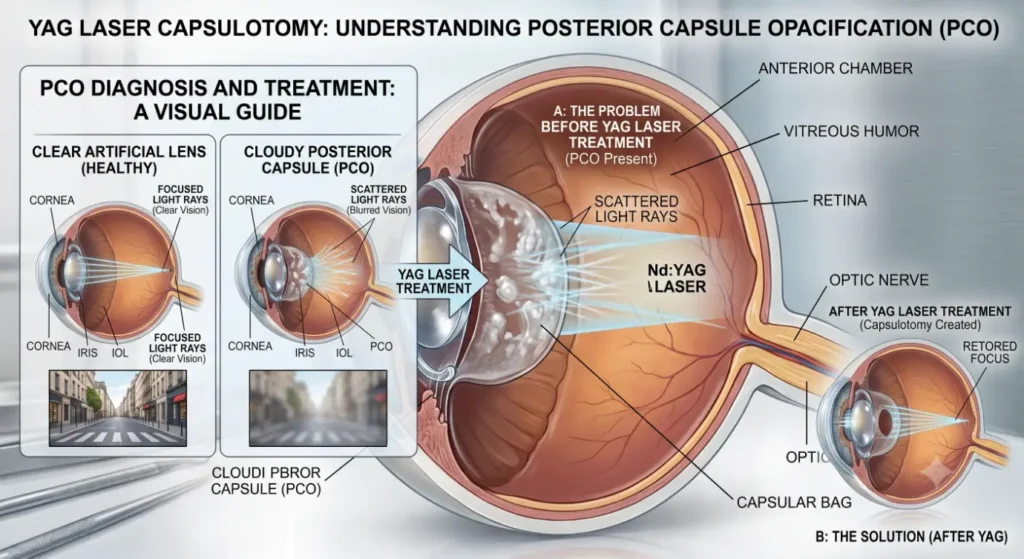
How Is YAG Eye Surgery Done?
YAG laser capsulotomy is usually performed in an outpatient setting, so you generally do not need to stay in the hospital.
Before the laser treatment begins, your doctor may put drops in your eye to enlarge the pupil and numb the surface.
The laser makes a carefully controlled opening in the membrane without removing the artificial lens.
The procedure itself is usually quite short. Afterward, your doctor may check your eye pressure and decide whether you need anti-inflammatory or other prescribed eye drops.
Also Read: Glaucoma Eye Surgery: Types,Treatment and Recovery
What Is Recovery Like After YAG Surgery?
One of the reassuring things about YAG laser treatment is that there is usually very little downtime. Some people notice that their vision is clearer soon after the procedure, while others may need a few days for their sight to settle.
For a smooth recovery, your ophthalmologist may advise you to:
- Take any prescribed eye drops according to the instructions
- Avoid touching or rubbing the treated eye
- Keep your scheduled follow-up appointment
- Give your eyes time to adjust if your vision feels temporarily unusual
- Wait to drive until your vision is clear and your doctor says it is safe
It is also possible to notice a few new floaters or mild blurring shortly after treatment. These symptoms often settle, but you should contact your eye doctor if they become severe, increase suddenly, or are accompanied by flashes of light or a sudden drop in vision.

Benefits of YAG Laser Capsulotomy
| Benefit | What It Means |
| Quick treatment | The laser procedure usually takes only a few minutes |
| No major incision | Treatment is performed using a laser |
| Short recovery | Most people return to normal activities quickly |
| May improve clarity | Vision can become clearer when PCO is the cause |
| Outpatient procedure | Hospital admission is generally not needed |
Possible Risks and Side Effects
YAG laser capsulotomy is generally considered safe, but complications are possible.
These may include:
- Temporary increase in eye pressure
- Eye inflammation
- Floaters
- Retinal swelling
- Rare damage to the artificial lens
- Rare retinal complications
Contact an eye specialist urgently if you experience sudden vision loss, a sudden increase in floaters, flashes of light, a dark curtain over your vision, or severe eye pain.
YAG Eye Surgery vs Cataract Surgery
| YAG Laser Surgery | Cataract Surgery |
| Treats cloudiness behind the artificial lens | Removes the cloudy natural lens |
| Uses a laser | Uses surgical instruments |
| Usually no conventional incision | Requires a small surgical incision |
| Usually takes only a few minutes | Generally takes longer |
Conclusion
YAG eye surgery is a commonly used laser procedure for people who develop cloudy vision because of posterior capsule opacification after cataract surgery. The treatment is usually quick, does not require conventional surgery, and often has a short recovery period.
If your vision becomes blurry or hazy after cataract surgery, an eye examination can help identify the cause.
Also Read:Robotic Eye Surgery: What You Need to Know
FAQs About YAG Eye Surgery
1. Is YAG eye surgery painful?
Most people do not experience significant pain. Numbing eye drops are normally used before the procedure.
2. How quickly does vision improve after YAG surgery?
Some patients notice improvement within a few hours. For others, it may take several days.
3. Is YAG laser surgery always necessary for PCO?
No. If PCO is mild and does not affect your daily activities, your doctor may recommend monitoring it instead of immediate treatment.
4. Can YAG surgery restore vision completely?
It can improve vision when PCO is the main cause of the problem. However, other conditions such as glaucoma, retinal disease, or corneal problems may also affect vision.