
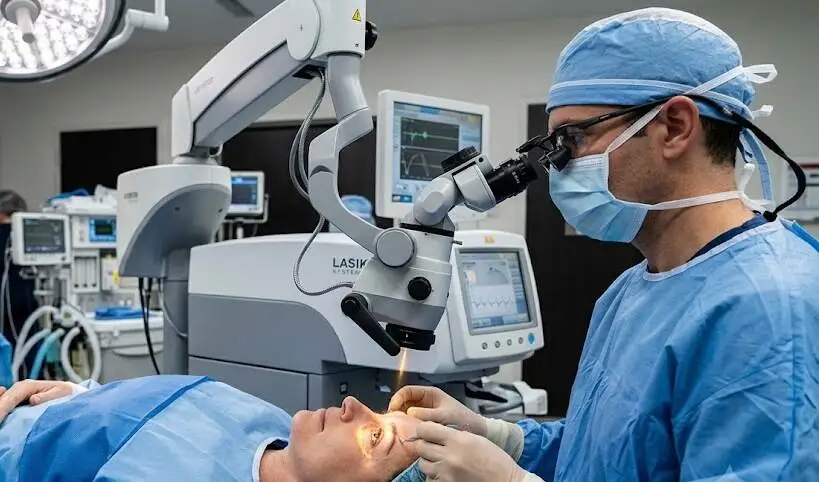
Waking up and reading the clock without reaching for glasses sounds like a small thing until you live without it. That everyday freedom is what draws most people to refractive eye surgery, a group of procedures that reshape the cornea or replace the lens so light focuses properly on the retina.
But a decision this personal deserves more than a glossy clinic brochure. This guide explains how refractive eye surgery works, which procedures exist, who qualifies, what recovery feels like and where the real risks sit. You’ll walk into your consultation with sharper questions.
Key Takeaways
- Refractive eye surgery changes how your eye focuses light, so you rely less on glasses or contacts.
- The two broad families are laser procedures on the cornea and lens-based procedures inside the eye.
- Your prescription should be stable for about a year before surgery.
- Thin corneas, severe dry eye and uncontrolled health conditions can rule you out.
- Laser healing usually takes days, while lens procedures can take a few weeks.
- Dry eye and night-time glare are common early on and usually settle.
- Reading glasses may still be needed later, because the natural lens keeps ageing.
What Is Refractive Eye Surgery and How Does It Work?
Your eye works a lot like a camera. The cornea, the clear dome at the front, and the lens behind the pupil bend incoming light so it lands sharply on the retina. When either part bends light too much or too little, the picture blurs.
Refractive eye surgery corrects that bending problem. A surgeon either reshapes the cornea with a laser or places or exchanges a lens inside the eye. The aim is a clearer image with less dependence on corrective lenses.
It’s normally an outpatient procedure, so you go home the same day. You may hear it called vision correction surgery, and clinics often use the shorter term refractive surgery.
Vision Problems That Refractive Eye Surgery Can Treat
Four common focusing problems are the usual targets.
- Nearsightedness (myopia): distant objects look blurry because light focuses in front of the retina.
- Farsightedness (hyperopia): close-up work strains the eyes because focus falls behind the retina.
- Astigmatism: an unevenly curved cornea stretches or distorts images at every distance.
- Presbyopia: the lens stiffens with age, making near tasks harder.
Surgeons grade these problems by strength, measured in dioptres (D). Myopia under 3 D counts as low, 3 to 6 D as moderate and above 6 D as high. For hyperopia, under 2 D is low and above 4 D is high.
Presbyopia is the tricky one. Surgery can’t restore the lens’s flexibility directly. Instead, surgeons often set one eye for distance and the other for near, an approach called monovision, and it takes some getting used to.
Main Types of Refractive Eye Surgery
Think of two families. Laser procedures work on the cornea, and lens-based procedures work inside the eye. Your eye doctor chooses between them based on your prescription, corneal thickness, age and lifestyle.
PRK and Transepithelial PRK: Surface Laser Treatment
PRK removes the thin outer layer of the cornea, and an excimer laser then sculpts the tissue underneath. No flap is created. That suits thinner corneas and people at risk of flap injury, such as contact-sport athletes and military personnel.
The trade-off is slower healing and more discomfort in the first days. In the transepithelial version, the laser removes the surface layer too, in one continuous step. European specialists found no clear difference in results between the two.
LASIK: The Most Common Laser Eye Surgery
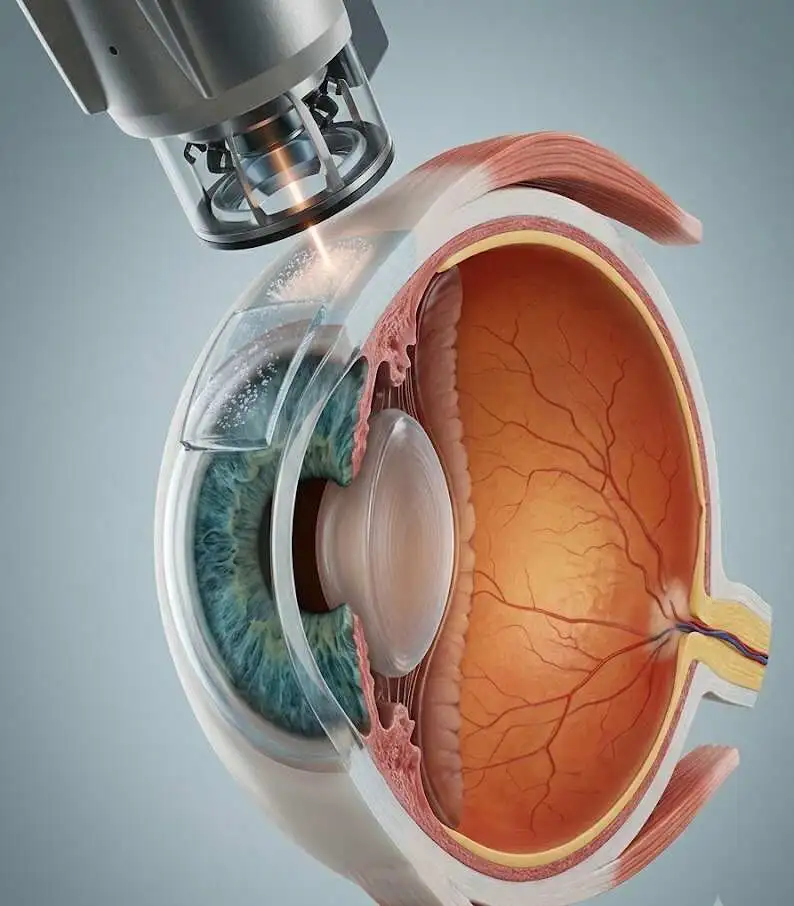
In LASIK, the surgeon creates a thin hinged flap on the cornea and lifts it. An excimer laser reshapes the tissue beneath, and the flap goes back without stitches.
Most clinics now cut the flap with a femtosecond laser rather than a blade, which is linked to fewer flap complications. Recovery is quicker and more comfortable than PRK, which is why LASIK remains the most widely performed laser eye surgery.
SMILE and Other Lenticule Extraction Methods
Lenticule extraction takes a different route. A femtosecond laser carves a small disc of tissue inside the cornea, and the surgeon removes it through a tiny opening of about 3 mm. There’s no flap and no surface removal.
Early dry eye tends to be milder than after LASIK, although that gap fades by around a year. It is mainly used for nearsightedness with or without astigmatism, though a version for farsightedness has recently been approved in Europe.
Phakic Implants: A Lens Added on Top of Yours
A phakic implant is a permanent lens placed in front of your natural one. It suits higher prescriptions, where reshaping a lot of corneal tissue could weaken the cornea. It also helps when your cornea isn’t suitable for laser treatment.
You need enough depth at the front of the eye, roughly 2.8 mm or more for myopia. Yearly check-ups matter afterwards, because the cells lining the cornea need watching. The implant is removed if a cataract forms.
Refractive Lens Exchange: Replacing the Natural Lens
This uses the same technique as cataract surgery, only there’s no cataract. Your natural lens comes out and an artificial one goes in, correcting your prescription and, with certain lenses, reading vision too.
It’s mostly considered for people in their presbyopic years or those with high prescriptions. Because it works inside the eye, it carries cataract-surgery risks, including a higher chance of retinal detachment in younger, highly nearsighted patients.
Who Is a Good Candidate for Refractive Eye Surgery?
Good candidates for refractive eye surgery tend to share a few traits: healthy eyes, a steady prescription and realistic expectations.
- A prescription that has changed by less than about 0.5 D over the past year.
- Corneas thick and regular enough for the planned treatment.
- No uncontrolled eye or whole-body condition that could interfere with healing.
- A prescription within the safe range for the chosen procedure.
- Expectations that match what surgery can actually deliver.
Age matters too. Surgery before 18 is usually avoided, and eyes in the early twenties can still be changing. Your clinic will run measurements, corneal mapping and tear tests before agreeing that you’re suitable.
When Vision Correction Surgery Isn’t the Right Choice
Some situations call for waiting or choosing a different route altogether.
- Keratoconus, early signs of it, or other corneal thinning.
- Uncontrolled diabetes or autoimmune and connective tissue conditions.
- Pregnancy and breastfeeding, since hormones can nudge your prescription.
- Active eye infection, inflammation or advanced glaucoma.
- Severe dry eye that hasn’t been managed.
- A past herpes infection of the cornea.
- Corneas thinner than about 500 microns, which narrows the options.
None of this closes every door. Someone turned down for laser eye surgery may still suit a lens-based option, and the reverse can be true as well.
How to Prepare for Refractive Eye Surgery
Preparation starts well before the day itself. Expect a detailed eye exam, measurements of your cornea’s surface and thickness, and a frank talk about the result you’re aiming for.
If you wear contact lenses, your clinic will usually ask you to stop for a set period first, because lenses can temporarily change the cornea’s shape.
Tell the team about every medicine and supplement you take. Some people are asked to start antibiotic drops beforehand, and a lens procedure may require fasting for a few hours. Arrange a lift home too, as you won’t be able to drive afterwards.
Take the consent process seriously. A good clinic explains the benefits, risks and alternatives, and gives you time to reflect before you sign.
What Happens on the Day of Refractive Eye Surgery
You’ll get numbing drops, and a small holder keeps your eyelids open. You stay awake and focus on a light while the laser or instruments do the work. Some pressure and a tapping or clicking sound are normal, but pain isn’t.
The procedure itself takes roughly 30 minutes, though you should plan on a few hours at the clinic overall. The team watches your eye briefly afterwards, and you can usually leave within an hour. A thin bandage lens may be placed on the eye.
Your vision will look hazy at first. That’s temporary, and it improves as healing begins.
Recovery and Aftercare
Recovery after refractive eye surgery depends on the procedure. Laser treatments often settle within a few days, while lens-based procedures can take a few weeks to heal fully. Among laser options, PRK is generally the slowest.
Most surgeons prescribe a drop schedule that can include antibiotic, steroid and lubricating drops. Follow it exactly. These habits protect your result:
- Don’t rub your eyes, even when they itch.
- Wear sunglasses outdoors to shield them from UV light.
- Keep dust, tap water and swimming pools away for as long as your surgeon advises.
- Skip eye make-up, heavy lifting and contact sports until you’re cleared, usually one to two weeks.
- Don’t drive until your surgeon confirms it’s safe.
- Go to every follow-up appointment.
Call your doctor promptly if you notice sudden vision loss, worsening pain, swelling, discharge, flashes of light or new black dots.
Risks and Side Effects of Refractive Eye Surgery
Serious complications after refractive surgery are uncommon, and specialist guidance describes both corneal and lens-based procedures as having a high safety profile. Even so, side effects are real, and honest counselling covers them.
Early symptoms are usually temporary: dry eyes, light sensitivity, fluctuating vision and halos or glare at night, mostly in the first one to three months. Specialists treat these as true complications only if they persist beyond about three months.
Less common problems include:
- Persistent dry eye.
- Under- or over-correction, which sometimes needs an enhancement.
- Infection or inflammation of the cornea.
- Corneal ectasia, a progressive bulging after tissue removal. The risk appears lower after PRK than after LASIK.
- Flap problems in LASIK.
- With lens procedures: raised eye pressure, cataract, retinal detachment, or loss of corneal cells after implants.
Thorough screening is your best protection, particularly for catching early corneal weakness before any tissue is removed.
How Well Does Refractive Eye Surgery Work?
Results of vision correction surgery are generally strong. After laser treatment, about nine in ten people reach 20/20 vision or better once healed, and nearly everyone gets to at least 20/40. After lens-based procedures, roughly eight in ten reach at least 20/40.
Your starting prescription matters. The further it sits from normal, the more likely you’ll still need glasses for some tasks. Results for low to moderate myopia are stable, while regression is more common with higher prescriptions and farsightedness.
Ageing carries on regardless. Presbyopia usually shows up in the forties, and cataracts come later. If you have cataract surgery down the line, tell your surgeon about your earlier treatment, since it changes how the new lens power is calculated.
How to Choose the Right Procedure and Surgeon
There’s no single best form of refractive eye surgery, only the best fit for your eyes. Someone with thin corneas or dry eyes may do better with PRK, while a person with a very high nearsighted prescription may be steered towards an implant.
These questions are worth asking before any refractive surgery:
- Which procedure suits my prescription and corneal thickness, and why?
- What are my personal risk factors?
- How much corneal tissue will be removed, and how much will remain?
- What happens if I need an enhancement, and is it included in the fee?
- What follow-up care is included?
Be wary of any clinic that skips detailed testing, promises perfect vision or rushes your consent. A good surgeon is as willing to say no as yes. This guide is general information, so please talk to a qualified ophthalmologist about your own eyes.
Frequently Asked Questions
Is refractive eye surgery safe?
For carefully selected patients, yes. Specialist guidance describes both corneal and lens-based procedures as having a high safety profile, with serious complications being uncommon. Safety depends heavily on thorough screening, the size of your prescription and your surgeon’s skill. Dry eye and night-time glare are the side effects people meet most often.
Is refractive eye surgery painful?
You shouldn’t feel pain during the procedure, because numbing drops are used. Some people notice pressure or hear a tapping sound. Afterwards your eyes may feel scratchy and sensitive to light. PRK tends to be the most uncomfortable in the first few days, while LASIK and lenticule extraction are usually milder. Your surgeon can suggest pain relief, and a bandage lens often helps.
How long does recovery take after refractive eye surgery?
Laser treatments often settle within a few days, though PRK takes longer than LASIK. Lens-based procedures can take a few weeks. Most activity restrictions last about one to two weeks. Halos and glare may linger for one to three months, and your surgeon will keep seeing you until your eyes have stabilised.
Is refractive eye surgery permanent?
The change to your cornea is lasting, but your eyes keep ageing. Some regression can happen, especially with higher prescriptions. Reading difficulty usually appears in your forties, and cataracts develop later in life. A phakic implant can be removed if needed, and an enhancement is sometimes possible if your vision drifts.
How much does refractive eye surgery cost?
There’s no single price. It varies by country, clinic, procedure type and the technology used. In many places insurers treat it as elective and don’t cover it. Ask for an itemised quote that includes pre-operative tests, follow-up visits and any enhancement policy, and don’t choose on price alone.
Bottom Line
Refractive eye surgery can be life-changing when it’s matched to the right person, the right eyes and the right procedure. Most people see well afterwards, but it isn’t risk-free and it doesn’t stop your eyes from ageing.
Start with a comprehensive eye exam, ask direct questions and give yourself time to decide. If the answers feel honest and the numbers fit your eyes, refractive eye surgery may be a safe route to clearer, more comfortable vision.