
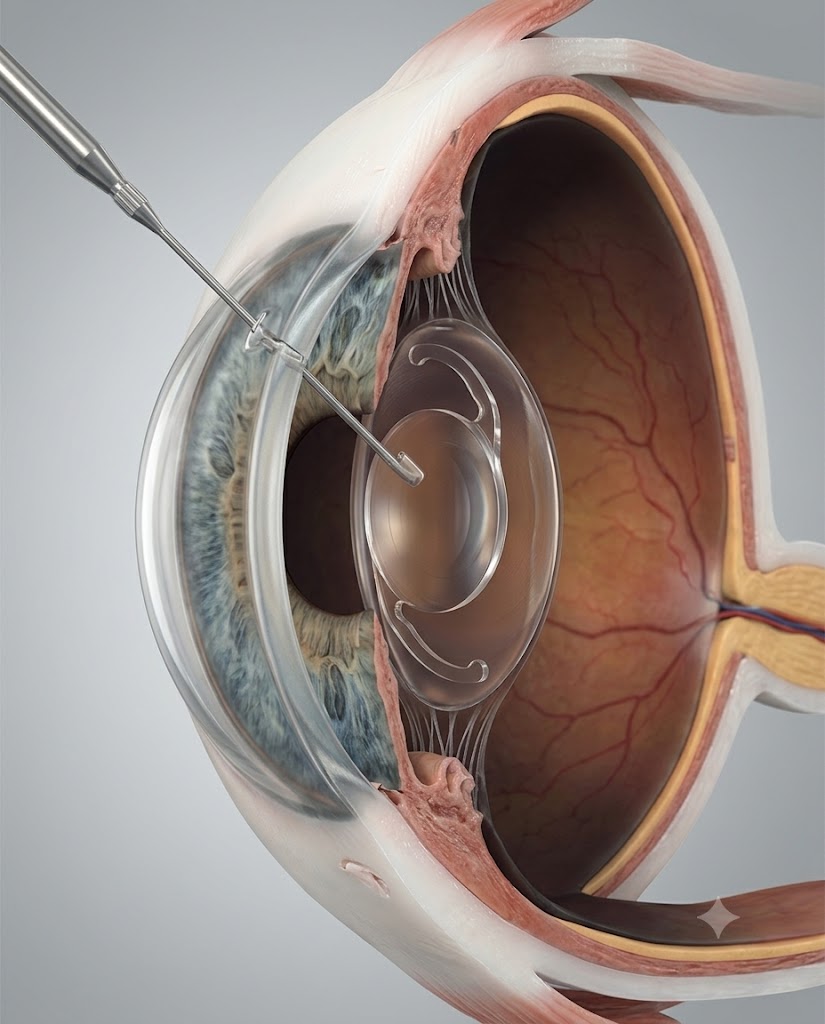
PCIOL eye surgery replaces a clouded natural lens with a clear artificial one, placed behind the iris where the original lens used to sit. PCIOL stands for posterior chamber intraocular lens, and it is the standard way surgeons restore focusing power once a cataract has been removed.
The term can sound more complicated than the operation really is. This guide to PCIOL eye surgery explains what the procedure involves, how a posterior chamber lens differs from other lens positions, what research has and has not shown, and what recovery usually looks like.
Key Takeaways
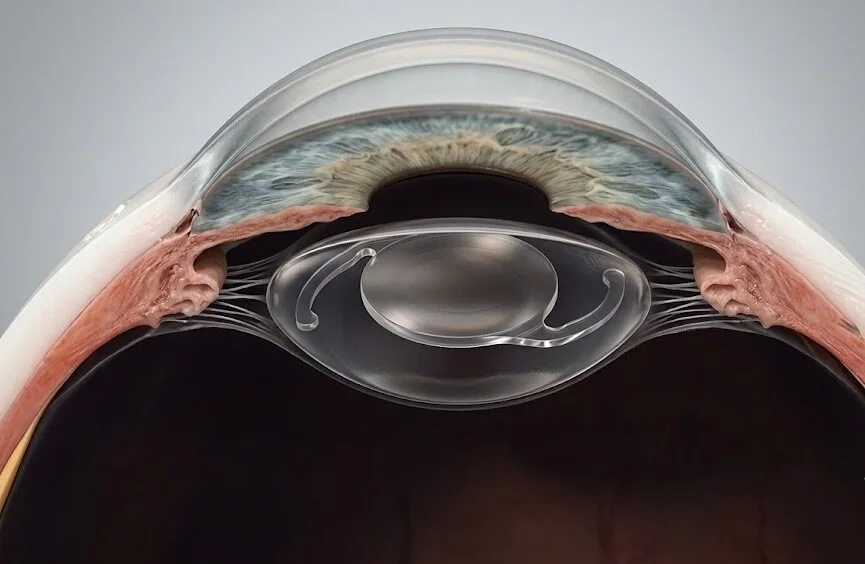
- PCIOL eye surgery places a posterior chamber intraocular lens, an artificial lens that sits behind the iris, usually inside the natural capsular bag.
- In PCIOL eye surgery, the term describes where the lens sits, not which type you receive. Monofocal, toric and multifocal designs can all be placed there.
- Studies of PCIOL implantation report good visual results, but many are single-centre studies with short follow-up.
- Eye pressure tends to dip slightly after phacoemulsification in people with normal pressure. That is an association, not proof of a treatment effect.
- Hazy vision months or years later is often posterior capsule opacification, which a quick laser procedure can usually clear.
- When the capsule cannot hold a lens, surgeons have other options, and the best choice depends on the individual eye.
What Is PCIOL Eye Surgery?
Inside a healthy eye, the natural lens sits just behind the iris and fine-tunes how light lands on the retina. With age, that lens slowly turns cloudy. This clouding is a cataract, and surgery is the only way to remove it.
Once the cloudy lens is out, the eye needs a replacement. That replacement is the intraocular lens, or IOL. “Posterior chamber” simply names the space behind the iris. Together, lens removal and lens placement make up cataract surgery with a lens implant.
During PCIOL eye surgery, the surgeon usually opens the front of the thin capsule that surrounds the lens and removes the cataract. The back and sides of the capsule stay in place like a small bag, and the new lens is slid into it.
Think of it as replacing a cloudy windowpane while keeping the original frame. Modern lenses are usually made of silicone, acrylic or similar plastics, and they carry a coating that filters ultraviolet light. Your surgeon sets the lens power using measurements of your eye’s length and the curve of your cornea.
PCIOL vs ACIOL: Where Can the Lens Sit?
A posterior chamber intraocular lens is not the only option, but it is the preferred one whenever the eye can support it. The capsular bag keeps the lens centred and holds it away from delicate structures at the front of the eye.
| Lens position | Where it sits | When it is usually considered |
| PCIOL in the capsular bag | Behind the iris, inside the natural capsule | The standard choice when the capsule is intact |
| Scleral-fixated PCIOL | Behind the iris, held by stitches anchored in the eye wall | When the capsule cannot support a lens |
| Iris-fixated PCIOL | Behind the iris, stitched to the iris itself | When the capsule is unsupportive but iris tissue is healthy |
| ACIOL (anterior chamber lens) | In front of the iris | An alternative when there is no capsular support |
Sometimes the capsule is torn, weak or missing, for example after an injury or in a condition called pseudoexfoliation. The surgeon then chooses between an anterior chamber lens, a lens stitched to the iris, or a lens fixed to the eye wall with sutures.
A 2006 literature review, built on an American Academy of Ophthalmology assessment from 2003, concluded that open-loop anterior chamber lenses, iris-sutured lenses and scleral-sutured lenses all had reasonable support as safe and effective options. In practice, the choice often comes down to the health of the eye and the surgeon’s experience.
That review is two decades old, so treat it as background rather than current guidance. Techniques and lens designs have moved on since.
How Is PCIOL Eye Surgery Done?
Most PCIOL eye surgery is done as day surgery, and the steps are broadly similar worldwide:
- The eye is numbed with drops or an injection, and the pupil is widened.
- Tiny incisions are made near the edge of the cornea.
- The cloudy lens is broken up and removed.
- The new lens is positioned in the capsular bag.
- A protective shield is placed over the eye.
Phacoemulsification vs small incision surgery
In phacoemulsification, ultrasound energy breaks the cataract into fragments that are suctioned out through an incision of roughly 2 to 3 millimetres. That small opening allows a foldable lens to be used. One 2021 study from Dhaka, for example, worked through a 2.4 mm incision.
Small incision cataract surgery (SICS) removes the lens in one piece through a slightly wider, self-sealing tunnel. It needs less equipment, so it is widely used in high-volume community programmes. A series from a Bangladeshi teaching hospital paired it with a rigid 5.5 mm PMMA lens.
Which approach suits you depends on how dense the cataract is, what technology is available and how your surgeon is trained.
PCIOL Lens Types: What the Name Does Not Tell You
In PCIOL eye surgery, the name describes the position of the lens, not its optical design. Cataract surgery with a lens implant can use several types:
- Monofocal: one focusing distance. It is the most common type, and many people choose distance vision and wear reading glasses.
- Toric: built-in correction for astigmatism.
- Multifocal and extended depth-of-focus: designed to reduce dependence on glasses at several distances.
- Accommodative: designed to use the eye’s natural muscle movement to shift focus.
- Light-adjustable: a monofocal lens that can be fine-tuned after the eye has healed.
Every option involves trade-offs. Halos and glare can be more noticeable with multifocal designs, and the American Academy of Ophthalmology suggests people who drive a lot at night think carefully before choosing one.
Multifocal and extended depth-of-focus lenses are also generally not recommended when glaucoma, macular degeneration or another eye disease limits vision. A Cochrane review has reported better near vision with multifocals than with monofocals, although the size of that benefit remains uncertain.
What Research Says About PCIOL Eye Surgery
Cataract surgery with a lens implant is one of the most studied operations in medicine, yet individual studies answer narrow questions. Here is what two published studies of PCIOL eye surgery found, and, just as importantly, what they cannot tell us.
Visual outcomes after small incision surgery
A retrospective study of 100 eyes in Rajshahi, Bangladesh, followed people aged 40 to 85 whose corrected vision before surgery was worse than 6/60. Six weeks after PCIOL implantation, 97 eyes had corrected vision of 6/12 or better.
Complications happened during surgery in 8% of eyes. After surgery, 38% had some problem, mostly temporary corneal swelling (18%) and inflammation inside the eye (13%).
The results are encouraging but limited. There was no comparison group, the work was done in one hospital, the lens was an older rigid design, and follow-up lasted weeks rather than years.
Eye pressure after phacoemulsification with a PCIOL
A 2021 observational study of 524 eyes in Dhaka looked at something less obvious: eye pressure. In people with normal pressure and no glaucoma, average pressure fell from about 13.4 to 11.5 mmHg one month after phacoemulsification with PCIOL implantation. The front chamber of the eye also became deeper.
Bigger drops tended to occur in eyes that started with higher pressure. Note the wording “tended to”. This is an association from one centre with one month of follow-up, and the authors acknowledge that no confirmed explanation exists.
It does not show that cataract surgery treats glaucoma, and on its own it is not a reason to have the operation.
What the evidence does not establish
- Long-term outcomes: both series followed patients for weeks, not years.
- Direct comparisons: neither study tested PCIOL surgery against another lens position or lens brand.
- Results in complex eyes: one study excluded glaucoma and complicated cataracts, so its findings may not apply to them.
Risks and Complications of PCIOL Surgery
Serious problems after PCIOL eye surgery are uncommon, but no operation is risk-free. The American Academy of Ophthalmology lists infection, bleeding, blurred vision, halos, glare and shadows, and, rarely, vision loss.
Posterior capsule opacification
The most common reason vision blurs again after uncomplicated surgery is posterior capsule opacification, often called a secondary cataract. Some lens cells always remain in the capsule. Later, they can grow across its back surface and haze the vision.
Reported rates vary widely between studies, depending on lens design, surgical technique, patient age and how long people were followed. Sharp-edged lens optics have been linked to lower rates.
Treatment is a short outpatient laser procedure called Nd:YAG capsulotomy, which opens a clear window in the cloudy capsule. It is generally safe, but not entirely risk-free. Pressure spikes, marks on the lens, swelling at the macula and retinal detachment have all been reported.
Other possible problems
Less common issues include a lens that shifts off-centre, lingering inflammation, and retinal detachment, which studies link to factors such as younger age and longer eyes.
Some warning signs after PCIOL surgery deserve prompt attention: worsening pain, a sudden drop in vision, increasing redness, or new floaters and flashes. Contact your surgeon or eye clinic without waiting for your next appointment.
Recovery After PCIOL Eye Surgery
After cataract surgery with a lens implant, many people notice clearer vision within a day or two, although it can fluctuate for a while. Mild scratchiness, watering and light sensitivity are common early on.
The eye keeps healing for several weeks after PCIOL surgery. That is why published studies usually check results at about one month to six weeks.
Surgeons typically prescribe antibiotic and anti-inflammatory drops. One hospital protocol in the studies above ran for six weeks, but regimens vary. Common-sense precautions include:
- Wearing the protective shield at night, as advised.
- Avoiding eye rubbing and keeping dust and water away until your surgeon clears you.
- Attending every follow-up visit. A final glasses prescription is usually given after healing.
Frequently Asked Questions
What does PCIOL stand for in eye surgery?
PCIOL stands for posterior chamber intraocular lens. It is an artificial lens placed behind the iris, usually inside the capsular bag, to replace the natural lens removed during cataract surgery.
Is PCIOL eye surgery painful?
Most people do not feel pain during the procedure because the eye is numbed. You may notice pressure or touch. Mild grittiness or aching afterwards is common, but strong or worsening pain is not normal and should be reported.
How long does recovery take after PCIOL eye surgery?
Vision often improves within a few days, and most healing happens over several weeks. Your surgeon will set the schedule for follow-up visits, drops and any new glasses.
How long does a PCIOL last?
The lens is designed to stay in place permanently, and the material does not cloud the way a natural lens does. The most common later change after PCIOL eye surgery is posterior capsule opacification, which laser treatment can usually clear without replacing the lens. Rarely, a lens shifts and needs repositioning.
What is the difference between PCIOL and ACIOL?
A PCIOL sits behind the iris, normally in the capsular bag. An ACIOL sits in front of the iris. A PCIOL is usually preferred when the capsule is intact, while an ACIOL is one alternative when capsular support is missing.
Bottom Line
PCIOL eye surgery is a well-established way to restore clear vision after cataract removal, and the posterior chamber lens remains the default choice whenever the eye can support it. Published studies are encouraging, but many are small, single-centre and short-term, so read them as reassurance rather than guarantees.
The best next step before PCIOL eye surgery is a conversation with your ophthalmologist about your eye’s anatomy, your lens options and realistic expectations. This article is general information and does not replace personal medical advice.