
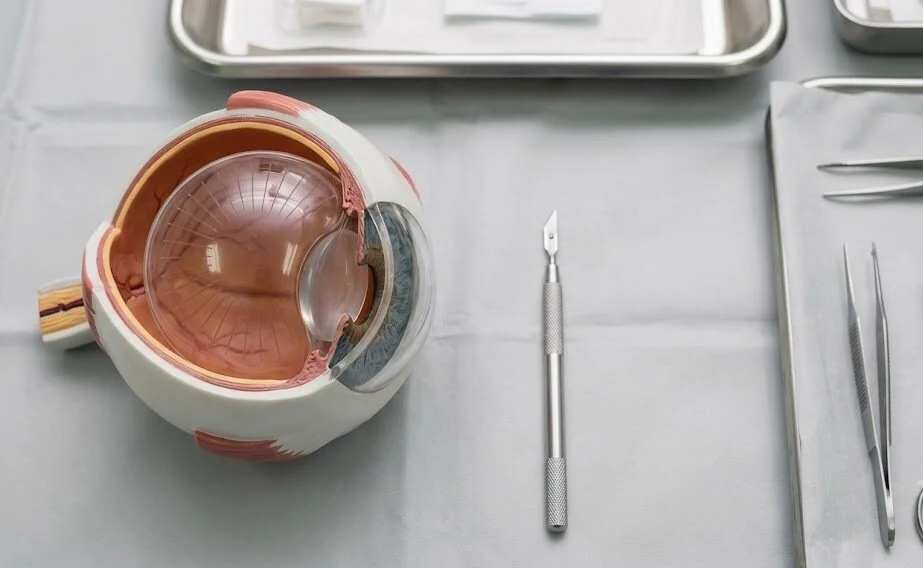
Keratotomy eye surgery is a vision correction operation in which a surgeon makes tiny cuts in the cornea to change its shape. The best-known type is radial keratotomy, which most people simply call RK, so you will see both names used for the same procedure in this guide.
It was once the go-to way to ditch glasses for nearsightedness. Several hundred thousand procedures were done worldwide in the 1980s and early 1990s. Decades later, many of those patients are asking new questions about their eyes.
This guide explains what keratotomy eye surgery is, how the operation worked, the problems that can appear years afterwards, and what you can do about them. It also covers cataract surgery after RK, which needs extra planning.
Key Takeaways
- Keratotomy eye surgery (RK) flattened the cornea with spoke-like cuts to correct nearsightedness.
- Laser surgery replaced it because laser results are more predictable.
- Vision can drift toward farsightedness for many years after RK.
- Swings in vision through the day, glare and starbursts are common complaints.
- Cataract surgery after RK needs special planning for lens power and incisions.
- Eye rubbing or a hard blow can reopen the old cuts.
What Is Keratotomy Eye Surgery?
Keratotomy eye surgery means reshaping the cornea, the clear window at the front of the eye, with small cuts. The best-known type is radial keratotomy, or RK, which was designed to correct nearsightedness, also called myopia. Russian eye surgeon Svyatoslav Fyodorov developed it in the 1970s.
A related procedure, astigmatic keratotomy, uses curved cuts to flatten the steepest part of the cornea and reduce astigmatism. This article focuses on RK, because it is the version most people ask about and the one studied most closely over the long term.
These three terms sound alike, so they are easy to mix up. Here is the difference:
- Keratotomy: cuts in the cornea, as in RK.
- Keratoplasty: a corneal transplant.
- Keratectomy: removal of corneal tissue, as in PRK.
The idea behind RK is simple. In a nearsighted eye, the cornea, the clear window at the front of the eye, focuses light too strongly. Flatten the cornea and the focus moves back to where it belongs.
RK was meant for people with nearsightedness. The PERK trial treated eyes with about minus 2.00 to minus 8.75 diopters of myopia, which shows the range the operation was designed to fix.
Keratotomy eye surgery is no longer a standard option. Even so, people who had it still need eye care that takes it into account.
How RK Surgery Worked
The surgeon made a set of fine cuts in the cornea, arranged like the spokes of a wheel. A small circle in the middle was left uncut. Each cut went down to roughly nine-tenths of the corneal thickness.
Those cuts weaken the cornea on purpose, which lets it relax into a flatter shape. A bigger central circle and fewer cuts gave less correction. A smaller circle and more cuts gave more.
Why RK Gave Way to Laser Surgery
Laser procedures such as PRK and LASIK took over because they offered sharper vision and more predictable results. RK was less exact. In the large US trial known as PERK, roughly six in ten eyes landed within one diopter of perfect focus after a year.
The same trial followed patients for ten years. Of those who had both eyes treated, about 70 percent said they no longer needed glasses or contacts for distance. That sounds like a success story, and for many people it was. The catch is what happened next.
Here is how RK compares with the laser procedures that replaced it:
| Feature | RK | PRK | LASIK |
| What the surgeon does | Makes spoke-like cuts in the cornea | Removes the surface layer, then reshapes with a laser | Creates a thin flap, then reshapes underneath with a laser |
| Predictability | Less exact; about six in ten eyes within one diopter in PERK | More predictable | More predictable |
| Long-term stability | Vision can drift toward farsightedness for years | Generally stable once healed | Generally stable once healed |
| Effect on the cornea | Cuts weaken it permanently and can reopen after a blow | Removes tissue; no flap | Removes tissue; leaves a flap |
| Status today | Rarely, if ever, performed | Standard option | Standard option |
Long-Term Problems After Keratotomy Eye Surgery
Because RK surgery weakens the cornea instead of reshaping it with a stable cut pattern, the eye keeps changing over time. These are the issues people report most often:
- Drift toward farsightedness: in the PERK study, 43 percent of eyes shifted toward farsightedness by one diopter or more between six months and ten years. The drift continued through the whole period, and smaller central circles were linked to more of it.
- Vision that changes during the day: the cuts swell slightly overnight, so eyes can be more farsighted on waking and settle back later.
- Glare, halos and starbursts: scars close to the pupil scatter light, and the cornea can develop an uneven curve called irregular astigmatism.
- Reading glasses: RK never stopped the natural stiffening of the lens, so most people still need help with near vision as they age.
- Rarer problems: corneal bulging (ectasia), infection and cuts that open after eye rubbing or a hard blow have all been reported.
None of this means every RK eye goes wrong. Many people stay comfortable for decades. But the surgery changed the structure of the cornea for good, and that is worth remembering at every eye appointment.
Cataract Surgery After Radial Keratotomy
Cataracts are what bring many RK patients back to the operating room. As that generation ages, more of them need cataract surgery, and surgeons face two main challenges: choosing the right lens power and protecting a cornea that already has old cuts.
- Measuring is trickier. RK leaves the centre of the cornea flat, but standard devices read a wider zone and can overestimate its power. That can lead to a farsighted surprise, so surgeons prefer detailed corneal mapping and calculators built for eyes that have had refractive surgery.
- The target is often slightly nearsighted. Many surgeons aim for mild nearsightedness, roughly minus 0.50 to minus 1.50 diopters, to guard against farsightedness. The trade-off is that you may need distance glasses afterwards.
- Incisions are planned around the old cuts. Surgeons try not to cross RK scars, may use a small peripheral cut or a stabilising stitch, and keep eye pressure low during the operation.
- Early results can mislead. Temporary farsightedness is common after surgery because the old cuts swell. The final result usually settles within about six to twelve weeks, so follow-up of at least three months is advised before changing glasses or lenses.
- Lens choice is debated. Multifocal and small-aperture lenses in RK eyes have only small studies behind them, so they remain controversial.
Cataract surgery after RK goes best when the surgeon knows your history, so tell them early if you have had RK and now have a cataract. If you still have your pre-RK prescription or surgery records, bring them, because they help with the lens calculation.
Options If Your Vision Has Changed After Keratotomy Eye Surgery
The right fix depends on what is going wrong and on the state of your cornea. This table shows the approaches that surgeons and optometrists discuss, not a promise that any of them will work for you.
| Problem | Approaches that may be considered |
| Farsighted drift or daily swings in vision | Glasses, or specialty contact lenses such as gas-permeable or scleral lenses |
| Glare and irregular astigmatism | Specialty contact lenses; in selected eyes, topography-guided laser treatment |
| Unstable or bulging cornea | Corneal cross-linking to help stabilise the cornea, often with glasses or lenses on top |
| Surprise result after cataract surgery | Glasses or contacts first; lens exchange or an added lens in some cases |
Be careful with any clinic that promises to fully restore your vision. Ask for published evidence, a clear explanation of the risks, and a second opinion before agreeing to surgery on an RK eye.
Protecting Your Eyes After Keratotomy Eye Surgery
- Do not rub your eyes, since the old cuts can open.
- Wear protective eyewear for sports, DIY and anything that could strike the eye.
- Tell every eye doctor and surgeon that you had RK, and keep your records.
- Have regular eye exams, and report any change in vision, glare or night driving.
When to See a Doctor Urgently
Old RK cuts can reopen, so some symptoms should not wait. Get prompt care from an eye doctor or emergency department if you have:
- Sudden eye pain.
- Sudden vision loss or a sudden drop in vision.
- Redness or discharge, which can signal infection.
- Any blow to the eye, even if it seems minor.
Frequently Asked Questions
Is keratotomy eye surgery still performed?
Rarely, if at all. Laser procedures such as PRK and LASIK replaced radial keratotomy because they give more predictable results and better image quality. Today the questions around keratotomy eye surgery mostly concern people who had it long ago.
Is keratotomy eye surgery permanent?
The cuts are permanent, but your vision is not fixed. Many eyes drift toward farsightedness over the years, and vision can vary from morning to evening.
Can you have cataract surgery after keratotomy eye surgery?
Yes. It needs more planning than usual, mainly for lens power and incision placement. Most people do well when the surgeon uses the right tools and sets realistic expectations.
Can you have LASIK after keratotomy eye surgery?
Sometimes. Surgeons have used laser treatment, corneal stitches and implantable lenses after RK surgery, but whether LASIK or another option suits you is decided case by case after detailed corneal testing. The old cuts cannot be undone.
What are the side effects of keratotomy eye surgery?
The most common are drifting vision, changes through the day, glare, halos and starbursts. Rarer problems include corneal bulging, infection and cuts reopening after trauma.
Is astigmatic keratotomy still performed?
Occasionally. This form of keratotomy eye surgery, called AK, uses one or two cuts at the steepest part of the cornea to reduce astigmatism. It has largely been replaced by limbal relaxing incisions and LASIK, although similar curved cuts are still used to treat astigmatism during cataract surgery. Unlike RK, it is not aimed at fixing nearsightedness.
Bottom Line
Keratotomy eye surgery helped many people drop their glasses, but it left the cornea permanently weaker, and the effects can keep changing for years. If you had it, keep your records, protect your eyes and tell every surgeon, especially before cataract surgery. A good eye specialist can usually find a sensible plan, even when RK has left your vision unpredictable.