
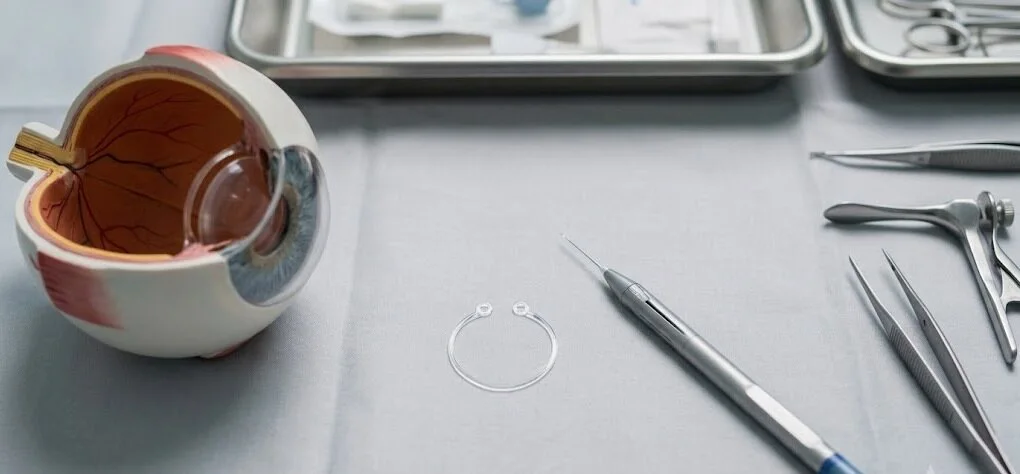
If your surgeon has mentioned CTR eye surgery, it may sound like a separate operation on top of your cataract procedure. It is not. A CTR, short for capsular tension ring, is a tiny implant that goes inside the eye during cataract surgery when the lens needs extra support.
This guide explains what the ring does, who is likely to need one, how surgeons place it, and where the risks lie. Everything is in plain language, so you can walk into your next appointment with better questions.
Key Takeaways
- A capsular tension ring is a small implant placed during cataract surgery.
- It supports the lens capsule when the fibres holding it are weak or damaged.
- Eye injury, pseudoexfoliation and some inherited conditions are common reasons for needing one.
- The type of ring depends on how much support is missing.
- The capsule must be intact, or the ring cannot be placed safely.
- Recovery generally follows the same path as routine cataract surgery.
What Is CTR Eye Surgery?
CTR eye surgery is not a stand-alone procedure. It is cataract surgery in which the surgeon also places a capsular tension ring inside the eye, which is why some people call it capsular tension ring surgery. Your natural lens sits in a thin, clear bag called the capsule, and tiny fibres called zonules hold that bag in position.
Think of the zonules as the cords that keep a hammock steady. When they are weak or torn, the bag can sag, tilt or collapse while the cloudy lens is being removed.
The ring is an open, C-shaped loop, usually made of PMMA, a rigid clear plastic with a long history in eye implants. It rests along the rim of the bag and presses gently outward. Small eyelets at the ends give the surgeon something to grip and steer.
The idea is not new. The ring was introduced in 1991, and the first human eye received one in 1993.
Why Surgeons Use a Ring in the First Place
Without enough support, the edge of the capsule can fold inward during surgery. That makes it easier for the instruments to damage the bag. It also raises the chance of vitreous, the jelly that fills the back of the eye, moving forward.
The ring keeps the rim open and shares the load with the healthy zonules. The result is a steadier workspace for the surgeon and a bag that stays rounder afterwards.
A rounder bag can help the new lens stay centred. There is some evidence for this with toric lenses, which correct astigmatism. In a small Japanese study of eyes with suspected zonular weakness, adding a ring reduced both lens decentration and axis misalignment.
When Is CTR Eye Surgery Needed?
Sometimes the need is obvious before the operation. Other times the weakness only shows itself once surgery is under way. These are the situations surgeons mention most often:
- Eye injury: a blow to the eye can loosen the zonules, even if it happened years ago and you have forgotten it.
- Pseudoexfoliation syndrome: flaky deposits build up inside the eye and slowly weaken the zonules.
- Inherited conditions: Marfan syndrome, Weill-Marchesani syndrome and Ehlers-Danlos syndrome are linked with zonular problems.
- Very long, short-sighted eyes: some surgeons reach for a ring more readily in these eyes, especially with a toric lens.
- Very advanced, hypermature cataracts: these appear in hospital series among the reasons rings were used.
How often a CTR in cataract surgery is used varies a lot. Two surgeons writing in EyeWorld put their own use at roughly 5 to 10 percent of cases, though both receive referrals for tricky eyes. An Indian hospital review of 6,000 cataract operations found a ring was used in under 1 percent.
Types of Rings and How Surgeons Choose
Capsular tension ring surgery does not use one design for everyone, because not every weak capsule needs the same fix. Published surgeon accounts broadly agree on this rough guide:
| Device | What it is | Typically used for |
| Standard ring | An open, C-shaped PMMA loop that sits inside the capsule | Smaller gaps in support, up to about a quarter of the circle |
| Capsular tension segment | A partial PMMA piece, stitched to the white of the eye | Larger gaps, roughly a quarter to half of the circle |
| Cionni ring | A modified ring with an eyelet for stitching to the eye wall | Gaps of more than half the circle, and by some surgeons in every Marfan case |
Surgeons set these cut-offs a little differently, so treat the table as a rough guide rather than a rule.
Surgeons sometimes combine a standard ring with a segment. Ring size is normally picked from a measurement across the front of the eye, called white-to-white, which stands in for the width of the bag.
There is a limit, though. When the lens is almost hanging free, adding a ring can make the damage worse. In those cases, some surgeons remove the cataract and fix the new lens to the eye wall instead.
How the Ring Is Placed During Surgery
The ring goes in after the surgeon has made the round opening in the front of the capsule. Timing a CTR in cataract surgery is a judgement call. Placed early, it steadies the bag while the cataract is broken up. Placed late, it avoids trapping leftover lens material behind it.
Most surgeons aim to place it as late as is safe, but early enough to prevent trouble.
Insertion is done with a preloaded injector or by hand with small hooks. The ring should glide smoothly around the rim of the bag. If it meets resistance, the surgeon stops, backs out and tries again, sometimes from the other direction.
Once the ring is in, the new lens is placed in the bag in the usual way.
Risks and Limits of CTR Eye Surgery
CTR eye surgery is a helpful tool, but it is not a cure-all. The main limits are worth knowing:
- It needs an intact capsule. If the bag is torn, the device could be lost into the back of the eye, so it is not used.
- It can trap lens material. Careful cleaning of the bag before or after placement helps.
- It does not always improve results. In a five-year study at the Aravind Eye Care System in India, reported by AAO EyeNet, ring placement did not improve outcomes in people with mild pseudoexfoliation.
- It does not stop every late problem. In pseudoexfoliation, the bag and lens can still drift years later, though the ring gives the surgeon something firm to anchor a repair to.
- Weak zonules often travel with other issues, such as vitreous prolapse, iris damage, retinal tears and macular swelling.
This is why complex eyes take longer in the operating room. Referring a difficult case to a surgeon who handles them often is a sensible choice, not a failure.

What to Expect Before and After CTR Eye Surgery
You will not feel the ring once it is in place. Healing after CTR eye surgery usually follows the same route as standard cataract surgery, with eye drops and follow-up visits. Complicated eyes may need closer monitoring.
Good questions for your surgeon include these:
- Why do I need a ring, and what did you find in my eye?
- Which type are you planning, and what is the backup plan if more support is needed?
- Do I have any other eye problems that could affect healing?
Frequently Asked Questions
What is CTR eye surgery?
It is cataract surgery with an added step: the surgeon places a capsular tension ring inside the lens capsule to support it. The ring is a tiny, open, C-shaped implant that keeps the bag open and stable.
Who needs a capsular tension ring?
People who need CTR eye surgery have zonules that are weak, damaged or missing. Common causes are old eye injuries, pseudoexfoliation, inherited connective tissue conditions and very advanced cataracts. Sometimes the weakness is only found during the operation.
Is CTR eye surgery safe?
Capsular tension ring surgery is widely used and generally considered a helpful safety measure in difficult eyes, but it carries risks like any eye surgery. It cannot be used if the capsule is torn, and it will not prevent every late lens shift.
Does CTR eye surgery make recovery longer?
Using a CTR in cataract surgery does not usually change what you feel or how you heal. Recovery tends to mirror routine cataract surgery, although eyes with weak zonules may need extra check-ups.
Can a capsular tension ring be felt or seen?
No. It sits inside the capsule behind the iris, so you will not feel it and it is not visible from outside. It is designed to stay in the eye permanently, so ask your surgeon if you have concerns.
How much does CTR eye surgery cost, and does insurance cover it?
There is no fixed price, because the ring is added to a cataract operation rather than sold as a separate procedure. The total depends on your surgeon, the facility, the lens you choose and how complex your eye is.
In the United States, insurance and Medicare generally cover cataract surgery that is medically necessary, and the ring is a recognised implant used within that surgery. Premium lenses are usually not covered. Ask the clinic for an itemised estimate and check with your insurer before the day.
How long does CTR eye surgery take?
Usually longer than a routine cataract operation, though there is no standard figure. Placing the ring is one extra step, and eyes with weak zonules tend to need more time and care throughout. Surgeons writing in EyeWorld advise setting aside additional operating time for these cases.
Your surgeon can give you a realistic estimate once they have examined your eye.
Is a capsular tension ring permanent, and is it safe for an MRI?
Yes, the ring is meant to stay in the eye permanently. It is made of PMMA, a plastic with no metal in it, so it is not expected to react to an MRI magnet.
That said, the manufacturers’ entries in the FDA device database do not carry formal MRI safety labelling. Tell the MRI team about your eye implant, bring your implant card if you have one, and ask your surgeon to confirm.
How does a surgeon know beforehand that the zonules are weak?
Often through your history and a close slit-lamp exam. Surgeons ask about past eye injuries, earlier eye surgery and family conditions such as Marfan syndrome. They look for flaky pseudoexfoliation deposits, uneven pupil dilation and a lens that wobbles when the eye moves, known as phacodonesis.
A dense cataract in one eye and a mild one in the other can also hint at an old injury. Even so, weak zonules are not always visible, which is why they are sometimes only found once surgery has started.
Bottom Line
CTR eye surgery gives surgeons a way to support a weak lens capsule and finish cataract surgery with a stable, centred lens. It is a sensible option for eyes with injury, pseudoexfoliation or inherited zonular weakness, but it has real limits. Talk openly with your eye surgeon about whether you need one and what the plan is if the eye needs more support.