
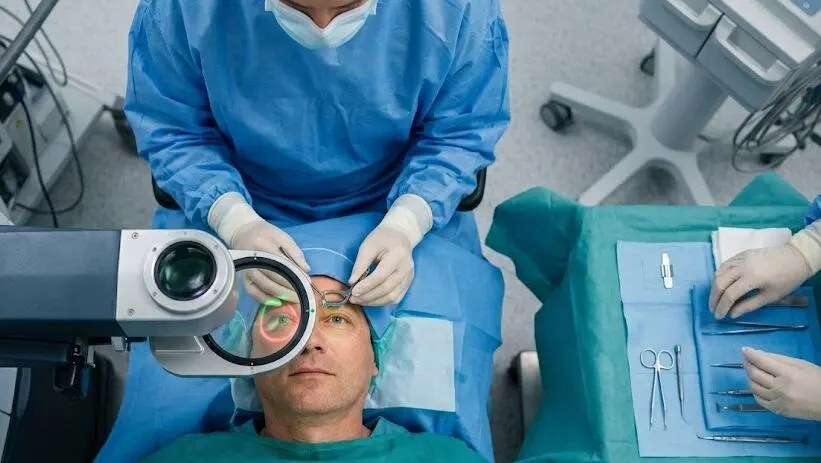
If your glasses mist up under a mask and your contact lenses leave your eyes scratchy by the end of the day, femto eye surgery may be the option you keep hearing about. This bladeless laser vision correction reshapes the front surface of the eye so that light focuses precisely where it should. For a suitable candidate, it can greatly cut the need for glasses or lenses. Below, you will find how the procedure works, who is eligible, what it costs in India and what the recovery period is really like.
Key Takeaways
- In femto eye surgery, one laser forms the corneal flap in place of a blade, and a second laser then corrects the prescription.
- It corrects short-sightedness, long-sightedness and astigmatism in adults whose spectacle power has held steady for roughly a year.
- The laser part is over in minutes, and most patients see clearly again within a day or two.
- Prices in India differ a lot, so request an itemised quote that covers follow-up visits.
- Dry eyes and night-time glare are the side effects people report most, and both generally ease within a few weeks.
- A full evaluation comes first because thin corneas, keratoconus and pregnancy can make you ineligible.
What Is Femto Eye Surgery?
Femto eye surgery is the common name for femtosecond LASIK, or femto LASIK for short. All LASIK procedures begin with a thin flap on the cornea, the transparent dome at the front of the eye. Earlier techniques made this flap with a small oscillating blade. In this version a laser does that work, which explains the name bladeless LASIK.
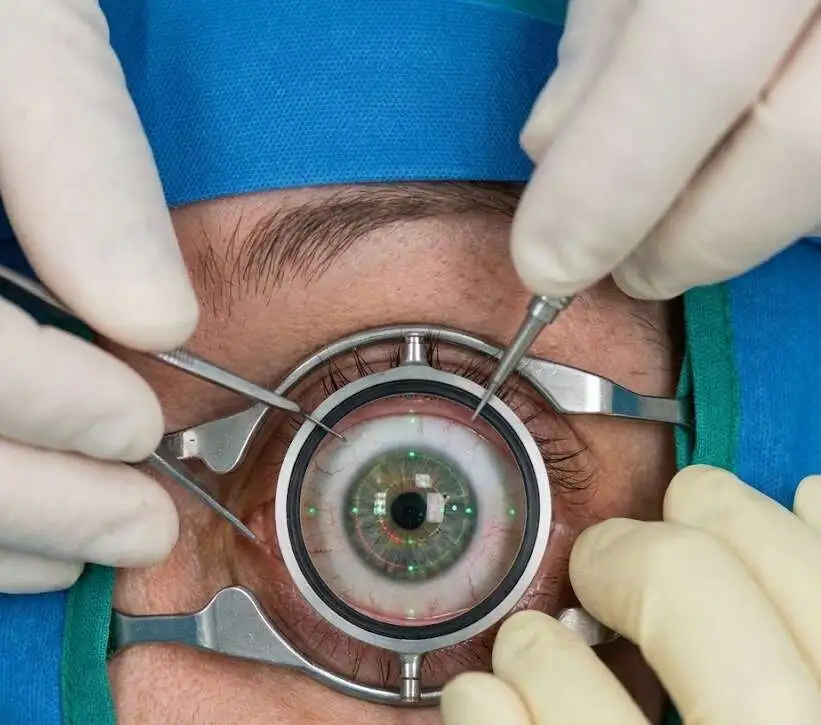
The femtosecond laser emits pulses lasting one quadrillionth of a second. Every pulse forms a tiny bubble within the corneal tissue, and thousands of these bubbles join up to free a smooth, uniform layer. Next, the surgeon folds back the flap and an excimer laser takes away a very small amount of the tissue beneath, fixing the focusing error. The flap is then placed back, and it heals into position on its own without stitches.
How Femto Eye Surgery Differs From Traditional LASIK
What really sets it apart is the way the flap is created. With femtosecond laser eye surgery, the laser can be set to a precise thickness, width and location, which produces flaps that are more even than those cut with a blade. This is the reason many surgeons now favour bladeless LASIK, particularly when a patient’s cornea is borderline thin.
One point is worth remembering. The excimer laser stage, where the vision is actually corrected, is the same in both approaches. What you gain is a safer and more predictable flap rather than a stronger correction.
Two other procedures are also worth knowing. SMILE takes out a small disc of tissue through a tiny keyhole incision, while PRK reshapes the surface of the eye without creating any flap. The right choice hinges on your corneal thickness, your prescription and your lifestyle, and that call belongs to your surgeon.
Here is a simple side-by-side view of the three procedures:
| LASIK with a femtosecond laser | SMILE | PRK | |
| Flap | Thin corneal flap made by laser | No flap; a small keyhole incision | No flap; the surface layer is removed |
| Early recovery | Usually quick, often within a day or two | Usually quick, though it can vary | Slower, with several days of discomfort |
| Often chosen when | The cornea is thick enough for a flap | Short-sightedness or astigmatism needs correcting | The cornea is thin or a flap is best avoided |
A few centres also provide personalised treatment, for example wavefront-guided or topography-guided correction. These methods chart the individual irregularities of your eye and build the laser plan around them. Not everyone needs this, so check with your surgeon whether your eyes would truly gain from it.
Who Can Have Femto Eye Surgery?
Surgeons generally check the following points before suggesting femto LASIK:
- You are 18 years of age or older.
- Your prescription has remained unchanged for a year or longer.
- Your corneas are healthy and thick enough, and there is no active infection.
- You are neither pregnant nor breastfeeding, since hormonal changes can alter your prescription.
- You accept what laser vision correction cannot do. You may still need reading glasses as you get older.
Certain conditions require extra care or suggest another procedure. Examples are keratoconus, very thin corneas, poorly controlled diabetes, autoimmune disorders, severe dry eye and some eye diseases. If a good clinic turns you down at times, that shows it is putting your safety first.
High prescriptions or thin corneas may also point towards PRK or ICL. ICL stands for implantable collamer lens, a small lens that sits inside the eye without removing any corneal tissue. This makes it a handy alternative when the cornea does not have enough thickness to reshape safely.
How to Prepare for Surgery Day
A bit of preparation helps the day go smoothly:
- Have someone take you home, because your vision will be hazy after the procedure.
- Avoid makeup, perfume, face creams and lotions on the day.
- Dress comfortably and bring a pair of sunglasses.
- Continue your usual medicines as directed, and let the team know about everything you take.
- Carry your old prescriptions and eye records, and note down any questions beforehand.
Femto Eye Surgery Procedure, Step by Step
Ahead of surgery day you will go through a thorough evaluation. The team maps the cornea, measures how thick it is, checks pupil size and tear quality, tests eye pressure and inspects the retina. You will also need to stop wearing contact lenses before the visit, typically for one to two weeks with soft lenses and longer with rigid ones, since lenses briefly alter the corneal shape and can distort the measurements.
Here is what happens on the day:
- Numbing drops are put in each eye, and no injections are involved.
- A soft suction ring keeps the eye still as the femtosecond laser forms the flap. You may notice pressure, and your vision can dim for a few seconds.
- The surgeon folds back the flap, and the excimer laser reshapes the cornea as you focus on a fixed light.
- The flap is put back in place and allowed to seal by itself.
The full visit lasts roughly 15 to 30 minutes for both eyes, with the laser active for just seconds per eye. You return home the same day wearing protective shields and carrying eye drops.
Femto Eye Surgery Recovery: What to Expect
The initial few hours are the hardest. You can expect a gritty or burning sensation, watery eyes and blurred vision, though a nap helps most people feel better.
Vision is typically a lot sharper by the next morning, and a check-up follows within a day or two. Plenty of people resume desk work after one to two days. Avoid driving until your doctor gives the all-clear.
Take care of your eyes during the first week:
- Avoid rubbing or pressing your eyes, even when they feel itchy.
- Apply the antibiotic and lubricating drops precisely as prescribed.
- Put on the shield when you sleep and sunglasses when you go outside.
- Leave out eye makeup for around a week, and stay away from dust, smoke and swimming pools.
Heavy exercise and swimming are normally off limits for a few weeks, so stick to the timeline your surgeon gives you. Vision continues to settle over several weeks and occasionally a few months, so follow-up visits are important even if your eyes feel fine.
Dry Eyes and Touch-Ups After Surgery
Dryness is the complaint heard most often during the first months. Using lubricating drops on schedule and taking regular screen breaks helps most people. One easy habit is to look away from the screen every 20 minutes and blink completely. Try also to keep air conditioners and fans from blowing directly onto your face.
Sometimes a little of the prescription is left once healing finishes. If so, your surgeon may recommend an enhancement, commonly called a touch-up. This is generally considered only after your vision has stabilised, and it depends on whether enough corneal tissue remains for safe treatment.
When to Call Your Surgeon
Mild discomfort is expected, but do not simply wait if you notice any of the following:
- Intense pain, or pain that keeps getting worse.
- An abrupt decline in vision.
- Growing redness, swelling or discharge.
- Sensitivity to light that worsens rather than settling.
- Any bump or injury to the eye in the first few weeks, however small.
Femto Eye Surgery Cost in India
Costs differ more than many people anticipate. A few centres advertise starting prices near ₹20,000 per eye, whereas premium hospitals may charge well over ₹1,00,000 for both eyes. The range most often quoted for both eyes is about ₹40,000 to ₹1,50,000, so view any number as an estimate and verify it with the clinic.
Several factors affect the price:
- The city and the standing of the hospital.
- How experienced the surgeon is.
- The laser platform used, and whether the treatment is tailored to your cornea.
- What is covered in the package, for instance tests, medicines and follow-up visits.
Check whether the quote is for one eye or two, and whether a future touch-up is part of it. Regular health insurance generally classes laser vision correction as elective, although a few policies cover specific cases like a very high prescription. Many clinics also provide EMI options, so ask about them.
Benefits of Femto LASIK
- Greater flap precision, since the laser follows a programmed plan rather than a blade guided by hand.
- Fewer flap-related complications with bladeless LASIK than with blade-based techniques.
- Fast visual recovery, with many patients seeing well inside 24 hours.
- Works for many different prescriptions, astigmatism included.
- Savings over time on glasses, lenses, solutions and frequent prescription updates.
A caution worth stating plainly: LASIK cannot prevent the reading difficulty that comes with age. Beyond roughly 40, many people still require reading glasses.
Risks and Side Effects of Femto Eye Surgery
Femtosecond laser eye surgery has a good safety record when patients are properly screened and operated on by an experienced surgeon, yet no surgery is entirely free of risk. The usual effects tend to be short-lived:
- Dry, gritty eyes.
- Light sensitivity.
- Glare and halos around lights after dark.
- Vision that varies during the first few weeks.
Less frequent issues include undercorrection or overcorrection, which could require a minor touch-up, as well as flap complications. Infection and inflammation are uncommon, as is transient light sensitivity syndrome, a brief reaction that settles with steroid drops. The most serious risk is ectasia, a progressive bulging of the cornea. It is extremely rare, and careful screening before surgery is largely meant to prevent it.
Inform your surgeon of every health condition and medicine, and of any family history of corneal disease, before the procedure.
How to Choose the Right Clinic
The surgeon and the screening count for more than the brochure. Before booking, ask about the following:
- Which tests are carried out before surgery and who goes over the results.
- The number of laser procedures your surgeon has done and how complications are managed.
- The laser systems the centre uses and how regularly they are serviced.
- What the package includes, such as follow-up visits and the touch-up policy.
- Whether the doctor talks openly about risks and will decline to operate if you are not a suitable candidate.
Be wary of steep discounts or pressure to book on the spot. A clinic that hurries the evaluation should not be trusted with your eyes.
Common Myths About Laser Eye Surgery
Myth: The laser can burn or blind you if you blink or move.
Reality: The laser is controlled by a computer, and an eye tracker follows slight movements. Serious loss of vision is very rare.
Myth: The results wear off after a few years.
Reality: The reshaping is permanent in itself. Normal age-related changes can still occur later on, however.
Myth: The procedure is painful.
Reality: Numbing drops keep you comfortable, and most people feel only pressure followed by a brief gritty sensation.
Myth: Anyone with a spectacle prescription can have it.
Reality: Eligibility depends on corneal thickness, eye health and a stable prescription.
Frequently Asked Questions
Is femto eye surgery safe?
Yes, for suitable candidates. Femtosecond laser eye surgery has been in wide use for years, and a flap made by laser reduces the risk of flap problems relative to a blade. Safety relies heavily on screening and on the surgeon’s experience, so pick a centre that tests thoroughly and is open about risks.
Is femto eye surgery painful?
Usually not. Numbing drops keep the eye comfortable, so what you feel is pressure instead of pain. After surgery, a few hours of burning or grittiness is common and settles quickly.
How long does recovery take?
Most people see clearly in one to two days and go back to normal work. Complete stabilisation may take a few weeks, and at times a few months.
Are the results permanent?
The correction lasts because the reshaped cornea does not regrow. Your eyes may still change as you age, though. Some people need a touch-up, and most need reading glasses in their forties or later.
How much does femto LASIK cost in India?
The commonly quoted range is roughly ₹40,000 to ₹1,50,000 for both eyes, based on the city, surgeon, technology and package. Ask for an itemised quote before deciding.
Conclusion
Femto eye surgery can change your life, but only if it suits your eyes. Begin with a thorough evaluation, ask about the technology and the full cost, get a second opinion if you are unsure, and follow the aftercare closely. Doing so gives you the best chance of clear vision for many years.
This article offers general information and is not medical advice. Schedule a consultation with a qualified ophthalmologist to learn whether you are a suitable candidate.