
If your eye doctor has brought up buckle eye surgery, you are probably dealing with something frightening: a retina that has started to peel away from the back of your eye. The reassuring part is that this operation has been repairing detached retinas for more than 60 years, and it still works very well for the right patients.
This guide explains what the procedure involves, how recovery really goes, what can go wrong and how it compares with other retinal detachment surgery options. By the end, you should feel ready to ask your surgeon sharper questions.
Key Takeaways
- What it does: buckle eye surgery repairs a detached retina by placing a soft silicone band or sponge on the outside wall of the eye. The silicone pushes the wall inward so the retina can settle back into place.
- It is an emergency: sudden new floaters, flashes of light or a shadow across your vision call for same-day care.
- Time in surgery: the operation typically takes one to one and a half hours, and many people go home the same day.
- Success rate: a single operation works in roughly 80% to 90% of cases, and most failures can be repaired with more treatment.
- Recovery: expect about two to four weeks, though it can run longer.
- Trade-offs: more short-sightedness, double vision, cataract and a repeat detachment are all possible.
- Choosing a method: your surgeon decides between a buckle, vitrectomy and pneumatic retinopexy based on where the tears are, your lens and the state of your vitreous gel.
What Is Buckle Eye Surgery?
The operation, more formally called scleral buckling, treats a rhegmatogenous retinal detachment. That is the most common type, and it begins with a tear or hole in the retina.
Picture the retina as wallpaper on the inside back wall of your eye. When fluid slips through a tear, it collects underneath and the wallpaper lifts. A lifted retina cannot send clear signals to your brain, so vision fades in that area.
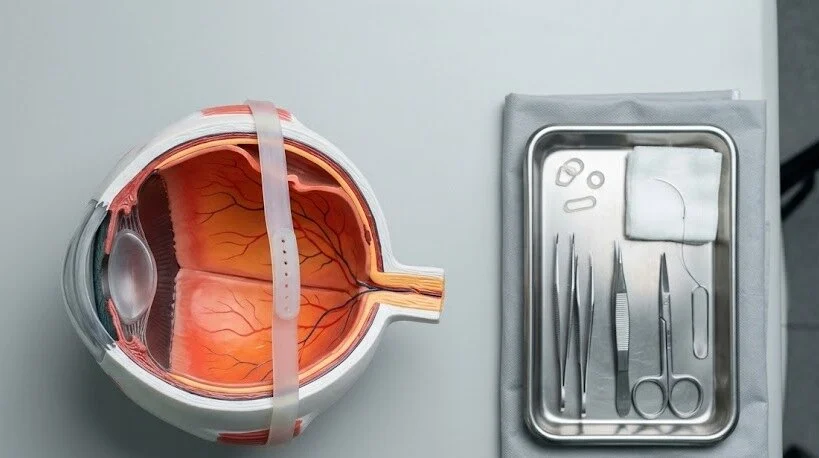
During scleral buckle surgery, the surgeon seals the tear and then stitches a flexible piece of silicone to the sclera, the white outer wall of the eye. The silicone sits entirely outside the eye. It presses the wall inward, which brings wall and retina back into contact and gives the tear a chance to heal shut.
Once healed, the buckle is usually invisible and, in most cases, stays in place permanently. Occasionally a surgeon removes it after the retina has healed, or sooner if an infection develops.
Types of Buckles Surgeons Use
Not every buckle looks the same. The surgeon chooses the shape based on how many tears there are, where they sit and how large they are.
- Segmental sponge or solid piece: supports one area of the retina, such as a single tear.
- Encircling band: a thin silicone strip that runs all the way around the eye, used when problem areas are spread across several parts of the retina.
- Grooved silicone tire: a wider piece placed under a band when extra height or width is needed over a specific spot.
Why the Retina Detaches and What It Feels Like
With age, the clear gel that fills your eye, called the vitreous, becomes more liquid and can pull away from the retina. Most of the time that is harmless. Occasionally the pull is strong enough to tear the retina, and fluid then seeps through the opening.
Several things raise the odds:
- Being very short-sighted
- Past cataract surgery or other eye surgery
- An eye injury
- Thin, weak patches in the retina, known as lattice degeneration
- Other eye conditions, such as uveitis
- Inherited retina and vitreous disorders
- Getting older
The early warning signs usually include:
- A sudden shower of new floaters that look like specks or cobwebs
- Flashes of light, often easiest to spot in the dark or when you move your eyes
- A shadow or curtain creeping in from the edge of your vision
- Blurred central vision once the detachment reaches the macula
Many people notice nothing until the macula is involved, so never wait and see. Treat these signs as an emergency and get to an eye doctor the same day. In India, many people delay because flashes and floaters seem minor, and that delay can cost vision.
Macula on versus macula off: the macula is the small central area of the retina that gives you sharp detail. If it is still attached, surgery aims to protect the vision you have. Once it has come off, the chance of regaining full sharpness drops, which is why surgeons move quickly when the macula is still on.
Can it be prevented? Not reliably. The one approach with solid evidence is treating symptomatic retinal tears with laser or freezing before fluid builds up underneath. That is another reason new flashes or floaters deserve a prompt dilated eye exam.
Who Is a Good Candidate for a Buckle?
Surgeons rarely pick a method at random. They weigh where the tears sit, how many there are, how healthy the vitreous gel is, whether you still have your natural lens and whether you can hold your head in a set position after surgery.
A buckle tends to be considered when tears or weak areas are spread across more than one part of the retina, when the natural lens is still in place, or when a retina has come loose again after earlier treatment. A single small tear may be handled with a simpler approach instead.
It is also worth knowing that scleral buckling has become less common as vitrectomy has grown more popular, especially in eyes with an artificial lens implant. Even so, it remains a valuable option, and in some eyes it is the best one.
Note that not every tear needs a buckle. A tear caught before the retina detaches can sometimes be sealed with laser or freezing alone.
Benefits of a Buckle
- A long track record: the technique has been used for more than 60 years.
- Strong results: most retinas reattach after a single operation.
- Natural structures stay in place: the repair is made mostly from outside the eye, so your own vitreous gel is left alone, and it avoids the faster cataract formation linked to vitrectomy.
- Less head positioning: when no gas bubble is used, you may not need to hold your head in a set position for days.
- Flexible: it can be combined with other procedures and used again after an earlier repair fails.
Buckle Eye Surgery vs. Other Retinal Detachment Repairs
There are three main types of retinal detachment surgery, and surgeons often combine them. Treat the table below as a rough guide rather than a fixed rulebook. The difference between scleral buckling and the other two is that the repair happens mostly outside the eye.
| Procedure | How it works | Often considered when | Main trade-offs |
| Scleral buckle | A silicone band or sponge on the outside of the eye indents the wall; freezing or laser seals the tear. | The natural lens is still present, there are several tears, or the retina has detached again. | More short-sightedness, double vision, longer soreness. |
| Vitrectomy | The surgeon removes the vitreous gel from inside the eye, treats the tear and fills the eye with gas or oil. | The detachment is complex, there is bleeding or scar tissue, or you have an artificial lens. | Faster cataract in a natural lens, head positioning, travel limits with gas. |
| Pneumatic retinopexy | A gas bubble is injected into the eye and the tear is sealed with freezing or laser. | The detachment is straightforward with a limited number of tears. | Needs strict head positioning and does not suit many detachments. |
How to Prepare for the Operation
Your surgeon will go over your medical history and examine the back of your eye after dilating it. You may also have an ultrasound if the view is poor.
- Tell your team about every medicine, vitamin and supplement you take, and ask which ones to pause.
- Follow the fasting instructions exactly. This usually means no food or drink after a set time the night before.
- If the detachment is active, your doctor may patch both eyes and ask you to rest in bed until surgery so the detachment does not spread.
- Arrange a driver, since you cannot drive yourself home.
- Ask what type of anaesthesia you will have and whether a gas bubble is planned.
- Line up help at home for the first few days.
What Happens During the Procedure
The operation takes place in an operating room, and most people are home the same day. It usually lasts about an hour to an hour and a half. Here is the general flow:
- You receive a sedative through an IV, plus local, regional or general anaesthesia, depending on your case. You need to stay completely still.
- Drops widen your pupil, and a small instrument holds your eyelids open.
- The surgeon makes a small opening in the thin clear covering over the white of the eye and checks the retina closely to find every tear.
- Each tear is sealed with a freezing probe or, less often, a laser. This creates a small scar that glues the retina in place.
- A silicone band or sponge segment is fixed to the outer wall of the eye. A band circles the whole eye, while a sponge supports only the troubled area.
- If needed, the surgeon drains fluid from under the retina and may place a small gas bubble inside the eye.
- The opening is closed, antibiotic is applied and your eye is patched.
Recovery After Buckle Eye Surgery: What to Expect
Recovery after scleral buckle surgery varies from person to person. The pattern below is typical, but your own surgeon’s timeline always wins.
The first day
Your eye will be patched, and you will go home once the sedation wears off. Expect soreness, scratchiness and a swollen eyelid. Over-the-counter pain relievers are usually enough if your surgeon agrees. Most people return the next day for a first check.
The first week
You will use prescribed eye drops, often including an antibiotic and sometimes drops that stop the pupil from widening or tightening. Your vision may stay blurry for a few days, and you should keep soap and water out of the eye. Avoid rubbing, heavy lifting and strenuous bending. If you have a gas bubble, your surgeon may ask you to hold your head in a particular position for part of each day.
Weeks two to four
Swelling and redness settle, and daily life gets easier. Ask exactly when you can shower freely, return to work or school, drive, swim and exercise, because the answer depends on your case. Some people need longer than four weeks.
After the first month
Vision can keep changing for a while. Because a buckle often makes the eye more short-sighted, you may need a new glasses prescription once healing settles. Once you are fully healed, most people return to reading, driving and moderate physical activity.
A note on gas bubbles: if a gas bubble was placed, flying, travelling to high altitude and having nitrous oxide anaesthesia can be dangerous until the gas is gone. The bubble expands at altitude and can spike eye pressure. Your surgeon will tell you how long the restrictions last.
How Successful Is This Surgery?
The numbers are encouraging. A single scleral buckle surgery reattaches the retina in roughly 80% to 90% of cases. Buckle eye surgery has a strong track record, and that is a big reason it has stayed in use for so long.
Between 5% and 20% of people do need more treatment because the retina detaches again. Most of these cases involve a tear that stayed open or a buckle that was not high enough, and they can usually be fixed with a second procedure. The more troublesome cause is scar tissue called proliferative vitreoretinopathy, which often calls for vitrectomy. Sometimes a second operation is simply part of the journey.
Your final vision depends heavily on timing. If the central macula was still attached before surgery, most people keep their sharp vision. If the macula had already come off, vision may improve, but a full return to normal is not guaranteed. That is why speed matters so much.
Risks and Side Effects
Most people do well, but no operation is risk free. Possible problems include:
- Changes in eye shape. An encircling buckle can lengthen the eye by about 1 mm on average, which adds roughly 2.5 dioptres of short-sightedness. A buckle placed close to the front of the eye can also cause astigmatism, although significant changes are unusual.
- Double vision. Eye muscles can be bruised or restricted, and the buckle can sit awkwardly beneath one. Most cases are temporary, and prism glasses or further surgery can help if it lasts.
- Cataract. Surgery can contribute to clouding of the natural lens.
- Raised eye pressure. This is usually temporary and is treated with drops or tablets if needed.
- Fluid under the retina layers. Some fluid collects in the layer beneath the retina (the choroid) in about 5% to 10% of operations and normally clears by itself.
- Swelling at the macula. Some swelling can appear three to six weeks after surgery in as many as one in three patients and is treated with anti-inflammatory drops.
- Macular pucker. A thin scar membrane over the macula has been reported in roughly 2% to 17% of successful cases, and vitrectomy can remove it.
- Infection. This is rare but serious. Pain, redness or discharge, even weeks later, needs prompt attention.
- Repeat detachment. Covered above, this is the most important complication to watch for.
When to Call Your Surgeon Right Away
- Your vision gets worse, or you notice new floaters, flashes or a shadow
- Severe pain, especially with nausea
- Swelling, redness or discharge that keeps increasing
When in doubt, call. Acting early protects your sight.
Practical Tips for a Smoother Recovery
- Set up a recovery spot before surgery with extra pillows, a bedside table and easy meals.
- Use your drops on schedule and wash your hands first. Phone alarms help.
- Wear any protective shield at night so you do not rub the eye in your sleep.
- Skip swimming, dusty work, heavy lifting and contact sports until you are cleared.
- Keep every follow-up visit, even if the eye feels fine.
- Report new symptoms early instead of waiting for the next appointment.
Cost and Insurance in India
The cost of this operation in India varies widely by city, hospital and the complexity of your detachment. As a rough guide, a primary scleral buckle commonly costs between ₹40,000 and ₹90,000 at private eye hospitals. The bill can reach roughly ₹1.4 lakh when a vitrectomy is done in the same sitting, and metro or corporate hospitals may charge more.
Several things move the price: the type of hospital (government, charitable trust or private), the type of buckle, whether vitrectomy is combined, the anaesthesia used, any overnight stay, medicines and follow-up visits. Government and charitable eye hospitals are often cheaper.
Insurance: retinal detachment surgery is medically necessary, so many health insurance policies cover it, although terms differ. Check your sum insured, waiting periods and whether the hospital offers cashless treatment with pre-authorisation. Eligible families may also be covered under government schemes such as Ayushman Bharat PM-JAY at empanelled hospitals. Whatever your plan, ask the hospital for a written estimate before surgery. All figures here are indicative, so confirm current prices with your hospital.
Living With a Buckle Long Term
Once you are healed, most people forget the scleral buckle is there. Keep up regular eye exams, because a detached retina can raise the chance of problems in the other eye as well. Report any new flashes or floaters immediately, and tell every future eye doctor about your history, especially before cataract surgery.
Late complications are uncommon. Still, pain, redness or a visible lump over the buckle should be checked, since buckle material that wears through the surface tissue may need removal.
Frequently Asked Questions
How long is recovery after buckle eye surgery?
Most people need about two to four weeks to feel settled, and some need longer. Soreness and swelling fade first, while vision and your glasses prescription can take longer to stabilise. Your surgeon will give you personal timelines for work, driving, exercise and swimming.
Is buckle eye surgery painful?
You should feel nothing during the operation because of anaesthesia. Afterward, the eye is typically sore and scratchy for a few days, and over-the-counter pain relievers usually help. Severe or worsening pain is not normal, so call your surgeon.
What is the success rate of buckle eye surgery?
About 80% to 90% of retinas reattach after a single procedure. If it does not work the first time, most people can be treated again.
Does the scleral buckle stay in your eye forever?
In most cases, yes. Silicone is a stable, well-tolerated material, and the buckle is normally left in place for life.
Can the buckle be removed?
Yes, but it is not routine. Surgeons usually remove a buckle only for a reason, such as infection, pain, a buckle that has worked its way through the surface tissue or a cosmetic concern. Occasionally it is taken out once the retina has healed. Removal is only considered after the retina has reattached and the scar holding it has matured, and when that is the case, the retina rarely detaches again. Never try to judge this yourself, as your retina surgeon will decide.
Can I fly or drive after buckle eye surgery?
Do not drive until your surgeon clears you. You will be sedated on the day, and your vision may be blurry for a while afterward. Flying depends on whether a gas bubble was placed. With a bubble, avoid flying and high altitude until the gas is gone, because it expands and can raise eye pressure. Without one, ask your surgeon when air travel is safe for you.
How should I sleep after retinal detachment surgery?
It depends on your operation, so follow your surgeon’s exact instructions. If a gas bubble was placed, you may be told to keep your head in a set position, such as face down or on one side, for much of the day and night. Without gas, strict positioning is often not needed. Many people are advised to rest with their head slightly raised on extra pillows, avoid lying on the operated side and wear the protective shield at night so they do not press or rub the eye.
Buckle eye surgery vs vitrectomy: which is better?
Neither is better for everyone. Scleral buckling often suits eyes with a natural lens and several tears. Vitrectomy is often chosen for complex detachments, bleeding or scar tissue, and for eyes with an artificial lens implant. Your ability to hold a head position after surgery also matters. Many surgeons combine the two, so ask why your surgeon recommends one approach for your eye.
What age is buckle surgery best for?
There is no single best age. Retinal detachment is more common in middle and older age, but a buckle can be used at any age. Surgeons often lean towards it for younger people with a clear natural lens, because vitrectomy can speed up cataract formation in those eyes. In older eyes with an artificial lens, vitrectomy is more often chosen. The tear pattern and your eye’s condition decide more than age.
Bottom Line
Buckle eye surgery is a time-tested way to save sight when the retina starts to detach. It is not the newest option, but for many eyes it remains the most reliable. The key is speed: sudden floaters, flashes or a shadow deserve same-day attention.
If you are heading into surgery, ask your surgeon why they chose this approach, what recovery will look like for you and which warning signs mean a call. Informed patients tend to heal with fewer surprises.