
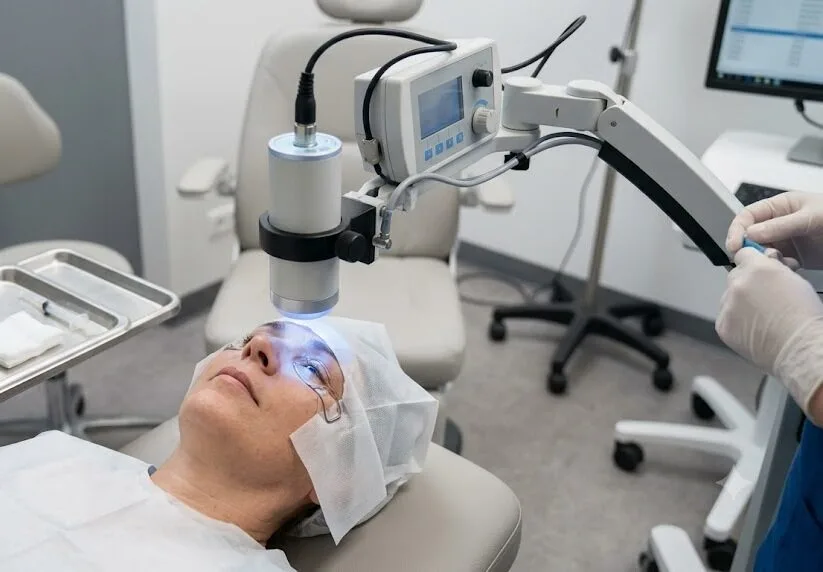
CXL eye surgery is a short procedure that strengthens a weak, thinning cornea so it stops bulging further.
For people with keratoconus, that can be the difference between keeping their own cornea and needing a transplant years down the line.
The name sounds bigger than the experience, though, and most patients arrive with the same worries: Will it hurt? How long is the downtime? Will it fix my blurry vision?
This guide answers those questions in plain language. You will see how the treatment works, who qualifies, what recovery looks like and where the science is heading, so you can have a better conversation with your eye surgeon.
Key Takeaways
- CXL eye surgery strengthens the cornea and aims to stop ectasia from getting worse.
- It is used for keratoconus and related conditions that thin and bulge the cornea.
- The long-standing method removes the surface layer, so the first few days can be uncomfortable.
- Vision often dips before it improves and usually settles in two to three months.
- Serious complications are rare, but lasting haze can affect a small group of patients.
- The goal is stability, not sharper eyesight, so you may still need glasses or contacts
What Is CXL Eye Surgery and How Does It Work?
Your cornea is the clear dome at the front of your eye. It keeps its shape because of tightly woven collagen fibres.
In keratoconus and similar conditions, those fibres weaken. The cornea slowly thins and pushes outward into a cone shape, which distorts vision and often brings frequent changes in your prescription.
Corneal cross-linking (CXL) creates new chemical bonds between those collagen fibres. The surgeon uses riboflavin, which is vitamin B2, together with ultraviolet A light. The riboflavin soaks up the light and sets off a reaction that ties the fibres together.
The result is a firmer, steadier cornea. Think of it as reinforcing a sagging structure rather than reshaping it.
Corneal collagen cross-linking is performed by an ophthalmologist and counts as an eye surgery, although only a small part of it is truly surgical. That part involves dealing with the thin surface layer of the cornea, called the epithelium, so the riboflavin can reach the deeper tissue.
Conditions Treated With Corneal Cross-Linking
Doctors recommend corneal collagen cross-linking when a corneal ectasia is progressing and putting your sight at risk. The usual reasons include:
- Ectasia that appears after LASIK, PRK or a corneal transplant, when the cornea weakens following surgery.
- Keratoconus, where the cornea slowly cones outward. It is the most frequent reason for treatment.
- Pellucid marginal degeneration, which thins the lower edge of the cornea.
- Terrien marginal degeneration, a rare thinning at the cornea’s outer edge.
- Keratoglobus, a rare condition in which the whole cornea thins. Specialists have reported using individualised settings here.
Researchers are also testing the technique in other situations, including some corneal infections. We cover that later in this article.
Keratoconus Signs and How Doctors Check for Progression
Early keratoconus can be easy to miss. Common signs include blurry or distorted vision, frequent changes in glasses prescriptions, glare, light sensitivity and streaking around lights at night.
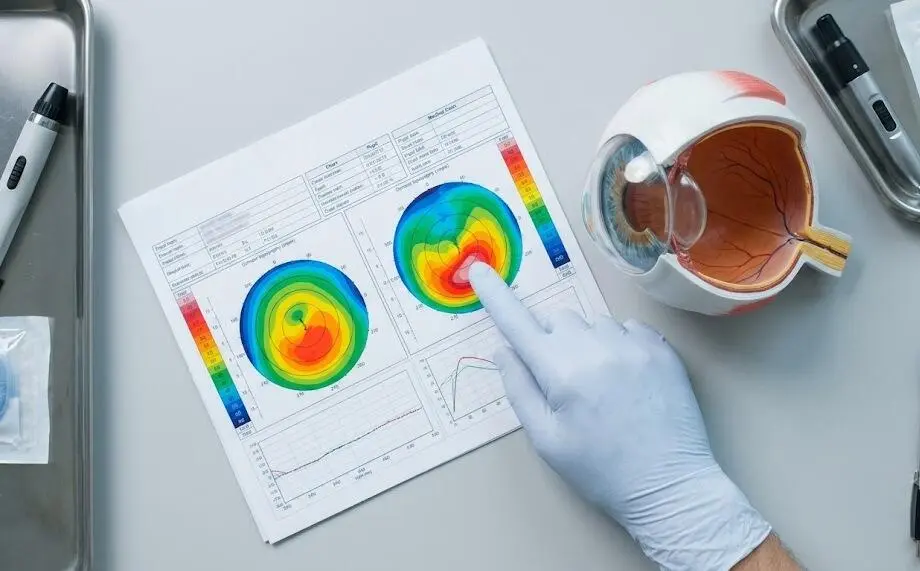
Diagnosis relies on scans that map the front and back surface of the cornea and measure its thickness. These are known as corneal topography and tomography.
For adults, specialists generally want proof that the condition is getting worse before they treat it. That usually means comparing scans taken weeks or months apart. Without that record, it is hard to tell whether the cornea is genuinely changing.
Who Is a Good Candidate for CXL Eye Surgery?
The best candidates are people whose cornea is clearly changing. Scans may show the shape shifting over time, or your vision may keep slipping despite new glasses.
Treating early matters. Stabilising a cornea with corneal cross-linking before much damage has happened can spare you more invasive treatment later.
Treatment may be unwise if your cornea is already extremely thin or heavily scarred or clouded, if you have had ocular herpes, or if you live with an autoimmune disease. Your surgeon will measure your corneal thickness and map its shape before the CXL procedure is planned.
Children and teenagers deserve a special mention. Keratoconus often moves faster in younger people, so specialists tend to treat them soon after progression is confirmed. If your child has been diagnosed, ask for a surgeon who regularly treats young patients.
Epi-Off vs Epi-On: Which Method Will You Get?
In the standard “epi-off” version of the CXL procedure, the surgeon removes the epithelium before applying riboflavin. It has the longest track record and has been FDA-approved in the United States since 2016.
The “epi-on” method leaves the surface layer in place. That means less discomfort and quicker healing. In October 2025, the FDA approved the first epi-on treatment in the US, called Epioxa, for keratoconus in people aged 13 and older.
There are two main ways to get riboflavin through an intact surface. One uses a mild electrical current, called iontophoresis. The other uses chemicals such as EDTA or trometamol that open small gaps between surface cells.
The catch is that an intact surface layer gets in the way twice: it limits how much oxygen reaches the tissue underneath, and it soaks up as much as 20 percent of the UV energy. In many earlier studies, that made epi-on less effective than epi-off. Newer protocols add extra oxygen and stronger UV settings to close the gap, and Epioxa is built on that approach.
| Feature | Epi-off | Epi-on |
| Surface layer | Removed or loosened | Left in place |
| Early discomfort | Often moderate to strong | Usually milder |
| Healing | About a week for the surface to regrow | Typically quicker |
| Evidence | Longest track record | Newer; older methods often showed a lower effect |
| Approval | FDA-approved since 2016 | FDA-approved in the US since October 2025 (Epioxa, ages 13+); varies elsewhere |
In the US, both methods now have FDA approval. Elsewhere, approvals differ from country to country and keep changing, so ask your surgeon which method is available and right for you.
What Happens During the CXL Procedure?
It is an outpatient treatment, so you go home the same day. You do not need special preparation, but you will need someone to drive you home.
Your eye is numbed with drops first. The surgeon then clears or loosens the thin surface layer, and riboflavin drops go on and are given about half an hour to soak into the tissue.
Next comes the UV light, aimed at the cornea for roughly another half hour. The surgeon finishes with antibiotic and steroid drops and covers the eye with a bandage lens to keep it protected.
From start to finish, the cross-linking treatment takes roughly an hour.
Those timings come from the original Dresden protocol, whose long duration is its main drawback. Accelerated protocols use stronger UV light for a shorter time, which makes the visit quicker. Some studies suggest the effect can be slightly different, so ask which version your surgeon uses.
Treatment is done on one eye at a time. If both eyes are progressing, your surgeon may stage the second eye a little later, and it can be repeated if the cornea keeps changing.
Recovery After CXL Eye Surgery: What to Expect
Most of the discomfort from this cross-linking treatment comes in the first few days. How much it hurts varies a lot, from barely noticeable to quite sharp, and prescription drops are given to ease it. If they fall short, tell your surgeon rather than waiting it out.
Expect the bandage lens to stay in for around seven days while the surface layer regrows. Steroid drops may carry on during that time.
During the first weeks, the eye may feel scratchy, look red or dry out, and bright light can be hard to tolerate. The cornea can also swell slightly, which adds to the blur.
Vision is often blurrier than it was before treatment at first, then improves as the surface heals. Expect it to steady over two to three months, which is the usual time to see whether new glasses or contacts are needed.
Some people develop corneal haze, a cloudy look to their vision, around three to six months after treatment. It is normally temporary, but published figures for lasting effects vary.
Cleveland Clinic says haze can become permanent in up to about one in ten people. An NHS patient leaflet puts the chance of some lasting vision loss from haze at about 3 percent. Differences in patient groups and in how haze is defined can explain gaps like this, so ask your surgeon about their own results.
First-Week Aftercare Checklist
- Use your drops exactly as directed, even when the eye feels better.
- Keep water out of your eye, so wash your face and hair carefully.
- Skip eye makeup until your surgeon says it is safe.
- Do not rub your eye, even if it feels gritty.
- Avoid driving until your follow-up check clears you.
- Keep every follow-up appointment.
Call your surgeon straight away if your vision suddenly changes or your pain is not controlled.
Benefits, Success Rate and Risks
The main benefit is simple. Cross-linking is the only treatment known to stop corneal ectasia from advancing. That protects against corneal hydrops, a sudden swelling of the cornea, and can keep a transplant off the table.
Success rates quoted for stopping progression sit around 95 percent. Most of that research comes from keratoconus, so figures for other types of ectasia are assumed to be similar.
The risks of corneal collagen cross-linking include infection, scarring and permanent corneal haze. All of these are considered rare, but they are the reasons you should choose an experienced surgeon and follow your aftercare plan closely.
Can CXL Eye Surgery Improve Vision?
Sometimes, but it is not promised. The core aim is to hold your cornea steady.
On average, standard treatment flattens the cornea by about one dioptre. The amount varies a lot from person to person and cannot be predicted in advance.
To get more from the treatment, surgeons have developed customised versions. Topography-guided CXL targets the steepest or thinnest areas with extra UV energy, and has produced flattening of roughly two to four dioptres in studies.
A newer approach called PACE removes a small patch of surface tissue over the cone before treatment. Early results show larger changes, but the evidence is still preliminary.
Some patients also have laser surface treatment on the same day or later, often alongside special contact lenses, to smooth the cornea and cut distortion. These combined protocols have shown lasting gains in vision and astigmatism, though they suit only selected eyes.
These are often grouped under the name “CXL-plus”. Besides surface laser, the options include corneal ring segments to reshape the cone, and phakic lens implants for high leftover nearsightedness once the cornea is stable. The aim is usable vision, not perfect 20/20 sight.
CXL vs Corneal Transplant: How They Differ
The two treatments solve different problems. Cross-linking strengthens your own cornea and is done in a clinic to stop the condition from advancing.
A corneal transplant replaces damaged tissue with donor tissue. It is a bigger operation with a longer recovery and a risk of rejection, so it is usually kept for advanced scarring or thinning.
That is why timing matters. Treating a progressing cornea early may help you avoid needing a transplant at all.
Newer Uses: Refractive CXL and Infection Treatment
Refractive CXL, sometimes called PiXL, applies a stronger UV dose in a custom pattern to reduce low levels of nearsightedness. It is usually done with the surface layer left on.
The early numbers are modest. In one small study of 14 eyes, the average improvement was about 0.7 dioptres at 12 months. Experts still describe the technique as an active research area, not an equal to LASIK, PRK or SMILE.
Two issues hold it back. The exact refractive effect is hard to predict, and nobody yet knows how treated corneas will behave decades later as they age. One leading surgeon has compared that uncertainty to what happened with radial keratotomy.
Combining CXL with laser vision correction in healthy eyes is another idea. Recent long-term studies suggest no extra benefit in vision or safety from doing it routinely.
A different use is called PACK-CXL, which treats serious corneal infections. The UV and riboflavin reaction damages bacteria, fungi and other germs. In a phase III trial, a single session worked about as well as standard antimicrobial treatment for bacterial, fungal and mixed infections.
Researchers are also exploring scleral cross-linking, which targets the white wall of the eye. The idea is to slow the stretching that drives high myopia. This is still at the research stage.
Looking further ahead, scientists are testing two-photon CXL, which uses a femtosecond laser to strengthen precise points inside the cornea. That is still experimental.
Cost and Insurance
Prices vary widely by country, clinic and method, and by whether the solution and UV device are approved locally.
Many insurers and public health systems cover treatment for documented, progressing keratoconus, while refractive uses are rarely covered. Ask the clinic for a written estimate and check whether your plan needs pre-approval.
Questions to Ask Your Surgeon Before Treatment
A good consultation before the CXL procedure should leave you clear on the plan. Consider asking:
- Is my cornea still changing, and how do you know?
- Are you recommending epi-off or epi-on, and why?
- How thick is my cornea, and does that affect my options?
- What results should I realistically expect for my vision?
- What does aftercare look like, and when will I be re-scanned?
- What will it cost, and is it covered by my insurance?
Frequently Asked Questions
What is CXL eye surgery used for?
It is mainly used to stop keratoconus and other corneal ectasias from progressing. By strengthening the collagen in the cornea, it helps protect the vision you still have and may delay or avoid a corneal transplant.
Is CXL eye surgery painful?
The procedure itself is done under numbing drops, so you should not feel pain during it. Afterwards, discomfort can range from slight to intense for a few days, especially with the epi-off method. Prescription drops help, and your surgeon can adjust them if they are not enough.
How long does it take to recover from CXL eye surgery?
The surface layer heals in about a week, when the bandage lens usually comes off. Vision generally stabilises over two to three months. Haze can appear later, between three and six months, and usually clears.
Is CXL eye surgery permanent?
CXL eye surgery is meant to give lasting stability, but nobody can promise it will last for life. In most people the cornea stays steady after treatment. In a small minority of eyes, the cornea keeps flattening slowly over time.
Experts still describe the long-term behaviour of cross-linked corneas as an unknown. That is why regular check-ups matter, even years after treatment.
What is the success rate of CXL eye surgery?
Cleveland Clinic cites a success rate of around 95 percent for halting progression, based mainly on keratoconus research. Individual outcomes depend on your condition, your cornea and the method used.
Bottom Line
CXL eye surgery will not give you perfect vision, but it can protect the vision you have by stopping a weakening cornea in its tracks. The earlier a progressing condition is treated, the more of your sight you are likely to keep.
If you or your child has been told that keratoconus is getting worse, book a corneal specialist and ask about treatment options, including whether epi-on is available and suitable. Epi-on is now FDA-approved in the US, but epi-off still has the longest track record.