
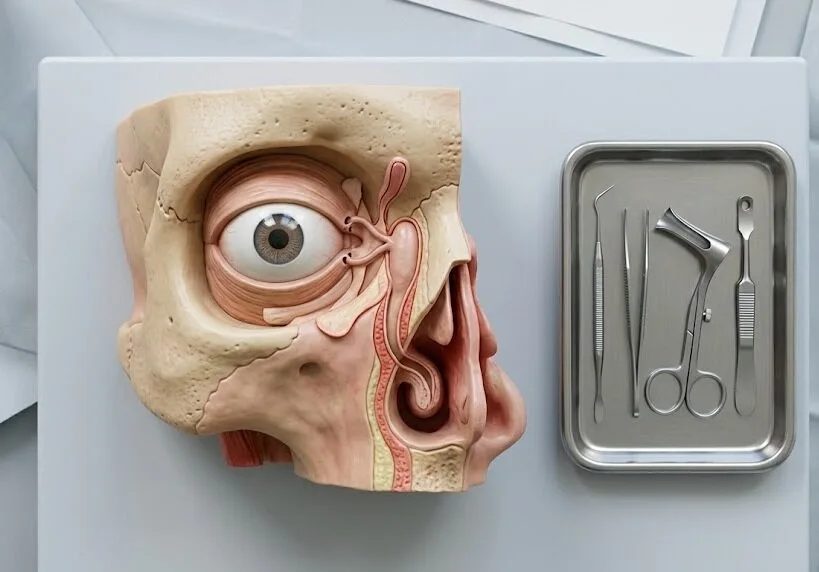
DCR eye surgery gives your tears a new way out when the natural drainage channel is blocked.
If your eye waters constantly, keeps getting sticky or infected, or leaves you dabbing your cheek all day, a blocked tear duct could be the reason. When simpler treatments fail, this operation is often the lasting fix.
This guide explains what the surgery involves, the different ways it is done, what recovery looks like and how well it works. It should help you ask sharper questions when you meet your surgeon.
Key Takeaways
- DCR eye surgery creates a new drainage route from the tear sac into the nose.
- It is mainly used for a blocked or narrowed tear duct that causes watery eyes or repeat infections.
- The operation can be done through the skin or through the nose with a camera.
- Success rates are high, usually well above 80 percent and often above 90 percent.
- Healing takes several weeks, and you must not blow your nose in the early days.
- Surgeons often try simpler options first, especially for mild symptoms and for babies.
What Is DCR Eye Surgery and How Does It Work?
Your eyes make tears all day. After they wash across the surface, the tears drain through tiny openings in the eyelids and travel down a narrow channel into the nose. That is why your nose runs when you cry.
If that channel is narrowed or blocked, tears have nowhere to go. They spill over the eyelid, the sac that collects them can become infected, and the eye may stay irritated.
The full medical name is dacryocystorhinostomy, usually shortened to DCR. It is also called tear duct surgery. The surgeon makes a fresh opening between the tear sac and the inside of the nose, so tears can bypass the blockage completely.
Think of it as building a detour around a closed road rather than trying to clear the road itself.
Signs of a Blocked Tear Duct
Not every watery eye needs surgery. Surgeons usually consider it when the symptoms are persistent or keep returning. Typical signs include:
- Constant tearing, even in a calm, warm room.
- Sticky or mucus-like discharge from the eye.
- Repeated red, irritated eyes that look like conjunctivitis.
- A tender swelling in the corner of the eye beside the nose, which can point to an infected tear sac.
- Blurry vision from tears pooling on the surface.
A complete or near-complete blockage is the usual reason a surgeon recommends an operation rather than waiting.
Why Do Tear Ducts Block?
Most blockages build up slowly. The drainage channel can narrow with age, after an infection or long-term inflammation, or following an injury or earlier surgery on the eyelids or nose. Small stones can also form inside the tear sac. Some babies are simply born with the channel unopened.
Watery eyes have other causes too. Dry eye, allergies and eyelid problems, such as lids that turn in or out, can all make eyes water, and they are treated very differently. That is why a proper examination matters before anyone books an operation.
How Doctors Confirm the Blockage Before Surgery
Surgeons want to be sure the blockage sits at the right spot, because the operation only helps if the problem is in the tear sac or the duct below it.
A simple flushing test is the most common check. Saline is gently passed into the drainage system. If fluid backs up through the opposite eyelid opening, the blockage is usually further down the duct, which is where this surgery works best.
If fluid comes back out of the same opening it went into, the blockage is nearer the eyelid. In that case, this operation is generally not the right choice.
Doctors may also look at how long a drop of dye stays on the eye surface, and many perform a look inside the nose with a thin camera. That nasal check can reveal a crooked nasal septum or other issues that need planning before surgery.
Scans such as CT, MRI or ultrasound are not needed for most patients. They are mainly used when there is a firm lump in the corner of the eye, to rule out something other than a swollen tear sac.
Who Needs DCR Eye Surgery?
Most adults who need it have a narrowed duct that developed over time. Others have small stones in the sac, or repeat infections that keep coming back.
Children can need it too. Many babies are born with a blocked duct, and most of these cases are handled with watchful waiting or simple probing first. Surgery is generally kept for those whose blockage persists after those steps.
Adults over 65 are also a common group, as the drainage channel can narrow with age.
You also need to be fit enough for anaesthesia. And if the inside of your nose is hard to reach, your surgeon may switch to the external route even when a camera approach was the original plan.
Options to Try Before Tear Duct Surgery
Surgery is not always the first answer. Depending on your symptoms, your doctor may suggest:
- Observation, if the watering is only a mild nuisance.
- Medicated drops, which may help when inflammation is part of the problem.
- Soft silicone tubes placed in the natural drainage system and left for a few months.
- Balloon widening or probing, mainly in children.
Another procedure, called conjunctivodacryocystorhinostomy (CDCR), is usually kept for cases where DCR did not work. It uses a small glass tube to carry tears from the corner of the eye straight into the nose.
External vs Endonasal DCR: Which Approach Is Used?
There are three main ways to perform the surgery. Your anatomy, your surgeon’s experience and your preferences all affect the choice.
| Approach | How it is done | Key points |
| External | Small cut in the skin beside the nose, then a new opening through the thin bone | Longest track record, success usually above 90 percent, a small scar is possible |
| Endonasal | Camera and instruments through the nostril, no skin cut | No facial scar and often quicker, but results depend heavily on the surgeon |
| Laser-assisted | Laser passed through the eyelid opening to make the new passage | Very quick, but reported success is lower, around 80 to 85 percent |
The external route is still seen by many specialists as the gold standard because it has been used for so long. Its drawbacks are a longer operation and a thin scar, although surgeons can place the cut to make it hard to see.
The endonasal route has grown popular because there is no skin incision. It needs special equipment and a steep learning curve, which helps explain why success reports vary between surgeons. Some experienced teams report results as good as the external method.
Laser-assisted versions have produced weaker results in studies, so many surgeons no longer use a laser for the endonasal route.
Getting Ready for Dacryocystorhinostomy
You will first meet an eye surgeon, an ear, nose and throat (ENT) surgeon, or both. In many hospitals the two specialties work together on the operation.
Before the DCR procedure, expect some health checks to confirm you are fit for anaesthesia. General anaesthesia is the usual choice, but some surgeons offer local anaesthetic with sedation to suitable patients. Either way, you will speak with the anaesthetist beforehand.
Your team will give written instructions on:
- Which medicines to pause, and for how long.
- Washing your face with a special soap, often the night before, to lower infection risk.
- When to stop eating and drinking before the operation.
Follow the fasting rules strictly. Anaesthesia on a full stomach can lead to serious breathing problems.
What Happens During the DCR Procedure?
You are put to sleep or heavily sedated, and a drip is placed in your arm or hand so the anaesthetist can give fluids and medicines.
In the external method, the surgeon makes a small cut on the skin between the nose and the eye. A window is opened in the thin bone behind the tear sac, and the sac is joined to the lining of the nose. A soft tube may be threaded through to keep the new passage open while it heals. The skin is then stitched.
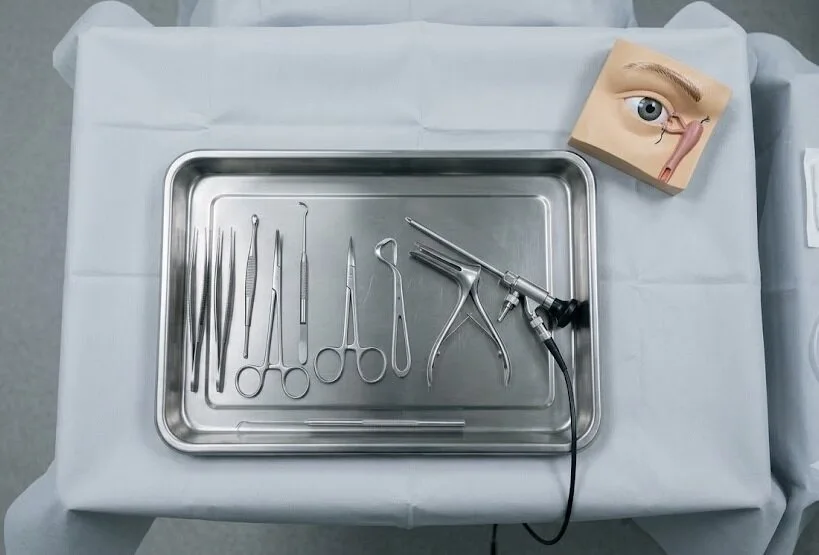
In the endonasal method, the surgeon works through the nostril using a camera. The bone is opened from inside the nose and the sac is opened to match. Many surgeons also pass a soft tube through the eyelid openings, and sometimes use soft packing to limit bleeding.
For a first-time operation, the external method often takes around 45 to 50 minutes, while the endonasal method takes about 30. Repeat operations are usually faster. Most people go home the same day.
Recovery After DCR Eye Surgery: What to Expect
Tear duct surgery is usually an outpatient procedure. After the DCR procedure, once you wake up, the team watches you for a short time and then sends you home with medicines, which may include pain relief, antibiotics, anti-inflammatory drops and decongestants.
The first week matters most. Expect some bruising and puffiness near the eye or nose, which tends to fade over a few weeks. Cold compresses in the first couple of days can help, and light activity is best at first.
Your surgeon will usually see you about a week after surgery. After external surgery, this is when stitches come out. After endonasal surgery, you may be given a saline nose rinse to use as directed.
Soft tubes, if placed, are removed in clinic. The timing varies, from about a month for some endonasal cases to several months for external cases.
Complete healing takes at least several weeks because the new opening goes through bone. In some people it takes a few months.
| When | What to expect |
| First 24 hours | A bandage may cover the eye and side of the nose. Mild nose bleeding is common. |
| Days 2 to 7 | Bruising and puffiness. Drops and nasal spray as prescribed. No nose blowing. |
| Weeks 1 to 2 | Follow-up visit. Stitches come out after external surgery. Swelling mostly settles. |
| Around 1 month | Tubes may be removed after endonasal surgery. Watering often improves. |
| Months 3 to 6 | Healing finishes and the final result is clear. Some surgeons book a final review. |
Aftercare Checklist
- Do not blow your nose in the early days. Surgeons give different timings, from a few days to at least a week, so follow your own surgeon’s advice.
- Take every medicine exactly as prescribed.
- Avoid swimming pools, hot tubs and steamy spa water for about 10 days, unless your surgeon says otherwise.
- Use any nasal spray or saline rinse as instructed, and do not swap in other products.
- Build back to your normal exercise gradually. Some surgeons allow it from around five days.
- Keep every follow-up appointment.
Practical Tips for Day One and Beyond
- Arrange for someone to take you home. After a general anaesthetic, avoid driving for about 48 hours.
- Skip alcohol and very hot food or drink for the first 24 hours.
- Expect some nosebleeds and bruising. Both are common.
- Do not rub your eye. Clean any stickiness gently with cotton wool and cooled boiled water.
- The eye may still water for a few weeks, or until the tubes come out, so do not judge the result too early.
- Some people feel air moving across the eye when they blow their nose. Lightly pressing a finger on the inner corner of the eye can ease it once you are allowed to blow.
Call your surgeon if tearing changes on the operated side, or if you notice fever, spreading swelling or warmth, or bleeding that will not stop.
Success Rate and Risks of DCR Eye Surgery
This is one of the more reliable operations in eye surgery. For external surgery, figures of roughly 85 to 99 percent are reported, and most series show success above 90 percent.
For the endonasal route, one summary gives a range of about 91 to 96 percent. Some individual studies report lower numbers, which is why the surgeon’s experience with the chosen technique matters.
Put plainly, several hospital leaflets say that around one in ten eyes keep watering after surgery. That is why follow-up visits matter.
Like any surgery, the DCR procedure carries some risk. The general ones are pain, bleeding and infection. Problems more specific to this operation include:
- Scar tissue or shifting tissue that narrows the new passage.
- A tube slipping out of place.
- A wound that reopens or a visible skin scar, after external surgery.
- Problems with the bone healing and closing over, after endonasal surgery.
A leak of the fluid that surrounds the brain is very rare, but serious. Warning signs are a constant runny nose or fluid trickling down the back of the throat, and it needs urgent attention.
If the Surgery Does Not Work
Sometimes the new opening closes as it heals, and the tearing returns. Surgeons then discuss a repeat DCR, which is often quicker than the first operation.
Some surgeons apply a medicine called mitomycin C to the new opening, mostly in repeat surgery. Studies on how well it works are mixed, so it is not used by everyone.
If repeat surgery fails, the glass-tube option mentioned earlier may be offered as a last resort.
Cost and Insurance
The cost varies widely by country, hospital, surgeon and approach. The anaesthesia, hospital stay and any tubes all affect the final bill.
Where the operation treats repeat infections or ongoing symptoms, many insurers and public health systems cover it, but rules differ. Ask for a written estimate and check whether pre-approval is needed.
Questions to Ask Your Surgeon
Going into the consultation with a short list helps you leave with a clear plan. Consider asking:
- Where exactly is my blockage, and how was it confirmed?
- Do you recommend an external or endonasal approach for me, and why?
- How many of these operations do you perform, and what are your own success rates?
- Will you place a tube, and when will it come out?
- Which anaesthesia will I have, and can I go home the same day?
- What happens if the tearing comes back?
Frequently Asked Questions
Is DCR eye surgery painful?
You will be asleep or deeply sedated during the operation, so you should not feel it. Afterwards you may have some soreness, bruising and a blocked-up nose. Your team will prescribe medicines to keep you comfortable, and you should tell them if the pain is not controlled.
What is the recovery time for DCR eye surgery?
You will see your surgeon about a week afterwards. Full healing generally takes several weeks and can stretch to a few months, because the new opening passes through bone.
How successful is DCR eye surgery, and can the blockage come back?
Reported success for external surgery ranges from roughly 85 to 99 percent. Endonasal surgery is reported at about 91 to 96 percent in one summary, though results vary more between surgeons. In around one in ten eyes the watering continues or returns, which is why follow-up matters and repeat surgery is sometimes needed.
Can DCR eye surgery be done under local anaesthetic?
In some cases, yes. General anaesthesia is the usual choice, but some surgeons offer local anaesthetic with sedation. Your surgeon will advise based on your health, the approach and your preference.
Will I have a scar after DCR eye surgery?
External surgery leaves a small skin scar beside the nose. Most scars fade well over time, though a faint mark can remain. Endonasal surgery avoids a skin cut, so there is no facial scar.
Bottom Line
DCR eye surgery will not repair the old duct, but it gives your tears a dependable new way out. For most people with a blocked tear duct, that means less watering, fewer infections and a clearer, more comfortable eye.
If your symptoms keep returning, see an eye specialist who can confirm where the blockage is. They can guide you toward the right approach, whether that is waiting, a simpler treatment or surgery.