
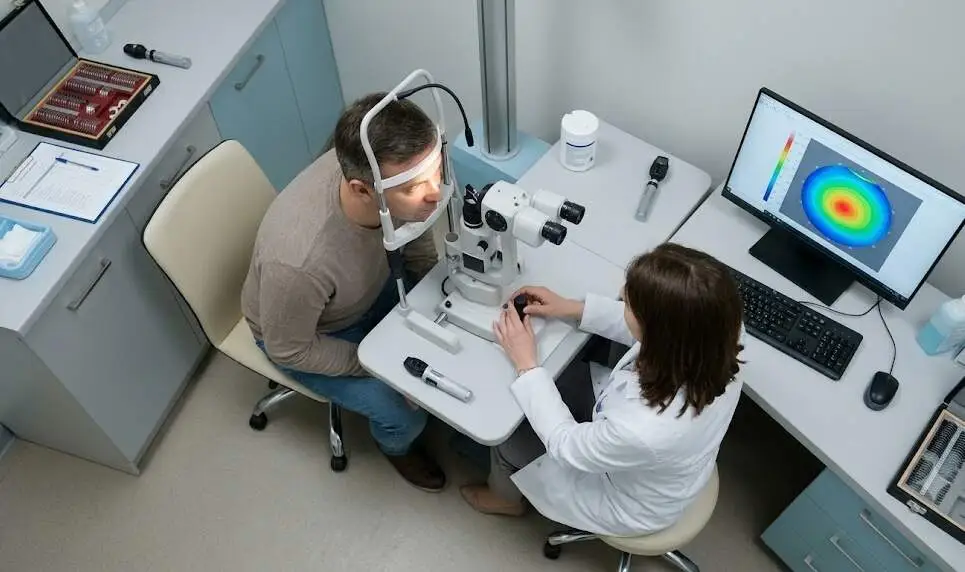
Eye surgery for thin cornea is an option for plenty of patients, even when LASIK is ruled out. What counts is fitting the procedure to the shape, strength and thickness of your own cornea rather than to one number on a scan. In this guide you’ll learn why thickness matters, how surgeons assess risk, and which choices, ranging from PRK and SMILE to implantable lenses, usually work best for thinner corneas.
Yes, plenty of people with thin corneas can still get their vision corrected. Surgeons generally steer away from LASIK and choose a flap-free surface laser (PRK or TransPRK), a carefully selected SMILE, PRK combined with cross-linking, or an implantable lens (ICL). The choice rests on corneal mapping, age, prescription and how much tissue would remain, rather than thickness by itself.
Key Takeaways
- Vision correction for thin corneas is frequently still achievable, although a thin cornea limits which procedures are safe.
- Instead of leaning on a single cut-off, surgeons consider thickness alongside corneal shape, age, prescription and the amount of tissue that would be left.
- PRK or TransPRK, which are flap-free surface lasers, and SMILE for suitable eyes are popular choices in laser eye surgery for thin corneas.
- Because implantable lenses don’t touch the cornea, they can work for very thin corneas or strong prescriptions.
- Irregular corneal mapping often concerns surgeons more than thinness itself, since it can point to early keratoconus.
- Careful planning is mainly meant to prevent ectasia, a gradual bulging of a weakened cornea.
What Counts as a Thin Cornea?
A typical central cornea measures roughly half a millimetre, averaging about 540 to 550 microns. Anything well under that counts as thin. Corneas below about 500 microns are generally viewed as thin and those below about 480 microns as very thin, the point at which many surgeons begin to look more closely.
A thin cornea isn’t necessarily an unhealthy one. Some people are simply born with slimmer corneas. In other cases the thinning reflects keratoconus or comes from an earlier eye procedure that already took away tissue.
Eye rubbing, which is often tied to allergies, along with keratoconus and previous laser surgery, are the usual causes. Thin corneas don’t get thicker with age, so stop rubbing your eyes, since doing so can weaken the cornea further.
This distinction is why a thorough assessment counts for more than the label when you are weighing eye surgery for thin cornea.
Why Thickness Matters in Eye Surgery for Thin Cornea
Laser vision correction adjusts your focus by removing a very small amount of corneal tissue. The tissue left behind has to stay strong enough to keep its shape against the pressure within the eye.
The remaining layer is known to surgeons as the residual stromal bed. When it is left too thin, or when the cornea was weak to begin with, the tissue can slowly bulge forward. This condition, called ectasia, produces blurred and distorted vision and may require further treatment.
Ectasia is uncommon, which is precisely why screening is so thorough. Any plan for eye surgery for thin cornea aims to keep well away from that risk.
How Surgeons Decide If You Are a Candidate
Many clinics long relied on a straightforward rule of leaving at least 250 microns of residual bed. Later research found that rule too crude. Ectasia has occurred in eyes above that figure, and some thinner eyes have done well, so no universal safe minimum exists. A CRSToday panel of several corneal specialists described aiming for about 275 to 280 microns or more in higher-risk eyes.
These days, a surgeon planning eye surgery for thin cornea bases the decision on several inputs:
- Corneal mapping (topography or tomography) to detect early keratoconus or an irregular shape.
- Pachymetry, which gauges thickness across the whole cornea rather than only at the centre.
- Age, since younger eyes face a greater risk of ectasia.
- Prescription strength, because stronger prescriptions mean more tissue is removed.
- The planned depth of the flap or cap and the amount of tissue the laser would remove.
- Corneal biomechanics testing where it’s available, plus a prescription that has stayed stable.
Scoring tools combine these factors. In one validation study, the Ectasia Risk Score System identified 92 percent of the eyes that went on to develop ectasia, compared with 50 percent for older screens built on abnormal topography or a 250-micron bed.
Experts continue to debate how much thickness matters by itself. Some contend it isn’t an independent risk when mapping appears normal, whereas others move away from LASIK at a lower threshold. A debate in the American Academy of Ophthalmology’s EyeNet shows how seriously the field takes both positions.
Treat any quoted “minimum thickness” with caution, and ask your surgeon what truly drives their decision.
Can LASIK Work with Thin Corneas?
Sometimes. Provided your mapping is normal, you aren’t especially young and the planned residual bed is comfortably sufficient, some surgeons will still offer LASIK. They may create the flap with a femtosecond laser and measure thickness during surgery to make sure it matches the plan.
Still, LASIK involves cutting a flap and removing tissue under it. When the cornea is borderline or the mapping looks unusual, many surgeons favor a flap-free approach to laser eye surgery for thin corneas.
Newer planning tools, including wavefront-guided and topography-guided treatments, sharpen precision. They don’t alter how much tissue your cornea can safely give up.
PRK and TransPRK: Flap-Free Laser Options
With PRK, the surgeon takes off the thin surface layer (the epithelium), reshapes the tissue beneath with the laser, and allows the surface to grow back. TransPRK accomplishes the same thing in one laser step. No flap is made, so none of the stromal bed is used up on one and more of the cornea’s depth remains.
For that reason, surface treatments are a frequent choice for laser eye surgery for thin corneas. Avoiding flap complications also benefits people who play contact sports or have physically demanding jobs.
What you give up is comfort and speed. Plan for a few days of discomfort, a bandage contact lens while the surface heals, and slower visual recovery than with LASIK. A small chance of corneal haze also exists.
SMILE for Thin Corneas: A Case-by-Case Choice
SMILE takes out a small disc of tissue through a tiny incision and creates no flap. More of the cornea’s stronger front layer stays in place, which makes it suitable for some thinner eyes. Early studies reported stable results even when the planned bed was around 280 to 300 microns.
That doesn’t make it automatically gentler. One matched comparison found that the residual bed was the main factor in lost stiffness, and in that study SMILE left a smaller bed (about 348 microns) than PRK (about 427). Ask your surgeon what residual thickness they would plan, and whether SMILE is approved for your prescription in your country.
PRK Plus Cross-Linking for Borderline Corneas
Corneal cross-linking stiffens the cornea using riboflavin drops and ultraviolet light. It is the standard treatment for keratoconus, and some surgeons combine it with PRK when a cornea appears borderline.
This is a specialist option, so ask how frequently your surgeon performs it.
Implantable Lenses: Vision Correction for Thin Corneas Without Touching the Cornea
Implantable collamer lenses (ICL) and similar phakic lenses are placed inside the eye, directly in front of your natural lens. They don’t reshape the cornea, so its thickness limits them far less. They can also correct higher prescriptions than lasers handle comfortably.
They do carry risks. Suitability depends on the space inside your eye and on the health of the cells lining the back of the cornea. Because this is an internal operation, possible complications include raised eye pressure, later cataract and, rarely, infection.
A practical benefit is that the lens can usually be removed or swapped if your needs change.
Other Routes: Lens Exchange, Glasses and Contacts
People in their late forties or older, or those already developing cataracts, may consider refractive lens exchange, which replaces the natural lens and leaves the cornea alone. It is a larger operation, so most younger people don’t start there.
Glasses and contact lenses are still safe options when surgery isn’t suitable. With irregular corneas, specialty contact lenses can sometimes deliver sharper vision than glasses.
Comparing Your Options at a Glance
| Procedure | Flap or cut | Effect on the cornea | Often considered when | Main trade-off |
| LASIK | Flap | Tissue removed beneath a flap | Mapping is normal and the bed stays comfortably thick | Least margin for thin eyes |
| PRK / TransPRK | None | Surface treatment keeps a thicker bed | Cornea is thin or borderline | Slower, more uncomfortable recovery |
| SMILE | Small incision, no flap | Disc of tissue removed | Selected thin corneas | Residual bed may be smaller; case by case |
| PRK plus cross-linking | None | Reshaped, then stiffened | Cornea of borderline strength | Specialist treatment |
| ICL | Incision into the eye | Cornea untouched | Very thin corneas or high prescriptions | Internal eye surgery risks |
Other Options: LASEK, Epi-LASIK and Ortho-K
LASEK and epi-LASIK are surface procedures similar to PRK. Rather than cutting a stromal flap, the surgeon moves the epithelium aside, so more of the cornea’s depth is preserved. Ortho-K is non-surgical: specially designed lenses worn overnight reshape the cornea temporarily.

Recovery and Risks to Expect
How you recover depends on the procedure. After surface treatments the surface typically regrows within three to four days, and driving may be possible after about a week. LASIK and SMILE generally give faster visual recovery, and lens implants usually feel comfortable within a few days.
Risks worth discussing include:
- Ectasia: uncommon, and the chief reason thin corneas call for careful selection.
- Haze following surface treatment, and dry eye after most laser procedures.
- Glare, halos and changes in night vision, which are usually temporary.
- Under- or over-correction, which may call for a touch-up.
- With lens implants: raised eye pressure, cataract and infection.
Questions to Ask Before Eye Surgery for Thin Cornea
- What do my thickness and mapping results show, and what residual bed would you plan?
- Which procedure would you recommend for my cornea, and why not the others?
- How do you screen for early keratoconus?
- Would cross-linking or an implantable lens be a better fit for me?
- What would you do if I needed an enhancement later?
If you are offered just one option, think about getting a second opinion from a corneal specialist.
How Much Does Eye Surgery for Thin Cornea Cost?
The price depends on the procedure, your surgeon’s experience, the technology used and where you live. Surface treatments such as PRK generally cost less per eye than implantable lenses (ICL), which cost more because they involve a premium lens and internal surgery. Request a written quote covering pre-op testing, the procedure itself and follow-up visits.
Frequently Asked Questions
What is the best eye surgery for thin cornea?
No single choice is best. PRK or TransPRK and implantable lenses are common options, while SMILE suits selected eyes. The right answer rests on your corneal mapping, age and prescription.
Can you have LASIK with thin corneas?
Sometimes, as long as mapping is normal and enough tissue would remain. Many surgeons still lean toward a flap-free option for thin or borderline corneas.
How thin is too thin for laser eye surgery?
There is no universal number. The old 250-micron rule is now seen as too simplistic, and surgeons consider residual bed, mapping, age and prescription together.
Does a thin cornea mean I have keratoconus?
Not necessarily. Plenty of thin corneas are healthy, but surgeons examine mapping closely because early keratoconus can be hidden behind normal-looking thickness.
Is eye surgery for thin cornea safe?
Outcomes are generally good with careful screening and the right procedure. Risks such as ectasia, haze and dry eye remain, which is why a thorough assessment comes first.
Can I have eye surgery with a thin cornea and dry eye?
Often yes, though the choice matters. LASIK tends to make dry eye worse, whereas ICL leaves the cornea unreshaped, so it is often considered for people with both conditions. Your surgeon should treat dry eye before any laser procedure.
What does eye surgery for thin cornea cost?
No single price applies. Costs differ by procedure and clinic, and surface laser treatments generally cost less than implantable lenses. Ask for an itemized quote before you book.
Bottom Line
Eye surgery for thin cornea isn’t an automatic no. Think of it as a matching exercise in which the best plan protects your cornea’s strength first and pursues sharp vision second.
Vision correction for thin corneas works best when you have detailed corneal mapping done, compare flap-free laser against implantable lenses, and pick a surgeon who can explain the reasoning behind their recommendation.