
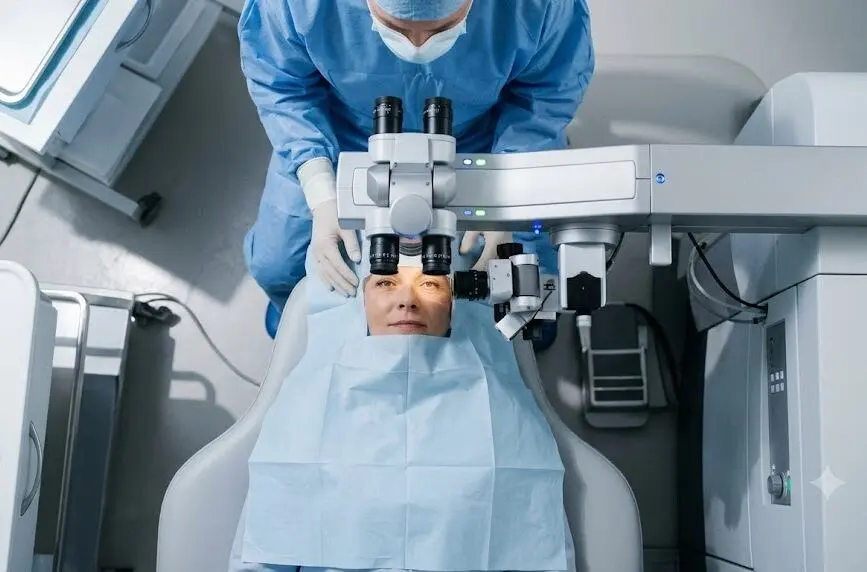
For many people in their forties and fifties, Presbyond eye surgery offers an option when close-up tasks become harder and reading menus means holding them farther away. The laser changes the shape of the cornea so the eyes can contribute to distance, computer and near vision together, often reducing the need for spectacles. This guide explains the procedure, suitable candidates, recovery and limitations to help you prepare for a consultation.
Presbyond is a LASIK-based procedure designed to address near-vision changes associated with age. One eye is optimised mainly for distance and the other for closer tasks; the brain learns to combine the images. It is commonly considered by people aged around 40–60 who have healthy eyes, and many find they need reading glasses less often afterwards.
Key Takeaways
- Presbyond uses LASIK-based laser blended vision to address age-related difficulty seeing nearby objects as well as distance vision.
- The surgeon prioritises distance in one eye and near vision in the other; the blend zone helps the brain bring both views together.
- Suitable candidates generally have healthy eyes, a stable prescription and no significant cataract. Many are between about 40 and 60.
- Reading glasses may be needed much less after treatment, although small print, low lighting or extended reading can still be challenging.
- Temporary dry eye, glare and halos can occur. Adjusting to the blended images may take several weeks or, for some people, months.
- Because presbyopia progresses as people age, vision may change later and cataracts can still develop.
What Is Presbyopia, and Why Does It Happen?
Usually during the early or middle forties, the eye’s natural lens becomes less flexible. It can no longer alter its shape quickly enough to focus on close objects. This age-related change is called presbyopia and eventually affects nearly everyone, including people who have never needed glasses.
Common clues include moving a phone farther away to read it, struggling with small lettering, feeling eye fatigue after prolonged screen use and keeping reading glasses close at hand.
The National Eye Institute identifies presbyopia as a normal age-related change, typically assessed during a comprehensive eye examination. This is one reason routine eye checks become more important after age 40.
Presbyopia can be managed with spectacles, contact lenses or selected procedures. Presbyond changes the cornea—the transparent surface at the front of the eye—rather than correcting the natural lens as it stiffens.
How Presbyond Eye Surgery Works
Presbyond eye surgery is a laser treatment profile used on the ZEISS MEL 90 excimer platform. The basic steps resemble LASIK: the surgeon makes a thin flap in the cornea, reshapes the tissue underneath with a laser and returns the flap to position. The distinguishing feature is the way the cornea is shaped.
The eyes are not corrected to exactly the same focus. The dominant eye is generally aimed at distance, while the other is adjusted toward nearer vision. The difference is kept relatively modest—up to approximately 1.5 dioptres.
A non-linear aspheric laser profile also manages spherical aberration within a planned range. This increases depth of focus, giving each eye a broader range in which objects appear clear. Adaptive-optics research has reported a possible increase of about 2 dioptres in depth of focus within that range.
The area where the two eyes’ visual ranges overlap is known as the blend zone. The brain combines the images, helping near and distant vision feel connected rather than separate.
Laser Blended Vision vs Traditional Monovision
Conventional monovision also assigns one eye to distance and the other to near, but it usually creates a greater difference between the eyes. Some people struggle to adjust to that gap, which may affect depth judgement or leave intermediate distances less clear.
Laser blended vision aims to reduce the difference by expanding the depth of focus in each eye. Clinic materials referencing published research report adaptation of about 97%, versus approximately 59–67% with traditional monovision. These numbers are not a personal prediction, so ask your surgeon about outcomes in their own practice.
Treatment planning takes account of which eye is dominant, the amount of imbalance a person can comfortably tolerate and spherical aberration across the entire optical system—not only the cornea. Some clinics can demonstrate blended vision in advance to help patients understand the likely trade-offs.
Who Is a Good Candidate for Presbyond Eye Surgery?
Suitability depends on a person’s age, prescription and overall eye condition. Only a comprehensive assessment can determine whether the procedure is appropriate, but surgeons commonly consider the following factors:
- Age of about 40 to 60, with noticeable difficulty reading or focusing up close.
- Healthy corneas of adequate thickness, with no keratoconus and no significant dry eye.
- A prescription that has stayed stable for roughly a year.
- No meaningful cataract. If the natural lens is already clouding, lens-based surgery usually makes more sense.
- Realistic expectations and a willingness to accept some trade-offs.
The treatment may be designed for presbyopia eye surgery alongside myopia, hyperopia or mild astigmatism. ZEISS gives an approximate spherical range of -8 to +2 dioptres, although the limits used depend on the laser system and local guidance. Presbyopia and hyperopia are not the same: presbyopia results from age-related changes in the lens, whereas hyperopia relates to the eye’s shape. Both can affect near vision and may occur together.
Daily activities can influence the decision as well. Frequent night driving, precision work at close range or employment with a higher risk of eye injury should be discussed, since the flap created during LASIK-based surgery needs protection.
What to Expect Before, During and After Presbyond Eye Surgery
The pre-operative work-up is detailed. It usually checks corneal shape and thickness, tear-film health, prescription and eye dominance, as well as how comfortably you manage different focus in each eye. Follow the clinic’s advice on when to stop wearing contact lenses before testing.
Some providers offer a contact-lens trial to give you a sense of blended vision and its compromises before surgery. Eye drops may be used to widen your pupils during assessment, so plan for someone to drive you or use public transport afterwards.
On the treatment day, anaesthetic drops are used to reduce discomfort. The surgeon creates a corneal flap, reshapes the underlying tissue with a laser and places the flap back. One published patient study describes about 5–10 minutes per eye and roughly 10–15 minutes for the procedure overall.
A scratchy sensation or watery eyes can occur after surgery. Your team will prescribe drops, and many patients resume usual activities within one or two days. Sight may vary during healing; for a short period, you may be told to avoid swimming and vigorous exercise.
Adapting to the new visual balance—known as neuroadaptation—takes longer than the laser treatment itself. This adjustment may happen over weeks, but can take a few months. Attend all scheduled reviews so the surgeon can identify and address concerns early.
What Do the Results Look Like?
Research into laser treatment for presbyopia eye surgery has reported encouraging results, although many studies come from specialist centres. A 2023 Journal of Refractive Surgery study followed commercial and military pilots, whose work requires clear sight at multiple distances. At the 12-month mark, every participant achieved 20/20 distance vision; 78% also reached near vision equivalent to 20/20. The remaining participants could read J2 print.
In a smaller retrospective review involving 20 patients, outcomes at one year were reported as safe and effective. Overall satisfaction was high, though some participants described mild night-vision symptoms or somewhat reduced sharpness for close work.
A large share of published reports follow patients for about a year. One retrospective study published in 2026 tracked 100 people for at least 15 months and described itself as the longest follow-up evaluation of Presbyond at that time. Ask your surgeon how such longer-term evidence applies to your situation.
Patient-reported satisfaction has also been favourable. In a cross-sectional study in Taif, Saudi Arabia, 80.9% of participants said their quality of life improved after the procedure. Because these results rely on patients’ own reports, they should be viewed as an indication rather than a promise.
Outcomes are not identical for everyone. Many patients substantially reduce their use of reading glasses, but perfect vision for every activity and lighting condition should not be expected.

Risks and Limitations of Presbyond Eye Surgery
- Dry eye: usually temporary, and often eased with preservative-free lubricating drops.
- Glare and halos: most noticeable at night early on, and they tend to fade as healing continues.
- Under- or over-correction: some patients need an enhancement. Some clinics quote a rate of around 6 to 10 percent, so ask about theirs.
- Difficulty adapting: a small group never feels comfortable with blended vision.
- Ongoing ageing: the natural lens keeps changing, so near vision can drift and cataracts may still arrive later.
- Flap-related risks: as with any LASIK-type procedure, the flap needs protection while it heals.
Because laser treatment removes some corneal tissue, the change cannot simply be reversed. Make sure you understand the implications before choosing surgery.
Other Ways to Manage Presbyopia
Presbyond is one possible approach to presbyopia, but it is not the only one. The most suitable option depends on your eye health, needs and preferences.
- Reading glasses, progressives or multifocal contact lenses: no surgical risk, but you stay dependent on them.
- Presbyopia eye drops: a newer, non-surgical option in some countries, used daily and effective only for a limited time.
- Monovision LASIK: simpler than blended vision, but with a larger difference between the eyes.
- Other corneal laser profiles: PresbyMAX and Supracor also reshape the cornea to add near focus, and published reviews compare them with Presbyond. Ask which profile your clinic uses and why.
- Refractive lens exchange: replaces the natural lens with a presbyopia-correcting implant. It can suit people with early cataracts or higher prescriptions, but it is intraocular surgery.
| Option | How it works | Main upside | Main trade-off |
| Reading glasses or contact lenses | External lenses add near focus | No surgical risk | You stay dependent on them |
| Presbyond | Laser reshapes each eye differently to blend near and far | Keeps your natural lens; quick procedure | Adaptation period; cannot be undone |
| Monovision LASIK | One eye set for distance, one for near | Simpler planning | Larger gap between the eyes; harder to tolerate |
| Refractive lens exchange | Natural lens replaced with an implant | Also removes future cataract risk | Intraocular surgery with its own risks |
Questions Worth Asking Your Surgeon
- Is Presbyond right for my eyes and my work?
- Will you test eye dominance and tolerance for a difference between the eyes?
- How many Presbyond procedures have you performed, and on which laser platform?
- What is your enhancement rate, and what does it cost me?
- What happens if I cannot adapt to blended vision?
- How would a future cataract operation be handled after this treatment?
Presbyond availability differs between locations and providers, so check whether a clinic near you offers the procedure.
Frequently Asked Questions
What is Presbyond eye surgery?
Presbyond eye surgery is a laser procedure for age-related loss of near focus. It reshapes the cornea so each eye contributes differently—one mainly for distance and the other for near tasks—and the brain combines the views. Many people become less dependent on reading glasses, but the procedure is not appropriate for everyone.
Is Presbyond eye surgery safe?
Studies report favourable safety and effectiveness in carefully selected patients, but laser surgery still has potential complications. Dryness, glare, halos and a possible need for further correction are among them. A thorough pre-surgery evaluation helps identify risks and assess suitability.
How long do the results of Presbyond eye surgery last?
The corneal change is permanent, yet the natural lens continues to age. Near vision may therefore shift over time, and some people later return to reading glasses or need cataract surgery.
Is Presbyond the same as LASIK?
Presbyond eye surgery uses LASIK technology but applies a different correction plan. Standard LASIK generally targets distance vision in both eyes, whereas Presbyond adjusts the eyes differently to support a blend of near, intermediate and distance vision.
How much does Presbyond eye surgery cost?
The price varies with location, clinic, laser equipment and the aftercare package. Request an itemised written estimate and check whether follow-up visits or enhancement treatment are included.
Does Presbyond hurt?
The procedure is usually comfortable because numbing drops are used. One patient account described some discomfort but no pain. A temporary gritty sensation or watering can happen afterwards; contact your surgeon promptly if pain is severe or worsens.
Can I have cataract surgery after Presbyond?
Having Presbyond does not prevent you from undergoing cataract surgery in the future. If a cataract develops, the natural lens can still be replaced. Prior corneal reshaping makes calculation of the replacement lens power more complicated, so retain your surgical records and share them with the cataract surgeon. Glasses may still be useful for some tasks after surgery.
What age is best for Presbyond?
There is no ideal age for everyone, although many candidates are around 40–60. Treatment may be considered once near focus becomes difficult while the natural lens remains clear and the prescription is stable. For people with more advanced age-related lens changes or cataracts, a lens-based procedure may be more appropriate.
Is Presbyond covered by insurance?
Insurance commonly does not pay for Presbyond because it is usually classed as elective vision correction. In India, policies often exclude refractive procedures below approximately 7.5 dioptres when classified as cosmetic, and presbyopia treatment may not meet coverage criteria. Terms vary by insurer and may include waiting periods or limits, so read the policy and obtain a written estimate from the clinic.
Bottom Line
Presbyond may suit people in their forties or fifties who have healthy eyes and want to use reading glasses less often. It does not stop the ageing process, and satisfaction depends partly on having realistic expectations.
Arrange a comprehensive eye assessment, discuss the questions listed above and compare Presbyond fairly with lens-based alternatives before making a decision.