
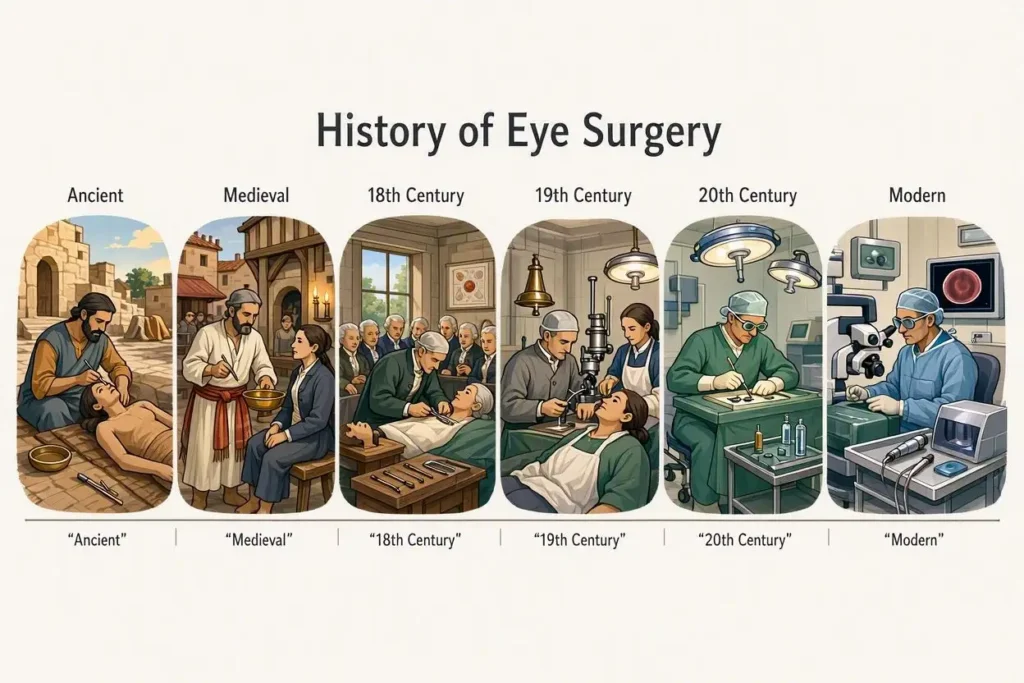
The history of eye surgery is a story of curiosity, innovation, and the desire to restore one of our most valuable senses—vision. Over thousands of years, treatments for eye diseases have progressed from basic manual techniques to highly sophisticated procedures using microscopes, lasers, and digital imaging. Today, many eye surgeries are completed in less than an hour with excellent success rates, but this level of precision is the result of centuries of medical advancement.
Key Takeaways
- Eye surgery has evolved over more than 3,000 years.
- Sushruta pioneered one of the earliest cataract operations in ancient India.
- Modern breakthroughs such as intraocular lenses and laser technology have transformed vision restoration.
- Emerging technologies like robotics, regenerative medicine, and AI are shaping the future of ophthalmic surgery.
Table of Contents
Understanding the History of Eye Surgery- Early Beginnings
The history of eye surgery began in Ancient Egypt, where the Ebers Papyrus (1550 BCE) recorded treatments for eye diseases using herbal remedies. Around 600 BCE, the Indian surgeon Sushruta described one of the earliest cataract procedures, known as couching, in the Sushruta Samhita. Although primitive, it was a significant step toward restoring vision. Later, Greek and Roman physicians, including Hippocrates and Aulus Cornelius Celsus, expanded knowledge of eye anatomy and cataract treatment. During the Islamic Golden Age (8th–13th centuries), scholars further advanced ophthalmology, with Ammar ibn Ali al-Mawsili introducing an early cataract extraction technique using suction, paving the way for modern cataract surgery.
The Birth of Modern Eye Surgery
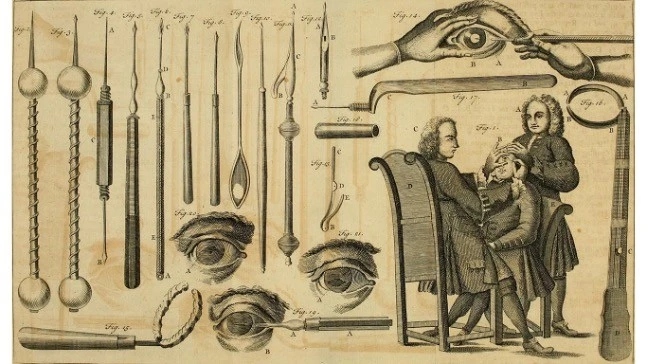
Major breakthroughs in the history of eye surgery occurred when 18th-century surgeons perfected early cataract extractions. The real transformation began in 1747, when French surgeon Jacques Daviel introduced extracapsular cataract extraction. Unlike couching, this procedure removed the cloudy lens from the eye, resulting in better vision and fewer complications. It laid the foundation for modern cataract surgery.
The 19th century brought additional improvements that made eye operations much safer:
- Anesthesia reduced pain during surgery.
- Antiseptic practices lowered infection risks.
- Improved surgical instruments increased precision.
- The invention of the ophthalmoscope allowed doctors to examine the retina more accurately.
These advances greatly improved patient outcomes.
The 20th Century: A New Era in the History of Eye Surgery
During the 20th century, ophthalmology changed rapidly with the introduction of operating microscopes, microsurgical instruments, and specialized training. The history of eye surgery changed dramatically after the 1940s invention of the intraocular lens implant.
One of the greatest breakthroughs came in 1949, when British ophthalmologist Sir Harold Ridley implanted the first intraocular lens (IOL) after cataract removal. Patients no longer had to rely on thick corrective glasses, making cataract surgery far more effective.
Later, laser technology transformed vision correction. Procedures such as LASIK, PRK, SMILE, and laser-assisted cataract surgery made treatments more precise, less invasive, and quicker to recover from.
Modern Eye Surgery
Today’s ophthalmic procedures combine advanced technology with decades of surgical expertise. Common eye surgeries include:
| Surgery | Primary Purpose |
| Cataract surgery | Replace a cloudy natural lens |
| LASIK | Correct refractive errors |
| Vitrectomy | Treat retinal disorders |
| Corneal transplant | Restore damaged corneas |
| Glaucoma surgery | Lower eye pressure |
Corneal keratomileusis techniques shaped the history of eye surgery by laying foundations for modern LASIK.
Modern surgeons also use optical coherence tomography (OCT), digital microscopes, femtosecond lasers, premium intraocular lenses, and AI-assisted surgical planning to improve surgical precision and patient outcomes.
Looking Ahead
The future of eye surgery continues to evolve with promising technologies such as robotic-assisted procedures, gene therapy for inherited retinal diseases, stem cell treatments, smart intraocular lenses, and artificial intelligence for surgical decision support.
Today’s history of eye surgery continues to expand through advancements in laser technology and gene therapy. These innovations aim to improve safety, personalize treatment, and expand options for patients with complex eye conditions.
Conclusion
The history of eye surgery reflects thousands of years of medical progress and human determination to restore sight. From Sushruta’s ancient cataract technique to today’s laser-guided and minimally invasive procedures, every advancement has contributed to safer surgeries and better vision. As research continues, the future of ophthalmology promises even greater precision, faster recovery, and new hope for preserving eyesight.
Frequently Asked Questions
1. Who performed the earliest documented eye surgery?
The Indian surgeon Sushruta described one of the earliest cataract surgeries around 600 BCE in the Sushruta Samhita.
2. What was the first eye surgery performed?
The earliest widely recorded procedure was cataract couching, which moved the cloudy lens away from the visual axis. The history of cataract surgery is diverse and well documented in Europe.
3. When did modern eye surgery begin?
Modern cataract surgery began in 1747 when Jacques Daviel developed extracapsular cataract extraction.
4. Who invented the intraocular lens?
Sir Harold Ridley introduced the first successful intraocular lens implantation in 1949.
5. How has eye surgery improved over time?
Modern eye surgery uses lasers, microscopes, OCT imaging, advanced intraocular lenses, and AI-assisted planning to deliver safer procedures and faster recovery.
Also Read: Preoperative care of eye surgery