
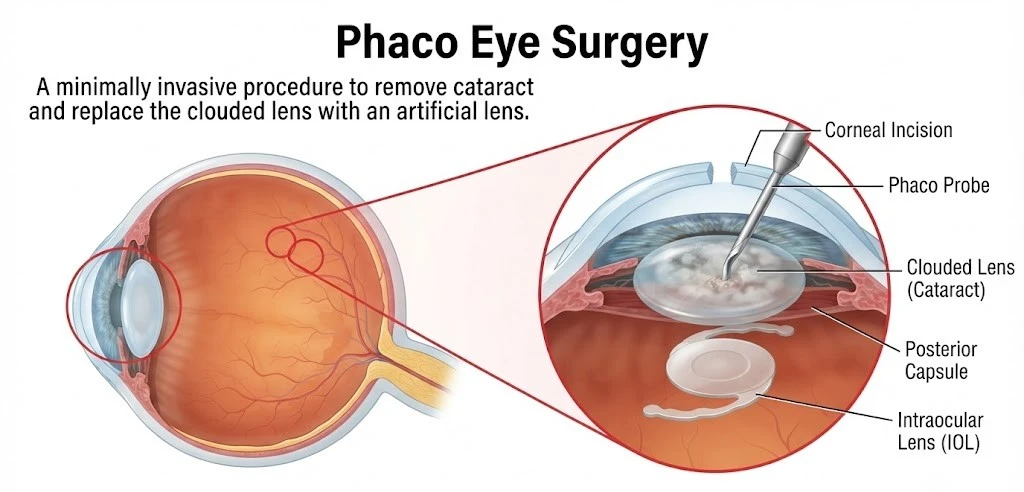
Phaco Eye Surgery, also called ‘phacoemulsification’, is the most widely used modern technique for cataract removal. A tiny ultrasonic probe breaks the cloudy natural lens into small fragments, which are then gently suctioned out through a micro-incision, and a foldable artificial lens is inserted in its place. Because the incision is so small, phaco is largely stitch-free and allows for a notably quick recovery compared to older surgical methods.
Key Takeaways
- Ultrasound energy breaks up the cloudy lens.
- Tiny, self-sealing incision speeds up healing.
- Widely performed as a same-day procedure.
Table of Contents
Who Benefits Most From Phaco Surgery
- Older adults with age-related cataracts benefit from its quick, minimally invasive approach to restoring vision.
- Patients seeking short recovery time gain from phaco’s same-day, stitch-free procedure.
- Those with mild to moderate cataracts are typically ideal candidates for standard phaco technique.
How Phaco Surgery Works
- Numbing eye drops are used instead of injections in the majority of cases.
- A very small cut measuring about 2 to 3 millimeters is made.
- Ultrasonic waves fragment the cataract into small pieces.
- The fragments are removed from the eye using gentle suction.
- The artificial lens, folded up, is inserted through the cut.
- The self-sealing wound does not usually require any sutures.
Pre-Op Diagnostic Tests:
- Visual Acuity: Tests your ability to see details clearly at different distances.
- Slit Lamp: Examines the external and internal structure of the eye through high magnification.
- Tonometry: Measures the intraocular pressure of the eye in order to check for diseases such as glaucoma.
- Retinal Exam: Checks the inner part of the eye which includes the retina and optic nerve for any diseases.
- Biometry: Determines the exact measurements of the eye in order to determine the artificial lens power.
Intraocular Lens (IOL) Types
- Monofocal: Provides clear vision at one single set distance.
- Multifocal: Offers clear vision at multiple distances simultaneously.
- Toric: Specifically corrects astigmatism for sharper distance vision.
How to Choose a Healthcare Centre for Phaco Eye Surgery
- Surgeon Expertise and Volume: Verify the ophthalmologist’s qualifications, experience, and annual surgical volume specifically for phacoemulsification.
- Advanced Technology: Ensure the facility is equipped with modern diagnostic tools and advanced micro-incision phaco equipment.
- Infection Control Standards: Confirm that the nursing home or eye center maintains strict sterilization protocols in its operation theaters to minimize infection risks.
- Post-Operative Support: Look for providers that offer transparent pricing, insurance support, and structured follow-up care protocols.
Benefits of Phaco Surgery
- Improves vision by replacing the clouded lens
- Reduces pain associated with surgery
- Ensures a stable implantation of the lens for a long period of time
- Permits fast resumption of reading, driving, and other activities
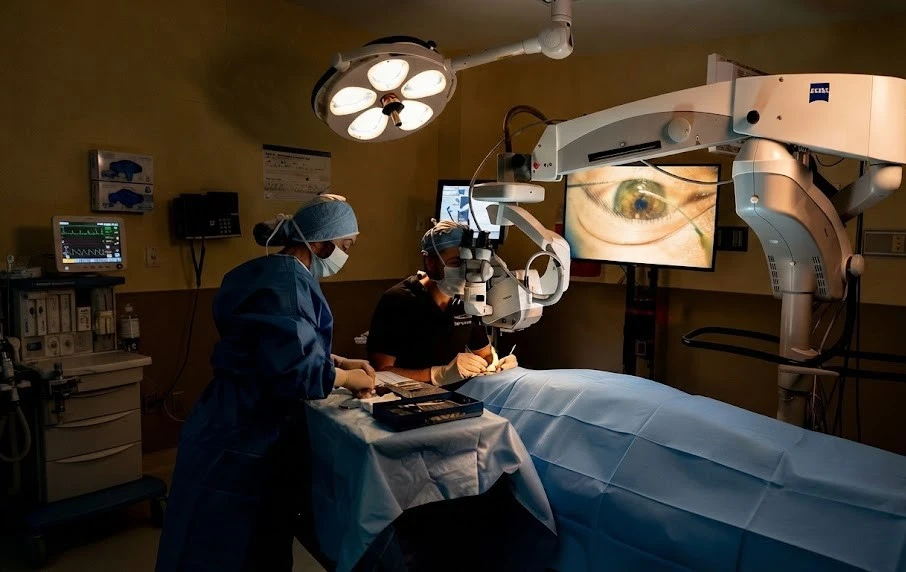
Phaco vs. Laser-Assisted (FLACS) Cataract Surgery
| Aspect | Phaco Surgery | Laser-Assisted (FLACS) |
| Technique | Ultrasonic energy breaks up the lens | Femtosecond laser automates key steps |
| Precision | Surgeon-controlled manually | Computer-guided, highly precise |
| Cost in India | Generally lower | Generally higher |
| Recovery time | Quick, similar in most cases | Quick, similar in most cases |
| Best suited for | Most routine cataracts | Complex cases needing extra precision |
Candidacy for Phaco Eye Surgery
This surgical procedure is usually ideal for patients with age-related and early to moderate cataracts who have reasonably healthy eyes. A thorough examination of the patient and measurement of the intraocular lens helps the surgeon determine the candidacy, whereas very thick or complex cataracts may require different techniques at times.
Conditions Restricting Candidacy
- Very dense, advanced, or complicated cataracts that may require alternative surgical techniques.
- Uncontrolled severe eye infections, severe corneal diseases, or advanced glaucoma.
- Serious, unstable systemic medical conditions that pose high risks during anesthesia.
Recovery After Phaco Eye Surgery
Phaco surgery is usually an outpatient procedure that takes less than 30 minutes. Most patients are able to return home on the day of surgery, and they can resume their light duties immediately. Postoperative sensations of mild gritty feeling and sensitivity to light are common, and patients usually experience improved vision within a week.
Precautions
- Get a thorough pre-surgery eye evaluation to confirm suitability
- Disclose all existing health conditions, including diabetes or blood pressure issues
- Arrange for someone to accompany you home after surgery
- Wear the protective eye shield as instructed, especially while sleeping
- Attend all follow-up visits to monitor healing and vision clarity
- Avoid swimming, makeup, and facial creams until cleared by the doctor
- Sleep facing away from the operated eye to prevent pressure
- Avoid heavy lifting and strenuous exercise for one to two weeks
- Continue prescribed eye drops exactly as directed by the surgeon
Common Mistakes
- Avoiding pre-operative eye check-ups or lens fittings
- Engaging in physical exercises or swimming too early after surgery
- Taking less of the eye drops recommended after surgery
- Disregarding signs of discomfort, red eyes, or sudden vision problems
- Selecting a hospital on the basis of low cost only
- Failing to attend follow-up sessions recommended post-surgery
Phaco Eye Surgery Cost in India
Phaco surgery cost varies by city, hospital, surgeon experience, and lens type chosen, with private nursing homes and eye hospitals across India offering it as a routine day-care procedure. Average price bands for phaco surgery in India typically range between roughly ₹15,000 and ₹60,000 per eye, while premium lens options can raise the cost further.
To Conclude
Phaco eye surgery remains the gold standard for cataract treatment worldwide, offering a safe, minimally invasive, and highly effective way to restore clear vision. With proper candidacy evaluation, careful post-surgery care, and timely follow-ups, most patients enjoy a smooth recovery and significantly improved eyesight within just a few weeks.
FAQs
1. Is phaco a major surgery?
No, it’s a minimally invasive, same-day procedure with a relatively quick recovery.
2. Which is better, phacoemulsification or laser cataract surgery?
Both offer similar outcomes; laser surgery adds precision but usually costs more.
3. Is phaco eye surgery painful?
No, it’s generally painless, as numbing drops are used instead of injections.
4. How much does phaco IOL surgery cost?
In India, phaco surgery typically costs between ₹15,000 and ₹1,40,000 per eye, depending on the lens chosen.
Also Read: SICS Eye Surgery