
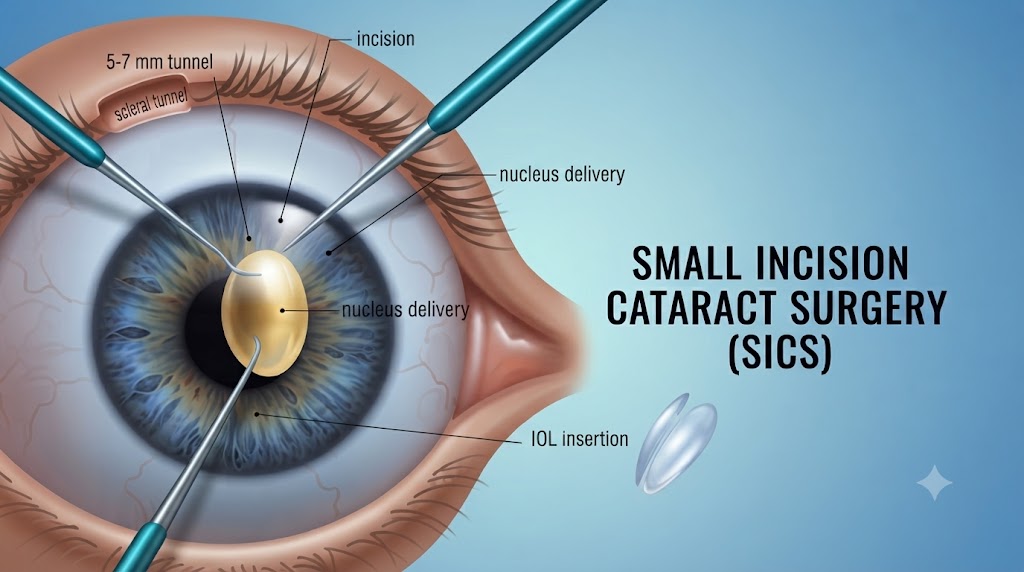
SICS is a cataract-removal technique using a small incision and an artificial intraocular lens. It can restore vision when cataracts significantly affect daily activities and visual function.
Key Takeaways
- SICS can restore vision affected by cataracts.
- Recovery requires prescribed drops and activity restrictions.
- Eye conditions may affect surgical suitability.
Table of Contents
What is SICS Eye Surgery?
Small Incision Cataract Surgery (SICS), also called Manual Small Incision Cataract Surgery (MSICS), is a low-cost, sutureless technique for removing cataracts. SICS is a modification of traditional ECCE technique in that it uses a small self-healing scleral tunnel wound instead of a big sutured incision. SICS is popularly used in mass and limited resource situations due to its ability to provide excellent visual results without use of costly ultrasound machines.
Who Benefits Most From SICS Eye Surgery
- Patients with dense or mature cataracts benefit from SICS’s ability to safely remove hard lens material.
- Patients in low-resource settings gain access to affordable, effective cataract treatment without expensive equipment.
- High-volume surgical programs benefit from SICS’s efficiency, enabling more patients to be treated in less time.
Types of Cataract Surgery
- Phacoemulsification – Ultrasonic energy is used to fragment and extract the cataract via a small incision.
- Manual SICS – Removal of the cataract via a self-sealing small scleral tunnel incision without ultrasonic energy.
- Extracapsular Cataract Extraction (ECCE) – Cataract extraction is performed via a larger incision, which may need sutures.
SICS vs. ECCE (Extracapsular Cataract Extraction)
| Aspect | SICS | ECCE |
| Incision size | Smaller, self-sealing tunnel | Larger incision |
| Sutures | Typically not needed | Usually requires sutures |
| Astigmatism risk | Lower | Higher due to larger wound |
| Healing time | Faster | Slower |
| Technique | Refined evolution of ECCE | Traditional, older technique |
How SICS Eye Surgery Works
In SICS, the surgeon creates a self-sealing tunnel incision in the sclera, opens the lens capsule, and removes the cloudy natural lens either whole or in fragments using manual instruments and fluid pressure. An intraocular lens (IOL) is then placed inside the eye, and the wound typically seals itself without stitches due to its unique tunnel architecture.
SICS vs. Phacoemulsification (Phaco)
| Aspect | SICS | Phacoemulsification |
| Incision size | Small, self-sealing tunnel | Very small, ultrasound-created incision |
| Equipment cost | Low; minimal machinery needed | High; requires specialized ultrasound device |
| Suitability | Works well even for dense cataracts | Best for moderate cataracts |
| Surgery time | Often quicker in skilled hands | Slightly longer for dense cataracts |
| Sutures | Usually not required | Rarely required |
| Recovery | Comparable visual recovery | Comparable visual recovery |
| Best suited for | High-volume, resource-limited settings | Well-equipped clinical settings |
Steps Involved in SICS Eye Surgery
- Anesthesia is given, which could be peribulbar or topical.
- Cleaning of the eye and the adjacent skin is done with antiseptic fluid.
- An incision tunnel of the sclera is made in a preferred location on the eye.
- The capsule of the lens is cut open, and the lens nucleus is freed from it.
- The lens nucleus is removed from the tunnel.
- The remaining lens material is cleared, and the IOL is inserted.
- The wound is confirmed to be self-sealing, and there are no stitches required.
Benefits of SICS Eye Surgery
- Restores vision by replacing the opaque natural lens
- No need for sutures, leading to faster wound healing
- Is cheaper compared to phacoemulsification devices and procedures
- Is effective even for mature and hard cataracts
- Can be done quickly by an experienced surgeon
- Yields similar visual results to phacoemulsification in many situations
- Helps reduce the number of cases of avoidable blindness in poor areas
Recovery After SICS Eye Surgery
- Days 1–3: Discomfort, blurry vision, and sensitivity to light may be experienced; eye drops and sufficient rest are essential.
- One week: Heavy lifting, bending, and strenuous exercises should be avoided as the eye starts to heal.
- Two weeks: Vision is greatly improved; however, recovery varies from patient to patient.
- One month: Most patients may start resuming their daily activities according to the guidance of the eye doctor.
Precautions
- Select an experienced surgeon because manual skill plays a key role in the process
- Take antibiotics and anti-inflammatory eye drops as directed
- Do not rub or apply pressure to your eye during recovery
- Protect your eye from dust, water, and bright light after the operation
- Attend all follow-up appointments to track progress and pressure
- Tell your surgeon if you have any bleeding disorders or eye problems

Common Mistakes
- Skipping pre-surgery eye drops or instructions
- Not disclosing existing health conditions like diabetes or hypertension
- Resuming strenuous activity or swimming too soon after surgery
- Ignoring signs of infection like redness, pain, or discharge
- Missing scheduled follow-up appointments after the procedure
- Rubbing the eyes despite doctor’s advice during the healing period
Risks and Complications
Just like any other cataract surgery, SICS is not free from potential risks.
Possible complications include:
- Eye infection
- Inflammation
- Bleeding
- Vision alterations
- Retinal detachment
- Cystoid macular edema
- Dislocation of intraocular lens
- Corneal swelling
Severe pain, increasing redness, discharge, or sudden vision loss requires prompt medical attention.
Contraindications
There may be some circumstances that would make SICS inappropriate or necessitate a further assessment prior to surgery. They are uncontrolled diabetes, advanced glaucoma, detached retina, serious corneal disorder, eye infection, inflammation or inability to dilate the pupils. The ophthalmologist assesses the condition and determines if the surgery can be done.
20/40 Vision and SICS Candidacy
Visual acuity of 20/40 or worse may be one indication for cataract surgery. However, the decision also considers how much the cataract affects reading, driving, work, daily activities, and overall quality of life. Therefore, 20/40 should not be presented as a mandatory SICS eligibility threshold. A comprehensive eye examination is needed before surgery.
Final Thoughts
SICS eye surgery remains one of the most valuable techniques in modern ophthalmology, offering an affordable, efficient, and effective way to restore sight, especially in settings where advanced phacoemulsification equipment isn’t accessible. With strong visual outcomes and a shorter learning curve for surgeons, it continues to play a critical role in reducing preventable blindness worldwide.
FAQs
1. Which is better, SICS or phaco?
Both offer similar visual outcomes; SICS suits dense cataracts and low-resource settings, while phaco suits well-equipped clinics.
2. Is SICS surgery effective?
Yes, SICS is a proven, effective technique with outcomes comparable to phacoemulsification in most cases.
3. What is the difference between SICS and ECCE cataract surgery?
SICS uses a smaller, self-sealing incision, while ECCE uses a larger incision that usually needs sutures.
4. What are three types of cataract surgery?
Phacoemulsification, Manual Small Incision Cataract Surgery (SICS), and Extracapsular Cataract Extraction (ECCE).
Also Read: SMILE Eye Surgery