
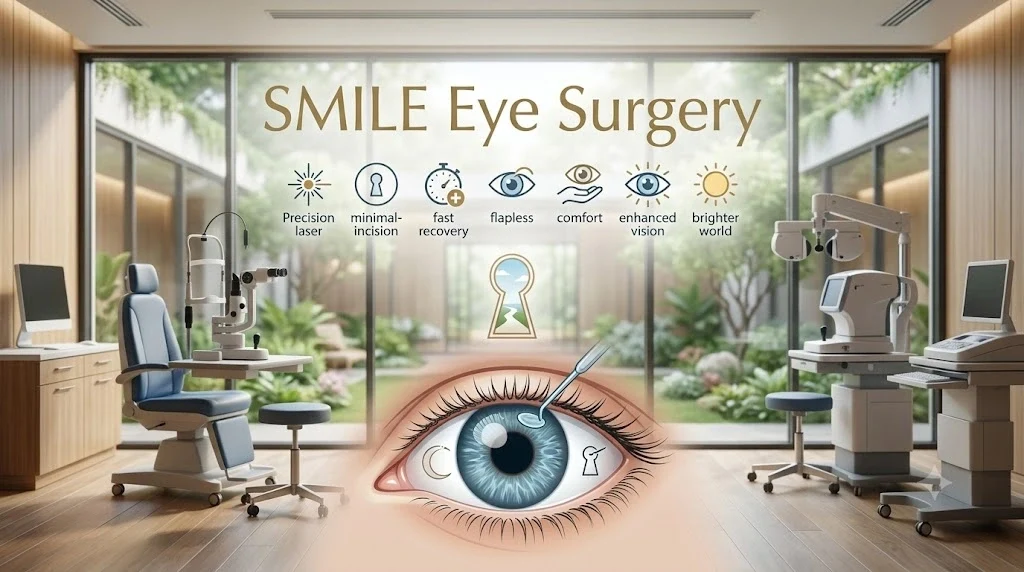
SMILE eye surgery is a minimally invasive laser vision-correction procedure used mainly to treat nearsightedness (myopia) and astigmatism. SMILE is an acronym that means Small Incision Lenticule Extraction. This eye surgery technique differs from LASIK in that SMILE makes use of the femtosecond laser to form a small disc of tissue in the cornea known as the lenticule, which is then excised through a very small cut.
Table of Contents
Key Takeaways
- SMILE uses a tiny corneal incision.
- Vision usually improves within days.
- Follow your surgeon’s recovery instructions carefully.
What is SMILE Eye Surgery?
SMILE eye surgery refers to a refractive surgery technique that helps to minimize dependency on glasses and contacts. During the surgery, the laser forms a lenticule in the cornea, which can then be extracted via a tiny incision.
Because SMILE does not require creation of a large corneal flap, it is considered less invasive than LASIK. The procedure itself usually takes only a few minutes for each eye, with the laser treatment taking around 30 seconds per eye.
Who Can Have SMILE Surgery?
It is not the case that every person who wears glasses or contact lenses automatically qualifies as a candidate for SMILE surgery. An eye exam must be performed prior to the procedure. The criteria include the following:
- Age of 22 years or more.
- At least one year of having had a stable prescription.
- Healthy corneas.
- Myopia which is within the treatment range.
- Astigmatism can be present, but within the accepted range.
- Understanding of the possible outcomes, pros and cons.
Candidates who are pregnant or nursing, have specific corneal problems, keratoconus, uncontrolled diabetes, severe eye disorders or previous eye surgery might not qualify.
How Does SMILE Eye Surgery Work?
The procedure generally follows these steps:
| Stage | What Happens |
| Eye examination | The surgeon evaluates corneal thickness, shape and overall eye health. |
| Numbing | Numbing eye drops are used before treatment. |
| Laser treatment | A femtosecond laser creates a lenticule within the cornea. |
| Small incision | A tiny opening is created to access the lenticule. |
| Lenticule removal | The surgeon removes the tissue through the incision. |
| Corneal reshaping | Removing the lenticule changes the cornea’s shape and improves focusing. |
No stitches are generally required, and the incision heals naturally.
Procedure Timing: The SMILE procedure usually takes only a few minutes per eye from start to finish. Within that brief timeframe, the actual laser treatment portion is remarkably fast, taking just around 30 seconds per eye.
Benefits of SMILE Eye Surgery
SMILE may provide several potential advantages for appropriately selected patients.
1. Tiny Incision
SMILE uses tiny incision without having a large corneal flap like LASIK.
2. No Flap Formation
As no corneal flap is formed in SMILE, there is no chance of flap getting dislodged due to impact.
3. Short Procedure
The process of the surgery is quite short for each eye.
4. Minimizing Need For Glasses
The basic aim of this treatment is to correct refractive vision and reduce dependency on glasses or lenses.
5. Possible for Some People Having Dry Eyes
People having problems with dry eye syndrome can opt for SMILE surgery.
SMILE vs LASIK
Both procedures reshape the cornea to correct refractive errors, but their surgical approaches differ.
| Feature | SMILE | LASIK |
| Main technique | Removes a corneal lenticule | Reshapes corneal tissue under a flap |
| Corneal flap | No | Yes |
| Incision | Very small | Larger flap incision |
| Common uses | Myopia and some astigmatism | Myopia, astigmatism and hyperopia |
| Recovery | Usually rapid | Usually rapid |
| Dry-eye considerations | May have advantages for some patients | Dry eye can occur |
| Suitability | Depends on prescription and eye health | Depends on prescription and eye health |
Is SMILE Eye Surgery Painful?
Since the eye will be anesthetized using the anesthetic drops during the SMILE eye surgery, the procedure should not be painful; however, some individuals may feel irritated, dry, light sensitivity, and other discomfort issues during the healing process.
There might be blurriness in vision that improves within the days and weeks after the procedure.
Recovery After SMILE Surgery
For most people, it would be easier to get back to their routine after surgery. After SMILE surgery, your eye doctor may suggest the following:
- Resting after surgery.
- Using eye drops prescribed by your doctor.
- Avoid touching your eyes.
- Wearing protective eyewear.
- Avoid swimming and hot tubs for a while.
- Keeping water from the eyes for a few days.
Vision can improve quickly, but complete stabilization may take longer. Follow-up appointments are important for monitoring healing.

Risks and Possible Complications
SMILE eye surgery is considered a safe and effective refractive procedure, but no surgery is completely risk-free.
Possible complications or side effects include:
- Dry eyes
- Halos or glare, particularly at night
- Temporary blurry or fluctuating vision
- Problems requiring additional treatment
- Rare loss of vision
The likelihood of complications varies between individuals. Choosing an appropriately qualified eye surgeon and completing a thorough preoperative assessment are important parts of the process.
Seek urgent medical attention if you experience severe eye pain, sudden vision loss, significant discharge, swelling or other signs of infection after surgery.
Final Thoughts
SMILE eye surgery is a modern laser vision-correction technique that uses a small incision to remove a corneal lenticule and improve focusing. It can reduce dependence on glasses or contact lenses for appropriately selected people with myopia and certain forms of astigmatism.
Although SMILE has advantages such as avoiding a corneal flap and requiring only a small incision, it is not automatically the right procedure for everyone. A comprehensive examination by an ophthalmologist is essential before deciding between SMILE, LASIK or another vision-correction option.
FAQs
1. Is SMILE better than LASIK?
Neither is universally better; both can provide effective vision correction, while SMILE may be preferable for some patients based on prescription, corneal health, dry-eye concerns and lifestyle.
2. Is SMILE eye surgery painful?
SMILE surgery is performed with numbing eye drops and is generally not painful during the procedure, although temporary irritation or discomfort can occur afterward.
3. Is SMILE surgery risky?
SMILE eye surgery is generally considered safe, but possible complications include dry eyes, halos, glare, additional treatment and, very rarely, vision loss.
4. What is the age limit for SMILE eye surgery?
Research articles list 22 years as a minimum age, while eligibility at an older age depends on eye health, prescription and individual assessment rather than a single universal maximum age.
Also read: Corrective eye surgery