
For people with moderate or high myopia, wearing glasses or contact lenses every day can become inconvenient. For people with a higher degree of short-sightedness, glasses or contact lenses can sometimes feel limiting in everyday life. Laser eye surgery, such as LASIK, can reduce the need for glasses, but it is not the right option for every patient. ICL (Implantable Collamer Lens) eye surgery offers another approach to vision correction.
Key Takeaways
- ICL corrects vision using an implanted lens placed inside the eye.
- The cornea is not reshaped, unlike LASIK surgery.
- A detailed eye examination is needed to determine ICL suitability.
- Recovery and results vary, so regular follow-up after surgery is important.
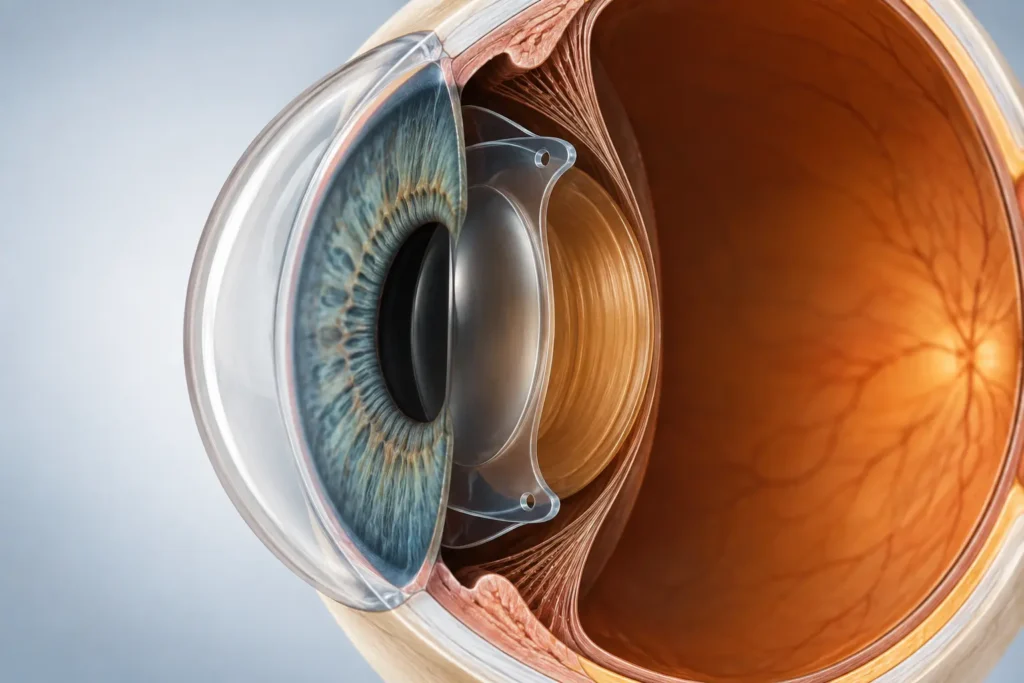
ICL stands for Implantable Collamer Lens. Instead of changing the shape of the cornea, this procedure uses a small, flexible lens that is placed inside the eye. Because the cornea is not reshaped and the natural lens is left in place, ICL Eye Surgery takes a different approach to correcting refractive errors than laser procedures.
What Is ICL Eye Surgery?
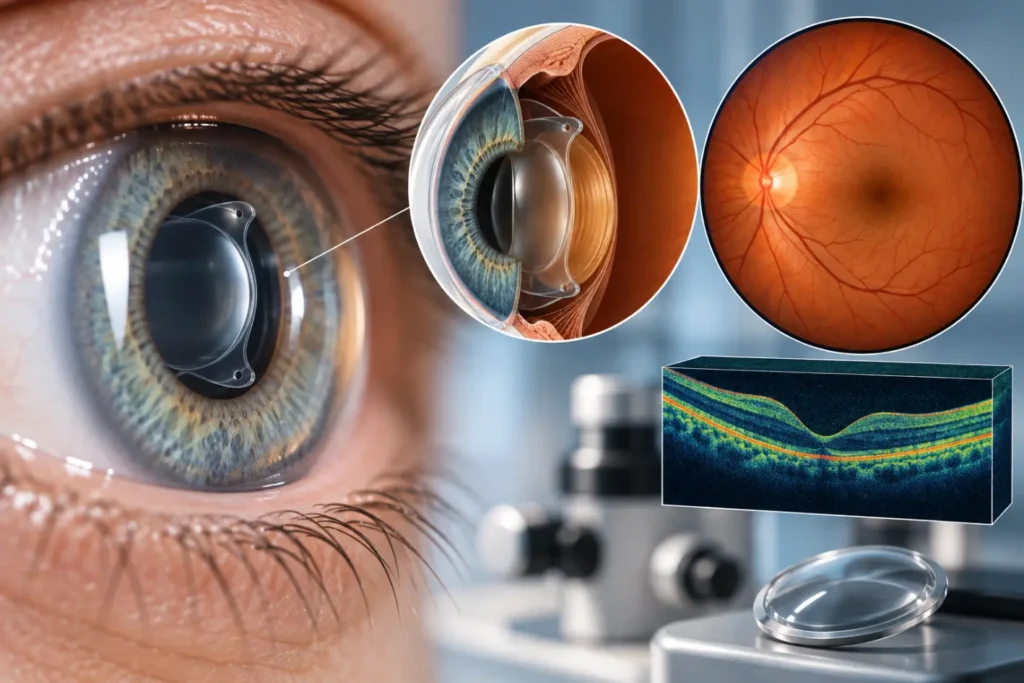
During ICL Eye Surgery, an ophthalmologist places a specially designed lens inside the eye, typically behind the iris and in front of the eye’s natural lens. Once positioned correctly, the lens helps focus incoming light more accurately onto the retina, which can improve blurred distance vision caused by myopia.
ICL Eye Surgery may be considered for people who have:
- Moderate to high levels of myopia
- Myopia combined with astigmatism, when a suitable lens is available
- A stable glasses or contact lens prescription
- Healthy eyes with anatomy suitable for lens implantation
- A cornea that may not be ideal for certain laser vision correction procedures
- Myopia with astigmatism, when a suitable toric lens is available
- Stable vision prescription
- Eye anatomy that is appropriate for lens implantation
Not everyone is a candidate. An ophthalmologist needs to examine the eyes and take detailed measurements before recommending the procedure.
Also Read: History of Eye Surgery
How Does ICL Eye Surgery Work?
Before surgery, the doctor performs a comprehensive eye examination. This may include checking your prescription, eye pressure, corneal condition, anterior chamber depth, and retinal health. These measurements help determine whether ICL is appropriate and which lens size and power may be needed.
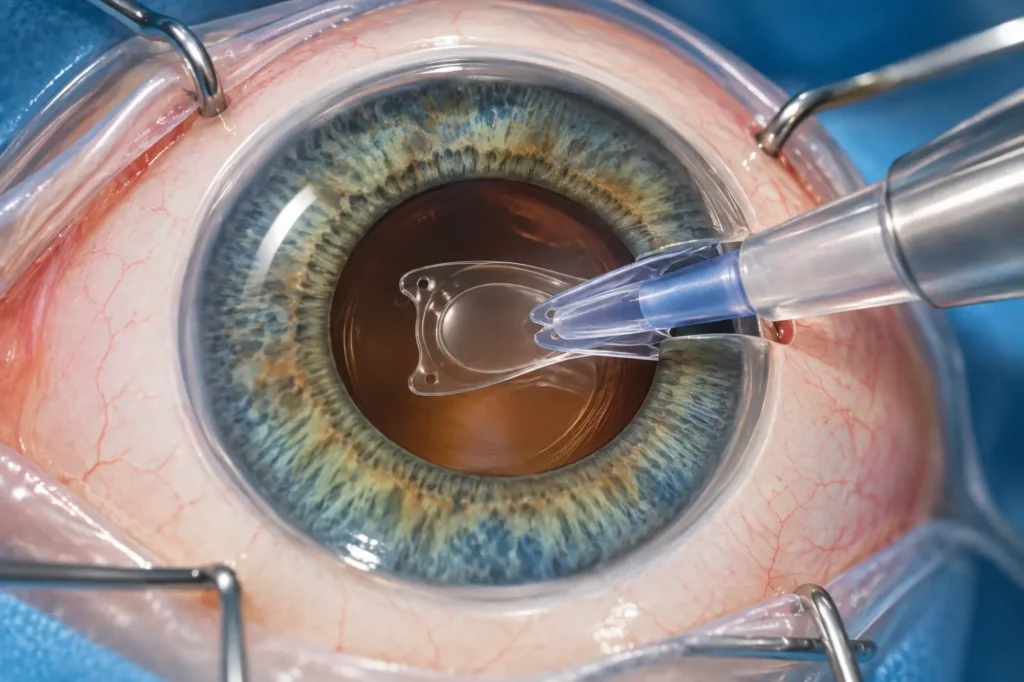
During the procedure, the surgeon makes a small opening and inserts the folded lens into the eye. The ICL is then positioned carefully behind the iris and in front of the natural lens.
The natural lens is not removed. Once the ICL is correctly positioned, it provides the optical correction needed to reduce myopia.
Also Read: How Much Does Eye Surgery Cost?
ICL vs LASIK: What Is the Difference?
Although both procedures can reduce dependence on glasses, they work in different ways.
| Feature | ICL | LASIK |
| How it works | An artificial lens is placed inside the eye | The cornea is reshaped |
| Corneal tissue removed | No | Yes |
| Natural eye lens | Preserved | Preserved |
| Common use | Often considered for moderate to high myopia | Used for suitable refractive errors |
| Can be removed? | The lens can potentially be removed or exchanged | Corneal tissue cannot simply be restored |
| Suitability | Depends on internal eye anatomy | Depends heavily on corneal characteristics |
The choice between ICL and LASIK depends on factors such as prescription, corneal measurements, eye health, age, and individual anatomy.
Potential Benefits of ICL Eye Surgery
For suitable patients, ICL Eye Surgery can offer several advantages:
- No corneal tissue removal: The procedure corrects vision without reshaping the cornea.
- Suitable for some high prescriptions: ICL Eye Surgery may be considered when the degree of myopia makes some laser procedures less suitable.
- Natural lens remains intact: The eye’s natural crystalline lens is preserved.
- Potentially removable: If clinically necessary, the implanted lens can be removed or exchanged.
- Reduced dependence on glasses: Many patients experience a significant improvement in unaided vision after successful surgery.
What Is Recovery Like?
ICL Eye Surgery is generally performed as an outpatient procedure.
Many patients notice an improvement in their vision shortly after ICL surgery, but the eyes can take a little longer to completely adjust. Your doctor may recommend specific eye drops during this period to help protect the eyes and support a smooth recovery. Regular follow-up appointments are also part of the process, giving the ophthalmologist an opportunity to monitor healing and confirm that the implanted lens and eyes are progressing normally.
Following postoperative instructions is important because recovery can vary from one person to another.
Are There Any Risks?
ICL is an intraocular procedure, so it has potential risks even when performed by an experienced surgeon. Possible complications include:
- Increased eye pressure
- Inflammation
- Infection
- Cataract formation
- Glare or halos
- Changes in vision
- Lens movement or incorrect positioning
- Retinal or corneal complications in some patients
- Need for additional treatment or surgery
A detailed examination before surgery helps identify factors that could increase risk.
Who Should Consider ICL?
ICL is not simply a choice based on having a high glasses prescription. A doctor may evaluate:
- Stability of your prescription
- Anterior chamber depth
- Corneal health
- Eye pressure
- Retinal condition
- Previous eye surgery or disease
Final Thoughts
ICL eye surgery offers an alternative approach to correcting myopia without removing corneal tissue. It can be particularly relevant for patients with higher prescriptions or for those whose corneal characteristics make laser vision correction less suitable.
However, ICL is not appropriate for everyone. A complete eye examination and discussion with a qualified ophthalmologist are essential before deciding whether the procedure is right for you.
Frequently Asked Questions
1.How long does ICL eye surgery take?
The surgical procedure itself is relatively short. However, preparation and postoperative observation mean that you will spend additional time at the clinic or surgical center.
2.Can ICL correct astigmatism?
Yes. A toric ICL may be used to correct myopia combined with astigmatism when the patient’s measurements and eye health are suitable.
3.Can I stop wearing glasses after ICL?
Many patients become much less dependent on glasses, but results vary. Some patients may continue to use glasses occasionally, particularly for specific visual tasks. Changes in vision can also occur naturally as the eyes age.
4.Is ICL Permanent?
ICL is designed to provide long-lasting vision correction. The implanted lens can remain in the eye for many years, although your ophthalmologist may recommend removal or replacement if there is a medical reason to do so. However, the lens can potentially be removed or exchanged if there is a medical reason to do so.